How Does a Spray Bottle Work

Founder of UKPACK, chief packaging engineer and designer with 18 years of experience, and Red Dot Award winner. I work on cosmetic packaging structure, material selection, mold feasibility, decoration processes, and leak-risk control, helping brands turn packaging ideas into reliable production-ready solutions. See my senior packaging engineer qualification.
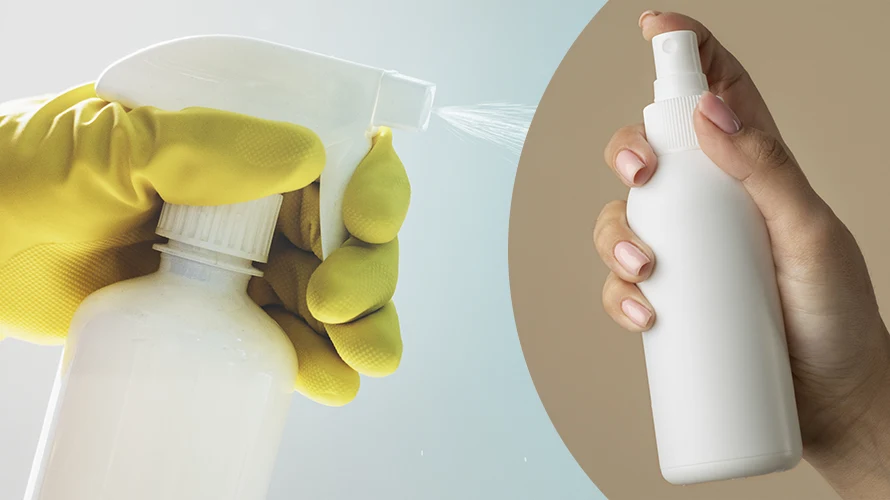
A pump spray bottle works by converting a short hand movement into a controlled discharge of liquid. When you press the trigger, a piston reduces the volume of a small pump chamber and pushes the liquid through the outlet valve and nozzle. When you release the trigger, the spring returns the piston, the inlet valve opens, and the chamber refills through the dip tube.
The bottle itself stores the formula, but the sprayer head does most of the mechanical work. Understanding that sequence helps packaging buyers choose the right sprayer, diagnose weak output, and test a formula before production.
What Parts Does a Spray Bottle Have?
Most pump spray bottles use the following components:
- Trigger and piston: The trigger moves the piston inside the pump chamber. The piston creates the pressure difference that moves the liquid.
- Inlet and outlet valves: These one-way valves control the direction of flow. The inlet valve lets liquid enter the chamber; the outlet valve lets it leave through the nozzle.
- Dip tube: This tube connects the pump to the liquid near the bottom of the bottle. Its length, cut angle, and connection affect how reliably the sprayer draws the formula.
- Spring: The spring returns the trigger and piston after each stroke. In many trigger sprayers, it sits inside the pump assembly and may contact the formula.
- Vent and closure: The vent allows air to replace the liquid leaving the bottle. The closure must seal the bottle neck without restricting the pump.
- Nozzle: The nozzle, including its small internal swirl chamber and orifice, turns the liquid flow into a stream, fan, or mist.
| Part | What it does | Typical failure symptom |
|---|---|---|
| Piston and pump chamber | Creates pressure and draws the next dose | Trigger moves but output is weak |
| Inlet valve | Lets liquid enter the chamber on the return stroke | Air enters or the pump will not prime |
| Outlet valve | Directs the pressurized dose to the nozzle | Liquid drips or flows backward |
| Dip tube | Carries formula from the bottle to the pump | Sprayer works only when tilted |
| Vent and closure | Maintains pressure balance and seals the bottle | Leakage, bottle deformation, or inconsistent output |
| Nozzle | Shapes the final spray pattern | Clogging, stream instead of mist, or uneven coverage |
How Does a Pump Spray Bottle Work Step by Step?
- Press: Pressing the trigger moves the piston forward and reduces the volume of the pump chamber.
- Close and open: The inlet valve closes so the dose cannot return to the bottle, while the outlet valve opens toward the nozzle.
- Discharge: The pressurized liquid passes through the nozzle. The internal geometry determines whether the result is a jet, fan, or finer mist.
- Release and refill: The spring returns the piston. The chamber expands, the inlet valve opens, and liquid rises through the dip tube to refill the chamber for the next stroke.
This is why a sprayer can stop working when air enters the dip tube, the nozzle is blocked, or the formula is too viscous for the pump design.
How Does the Nozzle Create a Mist or Stream?
The nozzle does not create pressure by itself. It uses the pressure produced by the pump and converts that flow through a small passage and outlet orifice. Internal swirl features can make the liquid rotate before it exits, helping break the flow into smaller droplets. A larger opening or higher-output design usually produces a heavier stream; a nozzle designed for fine atomization produces a lighter pattern.
Spray pattern is therefore a system result, not only a nozzle result. Pump output, formula viscosity, surface tension, nozzle geometry, and the distance between the nozzle and the target all influence what the user sees.
What Changes a Spray Bottle’s Performance?
- Formula: Thick, oily, particulate, or crystallizing formulas may need a different pump and nozzle than water-thin liquids.
- Priming: A new or empty sprayer may need several strokes before liquid reaches the chamber.
- Dip tube fit: A tube that is too short, curled, loose, or badly cut can cause air intake and incomplete draw-up.
- Compatibility: The formula contacts the bottle, tube, valves, piston seal, and sometimes a metal spring. All wetted parts should be checked.
- Closure and venting: A poor seal or blocked vent can create leakage or unstable output.
How Is a Trigger Sprayer Different from a Continuous Sprayer?
A standard trigger sprayer delivers a dose while the user pulls the trigger. A continuous sprayer first stores pressure in an internal chamber, then releases a short, more sustained spray after the user pumps it. They are related mechanisms, but they are not interchangeable for every formula or user experience.
For a broader explanation of fine atomization, see what a fine mist sprayer is. For the stored-pressure design, see how continuous spray bottles work.
What Should Packaging Buyers Test?
Before selecting a sprayer for a commercial product, test the complete package with the actual formula. Check the spray pattern, output consistency, priming time, leakage, dip tube length, closure fit, formula compatibility, and the feel of the trigger. Water-only testing can hide problems that appear with oils, alcohol-containing formulas, powders, shimmer, or higher-viscosity products.
Once the package passes the agreed test protocol, UKPACK spray bottles can be evaluated by the same formula, component specification, and decoration requirements used for the final order.
Conclusion
A spray bottle works through a simple sequence: the trigger moves the piston, the valves control one-way flow, the dip tube supplies liquid, and the nozzle shapes the discharge. The practical lesson for a buyer is to evaluate the sprayer and formula as one system. If the output is weak or inconsistent, check the nozzle, valves, tube, vent, and compatibility before changing the bottle alone.