How Do Continuous Spray Bottles Work: An In-Depth Look

Founder of UKPACK, chief packaging engineer and designer with 18 years of experience, and Red Dot Award winner. I work on cosmetic packaging structure, material selection, mold feasibility, decoration processes, and leak-risk control, helping brands turn packaging ideas into reliable production-ready solutions. See my senior packaging engineer qualification.
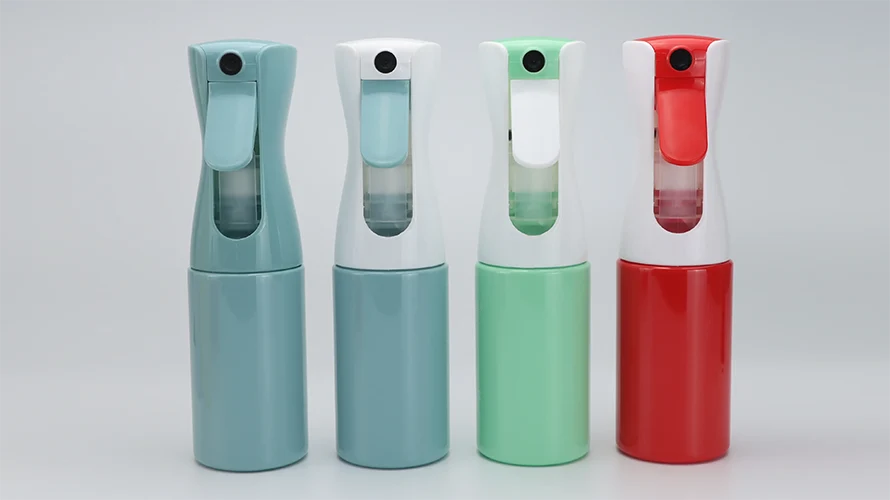
A continuous spray bottle works by storing a small amount of pressure in an internal chamber and releasing that pressure through a fine-mist nozzle. The user normally pumps the actuator several times to charge the chamber; the bottle then sprays for a short interval with less repeated hand movement than a standard trigger sprayer.
“Continuous” does not mean the bottle sprays indefinitely. The spray duration depends on the pump design, chamber capacity, formula, nozzle, and how fully the user charges the mechanism.
What Is a Continuous Spray Bottle?
A continuous spray bottle is a reusable package with a pump, pressure chamber, one-way valves, dip tube, and spray nozzle. Unlike a basic trigger sprayer, it separates the charging action from the discharge action: the user builds pressure first, then receives a short sustained spray.
This format is often considered for hair care, personal care, plant care, and other products that benefit from broad or repeated coverage. The formula still has to match the pump and nozzle; a continuous mechanism is not suitable for every liquid.
What Parts Does a Continuous Sprayer Use?
- Actuator: The button or trigger the user presses to charge the mechanism.
- Pump chamber: The space that receives liquid and builds pressure during pumping.
- Valves: One-way valves help draw liquid into the chamber and prevent the charge from escaping through the wrong path.
- Dip tube: The tube that supplies liquid from the bottle to the pump.
- Release path and nozzle: The outlet path meters the stored charge and shapes the final spray pattern.
- Closure and venting system: These maintain the seal and allow the bottle to replace liquid volume with air as it is used.
How Does a Continuous Spray Bottle Work Step by Step?
- Prime the pump: On a new or empty bottle, several presses may be needed before liquid reaches the chamber.
- Charge the chamber: Each press moves liquid and increases the available pressure in the internal system.
- Open the spray path: When the release mechanism is activated, the stored pressure pushes liquid toward the nozzle.
- Maintain the spray briefly: The chamber releases its charge over a short interval, giving a more sustained mist than one trigger stroke.
- Recharge: When the spray weakens or stops, press the actuator again to build the next charge.
| Feature | Continuous spray bottle | Standard trigger sprayer |
|---|---|---|
| How it is used | Pump to charge, then spray for a short interval | Press the trigger for each dose |
| User experience | Broader coverage with fewer repeated pulls | Direct control over each individual dose |
| Main mechanism | Pressure chamber plus release path | Piston chamber and nozzle |
| Key risks | Leakage, weak charge, blocked nozzle, or formula mismatch | Poor priming, clogged nozzle, air leak, or tube problem |
Why Does the Spray Stop or Become Uneven?
Most problems come from the relationship between the formula and the pump system:
- The chamber is not fully charged: Pump more slowly and completely, then test the release again.
- The nozzle is partly blocked: Residue can change a fine mist into drops or an uneven stream.
- Air enters the liquid path: A loose dip tube, poor seal, or damaged valve can weaken the charge.
- The formula is too thick or oily: Higher viscosity can reduce draw-up, chamber filling, and atomization.
- The bottle is nearly empty: A short or poorly positioned tube may stop drawing liquid consistently.
For a step-by-step fault check, see how to fix a spray bottle that will not spray.
How Should a Continuous Spray Bottle Be Maintained?
- Rinse the bottle and sprayer with a compatible cleaning liquid after use.
- Flush the nozzle with clean water when the formula can leave residue.
- Do not force a pin or needle into the nozzle; scratching the orifice can permanently change the spray pattern.
- Store the bottle upright and protect it from heat or conditions that can affect the formula and seal.
- Before refilling, confirm that the new formula is compatible with the bottle, tube, valves, seals, spring, and nozzle.
What Should Brands Test Before Ordering?
Use the final formula and final component combination. Test the priming process, spray duration, output consistency, spray angle, leakage, closure fit, dip tube draw-up, nozzle recovery, and storage behavior. If the product contains oil, alcohol, particles, fragrance, or a thicker base, include those conditions in the test plan.
A supplier should be able to explain which component controls the charge, what formula was used for the sample, and how performance was judged. UKPACK’s continuous fine mist spray bottle can be assessed against that same package brief.
Frequently Asked Questions
Can continuous spray bottles be refilled?
Many are designed to be refilled, but the bottle and sprayer should be cleaned and checked before the next fill. Refill suitability also depends on the formula and the materials in the liquid path.
Can I use any liquid in a continuous spray bottle?
No. Test the actual liquid first. Thick, oily, particulate, or crystallizing formulas may spray poorly or damage components that are not compatible.
Why does the bottle spray drops instead of mist?
Check whether the nozzle is blocked, the chamber is fully charged, or the formula is too viscous. If cleaning and proper priming do not help, review the pump and nozzle specification.
How long should a continuous spray last?
There is no single universal duration. It depends on the chamber, pump stroke, nozzle, formula, and user action. Confirm the expected spray duration with a sample using the final formula.
Conclusion
A continuous spray bottle uses a pump and pressure chamber to turn several charging presses into a short sustained mist. Its performance depends on the full package system: formula, valves, chamber, tube, nozzle, closure, and testing method. When those variables are matched, the format can provide a smooth application with less repeated trigger movement.