What Is an Airless Pump Bottle? An Engineer’s Guide for Cosmetic Brands

Founder of UKPACK, chief packaging engineer and designer with 18 years of experience, and Red Dot Award winner. I work on cosmetic packaging structure, material selection, mold feasibility, decoration processes, and leak-risk control, helping brands turn packaging ideas into reliable production-ready solutions. See my senior packaging engineer qualification.

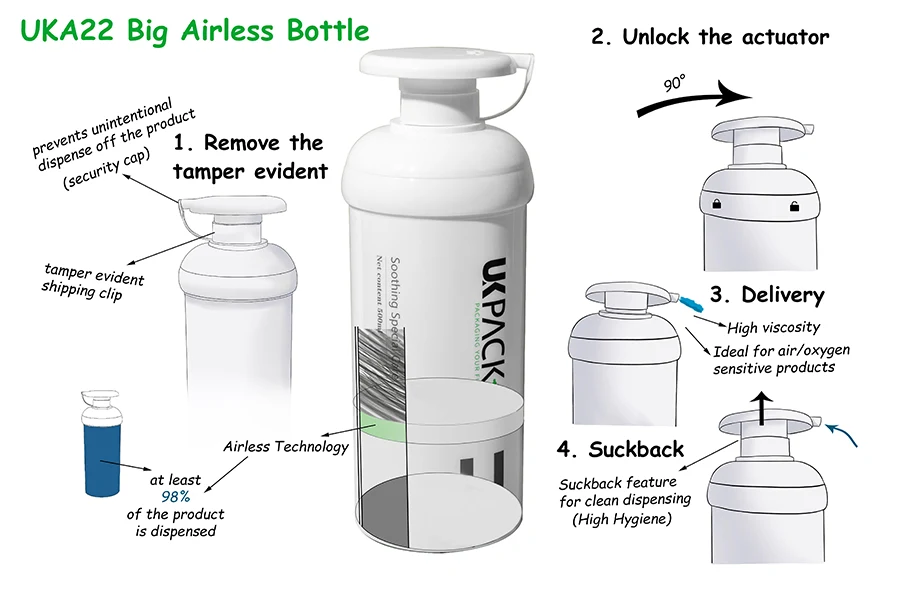
An airless pump bottle is a non-pressurized packaging system that dispenses product through a vacuum mechanism instead of a traditional dip tube. When the pump is pressed, an internal piston or disc rises from the bottom, pushing the formula upward and out through the actuator. This design helps limit air exposure, reduce contamination risk, improve dispensing consistency, and protect sensitive skincare or cosmetic formulas from oxidation. Airless pumps are commonly used for creams, lotions, serums, and other high-value personal care products.
Why Airless Pump Bottles Matter for Modern Cosmetic Formulas
Most brands don’t start with a decision to “go airless”. They start with a formula, a positioning and a target price, then discover where their existing packaging is falling short.
R&D may be working on a vitamin C serum with a narrow stability window. Marketing wants a “low preservative” claim and a cleaner ingredient list. The brand manager is pushing for 300 ml or 500 ml formats for family use or salon backbar because small bottles run out too quickly. At the same time, logistics is dealing with leakage rates and broken caps during transport.
Traditional jars and lotion pumps are perfectly adequate for many products, but they have built-in weaknesses: wide openings that invite fingers and air, dip tubes that leave a long “dead zone” at the bottom, and vents that constantly admit small amounts of air as the product is dispensed. For sensitive formulas or high-value packs, those weaknesses show up later as complaints about oxidation, drying, crusting and wasted product. This matters even more for serums containing advanced active ingredients. A private label GHK-Cu peptide serum is one example where airless packaging may better support product stability and a cleaner dispensing experience.
Airless pump bottles are engineered to address exactly those pain points. By removing the dip tube, sealing the system and using a piston or inner bag to push the formula upward, they offer better control of air ingress, more predictable dosing and much lower residual product. The key is to understand which type of airless system fits your specific project—and when a regular pack is still the more rational choice.
How Does an Airless Pump Bottle Work?
At first glance, an airless bottle looks similar to a regular lotion bottle with a pump. However, the internal mechanics are quite different.
Want the full stroke-by-stroke breakdown? See our guide on how do airless pump bottles work.
Core Components: Bottle, Pump Engine, Piston or Bag
A typical airless system consists of four main parts:
- The outer bottle or container body.
- The pump engine, including the actuator, closure, and internal pump chamber.
- A moving component inside the bottle—usually a piston at the bottom or a flexible inner bag.
- Seals and vents that control air movement within the system.
In a piston-based design, the formula is filled from the top while a plastic piston sits at the bottom. Once sealed and assembled, the piston creates a tight seal with the inner wall of the bottle. Without a dip tube, the pump chamber directly communicates with the formula above the piston.
In a bag-in-bottle design, the formula is packed into a soft inner bag secured inside a rigid outer shell. As the pump dispenses the product, the bag collapses while the outer shell remains intact.
The Dispensing Cycle: From First Prime to Last Dose
The first few strokes of the pump are used to prime the system. Each stroke moves the piston or compresses the inner bag, creating a partial vacuum in the chamber above. Ambient air pushes the piston upward, or collapses the bag, until the formula reaches the pump chamber.
Once primed, each subsequent stroke of the actuator:
- Moves the piston inside the pump engine, drawing a fixed volume of formula into the chamber.
- Closes the inlet and opens the outlet, forcing the formula through the nozzle.
- Allows the piston to rise slightly, following the volume that has been dispensed.
Because the system is sealed, air does not enter the product space as it would in a vented pump. The only air intake happens during priming, and it’s controlled to prevent exposure to oxygen during normal use.
Airless vs. “Looks-Like-Airless” Packs
It’s important to note that not every bottle that looks like an airless pack is truly airless. Some designs mimic the look of airless bottles but still rely on a vented pump or a non-moving bottom. These systems behave like regular lotion pumps with a fancy outer shell.
At UKPACK, we often begin new projects by clarifying whether the brand needs a true vacuum system or is simply aiming for an upscale aesthetic. This decision determines whether we engineer a fully sealed piston or bag structure, or a hybrid pack that combines the airless look with a standard pump to control costs.
Main Airless Structures and What They Are Good At
Airless systems come in several designs, each with its own strengths and limitations. Here’s an overview of the most common types.
Piston-Based Airless Bottles
Piston-based airless bottles are widely used in skincare and personal care. The piston moves upward as the product is dispensed, driven by the pressure difference created by the pump.
Key advantages:
- Excellent evacuation rates: Our standard target is a residual product rate of ≤5% during testing.
- Wide capacity range: From 3 ml mini sizes to 1000 ml family or salon formats.
- Strong performance across viscosities: When properly engineered, piston-based designs can handle a broad range of formulas.
However, piston systems require tight dimensional control and a smooth inner wall finish. The piston lips must form a tight seal to pass a vacuum leak test (e.g., at −0.06 MPa for 5 minutes), while still sliding smoothly as the formula is dispensed.
Bag-in-Bottle and Other Less Common Designs
In bag-in-bottle systems, the formula is contained in a flexible inner bag, housed inside a rigid outer shell. This design performs well with low-viscosity products or when nearly complete evacuation is needed.
Drawbacks include:
- Increased complexity and cost: More parts, more assembly steps, and a more challenging recycling profile.
- Less tolerance for trapped air pockets: Bag collapse or wrinkling may occur as the product empties.
Other niche designs, such as airless tubes or hybrid piston-plus-spring systems, are used for specific channels. For this guide, we focus on piston-based systems, which dominate cosmetic airless packaging.
External Spring, All-Plastic and Mono-Material Pump Engines
The pump engine itself can feature three main architectures:
- External spring pumps: The metal spring is placed outside the product path, keeping metal away from the formula while using familiar, reliable mechanics.
- All-plastic pumps: The spring effect is generated by plastic components, eliminating metal from the pump engine and simplifying recycling.
- Mono-material pumps: All parts, including the pump, actuator, and bottle, are made from a single polymer family, typically PP. Our mono-plastic airless bottles follow this principle and are backed by dedicated test reports.
The more you move toward all-plastic and mono-material designs, the easier recycling and future EPR compliance become. However, these designs require precise engineering and tooling to maintain the same smooth operation and reliability as traditional metal-spring pumps.
Matching Airless Pumps with Formula Viscosity and Use Cases
Choosing the right airless pump isn’t just about the look. The internal geometry, output dosage, and spring force must align with your formula’s viscosity and how the product is used.
At UKPACK, we categorize our airless pump engines into three main families based on output volume and viscosity compatibility.
Low-Viscosity Samples and Travel Sizes (0.1–0.23 ml)
The smallest pump engines in our portfolio deliver either 0.1 ml or 0.23 ml per stroke. These are typically used in mini sizes, travel packs, or formulas where a small dose is sufficient:
- Thin serums and essences
- Lightweight lotions
- Trial sizes and gift-with-purchase minis
These pumps are optimized for low-viscosity, free-flowing formulas. If the viscosity is too high, the pump may require many strokes to prime and could feel “stiff” during use. For mini formats and samples, this is unacceptable; users expect a smooth first impression.
Daily Skincare and Makeup (0.23–2.0 ml)
Most skincare and foundation products fall into this middle range, with pumps delivering 0.23 ml to 2.0 ml per stroke. This is the core of our standard airless pump bottles collection.
These pumps are ideal for medium-viscosity formulas, such as:
- Day and night creams
- Eye creams in larger formats
- Broad-spectrum sunscreens for the face
- Liquid foundations and tinted moisturizers
- Many dermocosmetic treatments
The internal channels, valve design, and spring force are engineered to reduce product hanging on the bottle wall, minimizing streaking and ensuring smooth evacuation as the piston rises.
High-Viscosity Sunscreens, Hair Care and Body Care (4.0 ml and Big Formats)
For thick formulas, especially in large bottles (300–1000 ml), a different pump system is required. Our high-output engine, delivering around 4.0 ml per stroke, is designed for these demanding products:
- Clear zinc and mineral sunscreens with high solid content
- Rich conditioners and hair masks
- Body butters and intensive treatments
- High-viscosity OTC or quasi-drug lotions
The pump engine used in our **300 ml Little Urchin project** and **500 ml VIRTUE conditioner** bottles is built specifically for these scenarios. The internal passages are wide enough to prevent clogging, and the spring force is increased to move thicker formulations. The piston geometry is designed to ensure smooth product movement even in large bottles.
Trying to push thick formulas through a standard 0.5 ml skincare pump often results in frustration—multiple strokes to prime, intermittent flow, and high residual product at the end of use.
For R&D teams looking to formalize viscosity ranges, test methods, and acceptance criteria by SKU, our dedicated matching airless pumps with formula viscosity article can provide further technical guidance.
For more ideas on packaging for shampoos, conditioners, and masks, you can explore our hair care packaging solutions as a starting point.
When You Really Need an Airless Pump Bottle—and When You Don’t
Airless systems are more expensive than traditional jars or lotion pumps, and they introduce new technical risks if the design or filling process isn’t correct. Therefore, airless packaging should be reserved for projects where it clearly adds value.
Formulation-Driven Triggers: Actives, Preservatives and Sensitivity
Formulas that benefit most from airless packaging include:
- High-activity serums with antioxidants like vitamin C and retinol, where oxygen exposure accelerates degradation.
- Low-preservative or “preservative-minimal” creams, which rely on the packaging to limit microbial risk.
- Sensitive-skin or dermocosmetic products where consumers should not touch the formula.
- Complex emulsions or mineral sunscreens that crust or dry out in vented packs.
In these cases, airless packaging isn’t just a marketing gimmick—it’s a crucial part of the product’s risk management and often a prerequisite for claims in frameworks like the EU Cosmetics Regulation (EC) No 1223/2009.
Brand and Channel Triggers: Positioning, Price Point, Storytelling
Even when a formula could work in a regular pack, brand and channel strategy can push the decision towards airless packaging:
- Premium segments where consumers expect refined dispensing and a modern aesthetic.
- Professional or clinic lines where hygiene and controlled dosing are part of the brand story.
- E-commerce-driven brands that need robust leak resistance through long distribution chains.
- Family-size or backbar packs where consumers will pump dozens of times per week.
Here, the decision is less about the chemistry and more about experience and differentiation. The key is to align the extra cost of airless with a clear value proposition—not just vague “luxury” claims.
Situations Where a Regular Pump or Tube Is Still the Better Choice
For some products, traditional packaging is still the best option. We often recommend staying with regular packs in the following cases:
- Very low-cost mass-market products, where the retail price doesn’t allow for a more complex pack.
- Ultra-fluid toners and essences, designed for cotton pads or splash applications.
- Large scrubs or products with exfoliating particles that can damage valves and seals.
- Products intended to be opened and refilled by consumers, which contradicts the hygiene and mechanical logic of a true airless system.
If you’re weighing airless vs. traditional pumps for a specific SKU, our airless vs. regular lotion pumps guide walks through the trade-offs in more detail, covering cost, risk, and user experience.
Quick comparison: airless vs regular lotion pumps
| Aspect | Airless pump bottle | Regular lotion pump / jar |
|---|---|---|
| Exposure to air & fingers | Sealed system, no direct finger contact with the bulk | Venting to air, wide openings, finger contact |
| Product waste / residual | Typically ≤5% residual when engineered correctly | Often 10–20% or more left at the bottom or on walls |
| Formula sensitivity | Better for oxygen-sensitive or low-preservative formulas | Better for robust, low-risk formulations |
| Unit cost | Higher hardware cost, more complex to engineer and fill | Lower cost, simpler to source and qualify |
| Sustainability profile | Can support mono-material and PCR, but more parts per unit | Fewer parts, but often mixed materials and metal |
| User experience | Controlled dosing, clean actuation, more premium perception | Wider range: from basic pumps to simple jars |
A quick way to decide is to ask whether your formula, claims, and channel can truly benefit from the added protection and control of airless packaging. If the answer is yes, the higher unit cost is usually justified. If not, a well-designed regular pump or tube may be the better choice.
Key Engineering Parameters: Sizes, Dosages, Materials and Compatibility
Once the decision to use airless packaging is made, the conversation shifts to defining key parameters. The goal is to ensure that your formula and the packaging hardware can work together reliably.
Capacity Range from 3 ml to 1000 ml
Our airless packaging range spans from 3 ml sample vials to 1000 ml large-format bottles designed for high-viscosity products. In practice, most cosmetic projects fall into the following capacity bands:
- 3–15 ml: Samples, deluxe minis, travel kits
- 15–50 ml: Serums, eye creams, facial moisturizers, anti-aging treatments
- 50–150 ml: Facial sunscreens, body care, leave-on hair treatments
- 200–500 ml: Family sunscreens, body lotions, hair conditioners, and masks
- 500–1000 ml: Backbar and salon formats
Larger bottles require more attention to piston design, wall thickness, and overall rigidity. A 300 ml or 500 ml vacuum bottle for products like zinc sunscreen or conditioner presents its own set of structural challenges compared to smaller packs.
Output Dosage and User Experience
Output dosage has a significant impact on how consumers experience your product:
- 0.1–0.23 ml: Precise, low-dose applications (e.g., serums, essences) where users tap or dab the formula.
- 0.23–0.5 ml: Facial skincare treatments (e.g., day creams, eye creams) requiring one or two pumps per use.
- 0.5–1.0 ml: Foundations, heavier face creams, and some body care products.
- 2.0–4.0 ml: High-viscosity sunscreens, hair care, and body products where users expect a generous amount.
When designing a new airless system, we start with the expected “pump count per use” and the product application area. This feedback helps determine the appropriate pump engine, spring strength, nozzle diameter, and bottle geometry. A well-designed 300 ml bottle with the wrong output can lead to a poor user experience, frustrating consumers every time they use it.
Plastics, PCR Content and Formula Compatibility
Most airless bottles in the beauty industry are made from:
- PP (polypropylene) for pumps, pistons, and sometimes the bottle itself
- PET or PETG for bottles that require good clarity and impact resistance
- AS and acrylic for high-gloss, prestige outer shells
- PCR (Post-Consumer Recycled) grades of PP and PET for brands prioritizing recycled content
From a compliance perspective, it’s crucial to ensure that materials conform to Regulation (EC) No 1907/2006 and other relevant standards. On the environmental side, heavy metals and contaminants are monitored under Directive 94/62/EC on packaging and packaging waste.
When assessing formula compatibility, we focus on:
- Interaction between actives and the polymer (e.g., stress cracking, swelling, extractables)
- Barrier performance in mono-layer vs. multi-layer bottles
- Sensitivity of fragrances, natural oils, or acids that could potentially damage seals
A good rule of thumb: involve your packaging supplier early with real formula samples or, at a minimum, an INCI list and physical properties (viscosity, pH, solvent content). This allows for compatibility screening before committing to packaging design and launch dates.
How We Actually Test Airless Pump Bottles at UKPACK
Many manufacturers claim “great performance” without explaining how it’s measured. At UKPACK, we treat airless pumps as mechanical systems that must pass defined tests before they can be approved for use.
Vacuum Leak, Residual Rate, and Priming Tests
For true airless performance, we routinely perform the following tests:
- Vacuum leak tests: Bottles are filled with test liquid, sealed, and placed under negative pressure (e.g., −0.06 MPa for 5 minutes). We check for any bubbles or pressure decay to ensure the system stays sealed. Our all-PP airless bottles are tested according to ASTM vacuum leak test methods for packaging.
- Residual product tests: After repeated pumping until the pack “fails to deliver”, we cut the bottle open and measure the remaining product. Our target is a residual rate of ≤5% for standard piston designs.
- Priming stroke counts: We measure how many strokes are required to deliver the first full dose from a brand-new bottle. This is especially important for high-viscosity systems, and we use this data to fine-tune the pump design (e.g., clearances and spring force).
These tests help reduce surprises during filling trials and allow us to explain trade-offs to our brand partners before launch.
Drop, Temperature, and Transport Simulations
Real-life conditions are harsher than lab settings. To simulate stress in the field, we conduct:
- Drop tests: We simulate impacts at various heights and orientations to evaluate the durability of closures and pump engines.
- Temperature tests: We expose bottles to both high and low temperatures to check seal integrity and appearance, especially for products intended to travel across climates.
- Transport simulations: Combining vibration, stacking, and temperature changes, we identify potential weak points in the pack or secondary packaging.
When developing new geometries or using heavy outer shells, we often conduct multiple rounds of these tests with incremental design changes.
Reading a Test Report and What to Ask Your Supplier
A comprehensive airless pump test report should include:
- The test methods used (or the standards they are based on).
- Sample sizes and acceptance criteria.
- Measured values for leak rates, residual product, and priming strokes.
If you receive a vague statement such as passed internal Q without specific numbers, request more detailed information. While it doesn’t need to be a lengthy report, your team should be able to see that the pump has been tested under realistic conditions.
If you need to build or audit your own qualification protocol, our how to test airless pump bottles checklist provides step-by-step procedures for in-house or third-party testing.
Common Failure Modes and How to Avoid Them
Even with excellent design, airless packs can experience issues if any part of the system—formula, hardware, or assembly—is not properly executed. When brands say “the airless pump doesn’t work,” they’re usually referring to a small set of recurring failure modes. Understanding these patterns helps prevent problems in future production runs, rather than blaming the concept of airless packaging itself.
Too Many Strokes to Prime the Pump
The most common complaint is that it takes too long to get the first dose. Typical causes include:
- Viscosity is higher than the pump engine is designed for.
- Underfilled bottles, leaving too much headspace under the actuator.
- Air trapped in the bulk or pump during filling.
- Horizontal storage or transport, causing the piston to start in the wrong position.
In new projects, we set a target, such as “full prime within 10–12 strokes,” and test it during pilot runs. If the count is higher, we either switch to a stronger engine, increase the fill height, or adjust the filling and capping process to ensure better air purging.
Leaking During Storage or Transport
Another common issue is leakage during transport, especially with higher-viscosity creams and sunscreens. Common causes are:
- Damaged or out-of-spec pump engines.
- Poor fit between the pump and bottle neck, or improper torque on the closure.
- Dimensional mismatch between the piston and bottle, preventing the system from holding a vacuum under stress.
Preventive actions include tighter incoming inspection on pumps, clear torque specifications for capping, and routine vacuum leak tests on filled samples. For large-format airless projects, we also pay close attention to neck-finish tolerances to ensure a robust pump seat.
High Residual Product at End of Life
If consumers see a thick ring of cream left at the bottom or along the inner wall, the airless system’s value is lost. High residuals typically point to:
- Piston design that doesn’t follow the inner wall closely enough.
- Rough inner surfaces causing product to cling to the bottle.
- Mismatch between outlet size and formula rheology, leading to partial clogging.
In development, we focus on both shot count and residual percentage. For most cosmetic projects, we target a residual rate of ≤5%, tuning piston geometry and inner-wall finish until the evacuation curve meets our standards.
Failures After Consumers Tamper or Try to Refill
Complaints often arise after consumers attempt to open and refill the pack. Airless pumps are sealed mechanical systems; once the actuator and pump body are pried open, the piston and internal clearances are compromised. While the system may still operate for a while, loss of vacuum and contamination are almost guaranteed.
This is why we don’t position standard airless packs as refill-at-home solutions. Instead, we treat these behaviors as part of airless pump failure modes. For refillable projects, we use designs that are intended to be opened, cleaned, and re-closed under controlled conditions, either at the brand or retailer level, not by consumers at home.
Sustainability and Design-for-Recycling in Airless Packaging
Sustainability has shifted from a “nice to have” to a core requirement in many briefs. Because airless packs are mechanically complex, designing them for better recyclability requires deliberate choices on materials and architecture.
All-PP Mono-Material Airless Pumps
One of the most direct ways to improve recyclability is to commit to a single polymer family. Our mono-plastic airless bottles use PP for the pump engine, actuator, piston, and bottle body. This approach:
- Eliminates metal springs in the product path.
- Avoids combinations of incompatible polymers that must be separated.
- Simplifies alignment with guidelines such as ISO guidelines on recyclability of plastic packaging.
Mono-material does not automatically make a pack “fully recyclable” in every market, but it removes several major obstacles and positions the brand better for upcoming Extended Producer Responsibility (EPR) schemes.
Using PCR Resins: Aesthetic and Process Considerations
We routinely mould airless components in PCR grades from around 10% up to 100%, depending on the project and target market. Brands should be prepared for a few trade-offs:
- Cosmetic appearance: Higher PCR levels typically introduce more specks and colour variation. Minimalist, light-coloured designs need careful balancing.
- Process stability: PCR can be less consistent from batch to batch, which calls for tighter process windows and occasionally small tooling or gate adjustments.
The advantage is a clear, quantifiable sustainability claim. A practical path is to start with a modest PCR level in the first generation and increase it over time as both supplier and brand gain confidence.
Multi-Material Prestige Packs vs. Future EPR Pressure
Many prestige airless packs combine a PP inner bottle with a thick acrylic or SAN shell and metalised or anodised accents. These structures look and feel substantial, but they are harder to recycle and add weight and CO₂ to every unit.
We still develop these architectures where the business case is strong, especially for flagship ranges. In parallel, we encourage clients to explore lighter, mono-material versions for future lines or certain regions. As EPR fees and material restrictions tighten, the cumulative cost of heavily decorated, multi-material packs will increase.
For sustainability and packaging teams working on ESG reporting or EPR simulations, an airless bottle material and recyclability guide can map resin choices and decoration options to likely recycling streams, risks, and long-term cost.
Case Snapshots: From Problem Brief to Airless Solution
The theory above becomes more concrete when you look at real projects. Two examples illustrate how high-viscosity formulas and large capacities can be handled when the packaging is engineered from the start.
A 300 ml Family Sunscreen That Had to Perform on the Beach
We engineered a custom 300 ml airless pump bottle for Little Urchin, an Australian brand focused on natural sunscreens for families. The formula is thick, loaded with mineral UV filters and used intensively outdoors, often in hot conditions.
The initial challenge was a combination of:
- High viscosity and solid content.
- Family-size usage: lots of pumping with sandy hands.
- Desire for a clean, matte finish on a relatively large bottle without blowing up the cost.
We designed a piston-based 300 ml airless bottle using our high-output 4.0 ml pump engine. The piston geometry and inner bottle finish were tuned to keep the evacuation smooth despite the formula’s thickness. Instead of adding a separate coating step, we created the matte effect directly through the mold surface, cutting out a decoration process and saving around sixty cents per unit for the brand at volume.
The result is a family-friendly sunscreen bottle that is comfortable to hold, easy to pump on the beach and efficient at evacuating the dense zinc formula.
A 500 ml Conditioner Built for Wet Hands in the Shower
Another project involved a 500 ml conditioner for a premium hair-care brand. Conditioners and hair masks are classic “high-viscosity plus high-usage” products: consumers expect a full, rich handful, often with wet and slippery hands.
Here the brief called for:
- A tall, stable bottle that would not tip easily in the shower.
- A generous, consistent dose per stroke.
- Minimal leftover product at the bottom once the bottle feels “empty”.
We again used the high-output 4.0 ml airless pump engine and adjusted the bottle’s footprint for better stability. The piston and inner surface were designed to move steadily even when the conditioner clings strongly to the walls. Because of the density of the formula, special attention was paid to priming stroke count and spring force; the team iterated the combination until the first dose arrived quickly without making the pump tiring to use.
Upgrading from a Regular Lotion Bottle to Solve Complaints
Not every airless project starts from a blank sheet. In one case a client came to us with a mid-viscosity lotion packed in a regular vented pump bottle. Consumers were reporting:
- Intermittent “spitting” of air and product as the level dropped.
- Noticeable amounts of lotion left at the bottom once the pump began to fail.
Rather than simply swapping the pump, we reviewed the formula, viscosity and usage pattern and proposed an airless piston bottle with a new engine tuned to the product. After validation and launch, the brand saw a marked reduction in these complaints. Consumers no longer felt they were throwing away usable product, and the brand’s support team stopped dealing with “half-full but not pumping” tickets.
Conclusion: Choosing the Right Airless Partner for Your Formula
Airless pump bottles are not a one-size-fits-all solution—they are mechanical systems that must either align with your formula and channel or cause problems.
Once you understand how pistons, pump engines, viscosities, and materials interact, it becomes easier to determine where airless packaging justifies its cost and where a simpler solution suffices.
By providing clear details about your formula, target capacity, price range, and sustainability goals, our team can quickly identify suitable options and propose hardware solutions that fit your needs.
From there, we engineer the specifics, validate the design in the lab and on the filling line, and deliver a reliable airless system that protects your product from first fill to final dose.
Frequently Asked Questions About Airless Pump Bottles
1. Do airless pump bottles really keep products fresher?
They cannot change the chemistry of your formula, but they do reduce oxygen exposure and finger contact compared with jars or vented pumps. For sensitive actives or low-preservative systems, that extra protection often means a more stable product over its intended shelf life.
2. Are airless pump bottles recyclable?
It depends on the specific design and the recycling infrastructure in each market. All-PP mono-material systems are easier to align with ISO guidelines on recyclability of plastic packaging, while heavily decorated multi-material packs are more difficult to process. The key is to minimise mixed materials and avoid metal in the product path wherever possible.
3. Can I open and refill an airless pump bottle at home?
We do not recommend it. Airless systems are designed as sealed mechanical devices that protect a professionally filled bulk, and opening them breaks both the vacuum design and the hygiene logic. If your support team frequently receives how to open an airless pump bottle questions, it’s better to explain the risks clearly rather than encouraging DIY refills.
4. Why does my airless pump sometimes stop working near the end of the bottle?
Common causes include a mismatch between formula viscosity and pump engine, excessive headspace because the fill volume is too low for the nominal capacity, or poor piston / bottle tolerances. In many cases these issues can be engineered out by tuning geometry and filling conditions in the next production run.
5. Are airless systems suitable for OTC or quasi-drug products?
Yes, many OTC and quasi-drug products use airless packaging to support dosage control and hygiene claims. However, these projects usually require tighter testing, more documentation and careful alignment with regulations such as EU Cosmetics Regulation (EC) No 1223/2009 and national drug guidelines, so early involvement of your packaging supplier is essential.