Cosmetic Packaging Prototyping Guide

Founder of UKPACK, chief packaging engineer and designer with 18 years of experience, and Red Dot Award winner. I work on cosmetic packaging structure, material selection, mold feasibility, decoration processes, and leak-risk control, helping brands turn packaging ideas into reliable production-ready solutions. See my senior packaging engineer qualification.
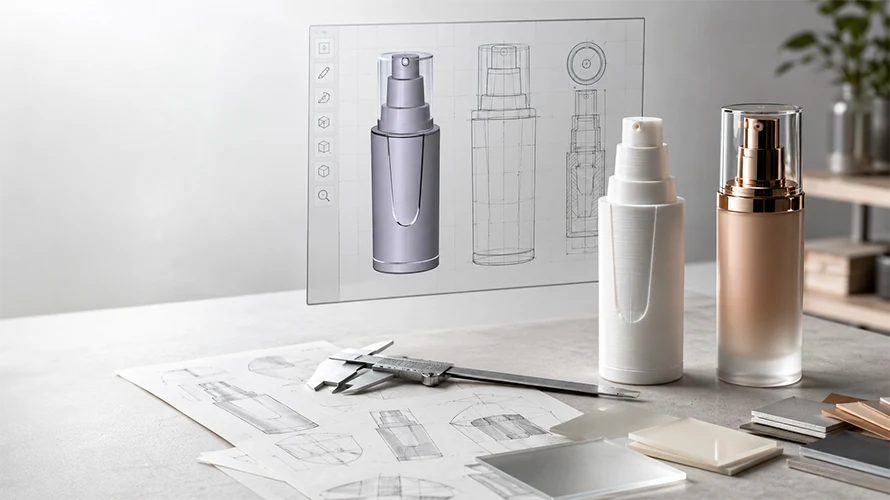
Cosmetic packaging prototyping is the process of turning a packaging concept into increasingly representative visual models, physical samples, molded parts, and production references. It may include 3D renders, appearance mockups, 3D-printed parts, CNC samples, vacuum-cast copies, prototype tooling, mold trials, and pilot production.
Each method answers a different question. A render can help approve the appearance. A 3D print can support form and approximate-fit review. A mold trial shows how the part behaves when produced through the intended manufacturing process. Formula compatibility, dispensing performance, filling-line behavior, and production consistency require additional samples and controlled tests.
The objective is not to create one perfect prototype. It is to choose the least expensive and fastest method that can reliably remove the next project risk.
What Is Cosmetic Packaging Prototyping?
Cosmetic packaging prototyping is a staged validation process used before full production. It helps brands, packaging designers, engineers, fillers, and manufacturers determine whether a packaging concept is ready to move forward.
A prototype may be used to review:
- Shape and proportions
- Capacity and overall dimensions
- Component interfaces
- Closure or applicator movement
- Pump and dispensing direction
- Color and finish intent
- Artwork placement
- Formula and material interaction
- Filling and assembly requirements
- Manufacturability
However, not every prototype can validate every item on this list.
A 3D render does not prove that two components will fit. A printed resin model does not prove that the final PP, PE, PET, PETG, ABS, or PMMA part will behave the same way. A visually approved sample does not confirm sealing, compatibility, drop resistance, or repeatable mass production.
The first step is therefore to define the question the prototype needs to answer.
What Does the Prototype Need to Validate?
Before choosing a prototype method, separate the project into five validation goals.
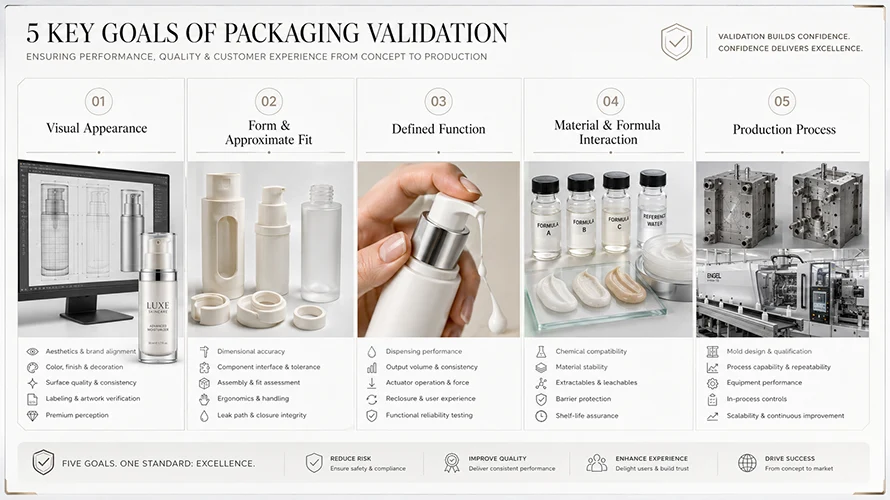
Visual appearance
Visual validation covers the overall shape, proportions, color direction, surface finish, artwork placement, and shelf impression.
Typical tools include:
- 3D renders
- Appearance mockups
- Decorated stock components
- Painted or coated display models
These tools help the project team approve how the packaging should look. They do not confirm engineering performance.
Form and approximate fit
Form-and-fit validation checks the physical size of the package, how components relate to one another, how the package feels in hand, and whether there are obvious assembly conflicts.
Typical tools include:
- 3D printing
- CNC machining
- Vacuum casting
- Modified stock components
The word “fit” should be used carefully. Early prototypes may identify obvious interference or alignment problems, but they do not automatically confirm production tolerances, sealing surfaces, snap-fit durability, or final molded shrinkage.
Defined function
Functional validation checks a specific movement or action under stated conditions.
Examples include:
- Opening and closing a cap
- Rotating a stick mechanism
- Pressing an actuator
- Moving an applicator
- Engaging a latch or snap feature
- Checking an initial dispensing concept
A functional prototype should be tied to one clear question. It should not be treated as proof of broad reliability across every formula, temperature, use pattern, or production batch.
Material and formula interaction
Meaningful formula compatibility testing requires samples made from the intended product-contact materials and assembled with the intended pump, gasket, closure, dip tube, pouch, liner, or other wetted components.
Printed resin, polyurethane casting material, and visual mockup materials generally do not represent the final packaging material system.
Material and formula evaluation may include:
- Visual change
- Swelling or softening
- Stress cracking
- Weight loss
- Leakage
- Odor transfer
- Color change
- Pump output change
- Component deformation
- Accelerated and real-time aging
Compatibility is always specific to the formula, packaging components, filling conditions, storage conditions, and test period.
Production-process validation
Production-process validation begins when samples are produced through the intended or a production-related manufacturing process.
This may include:
- Injection-mold trials
- Extrusion blow-mold trials
- Injection blow-mold trials
- Injection stretch blow-mold trials
- Decoration trials
- Assembly trials
- Filling-line trials
- Pilot production
These stages provide stronger evidence about tooling, molding, wall distribution, shrinkage, decoration, assembly, and process consistency.
They still do not guarantee every future production batch. Production control must continue after approval.
Common Cosmetic Packaging Prototype Methods
Prototype methods should not be confused with approval stages. A method describes how the sample is made. An approval stage describes where the project is in the development process.
3D renders and appearance mockups
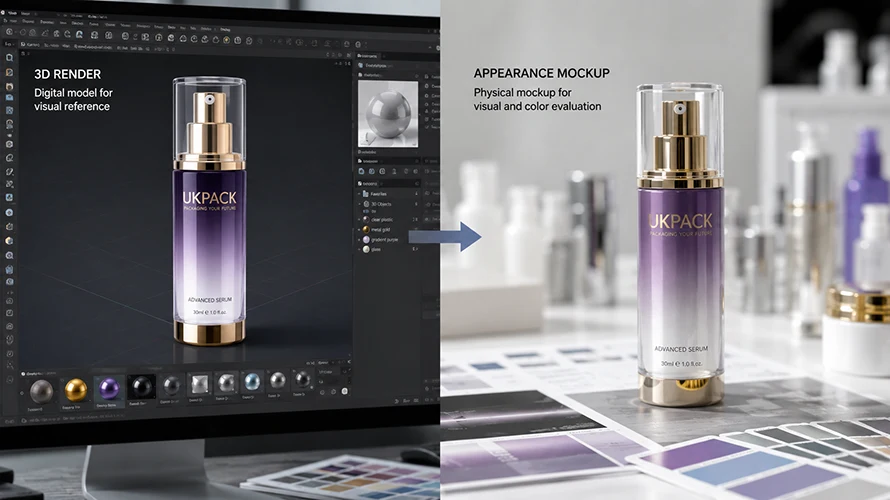
A 3D render provides a digital view of the packaging concept. It is useful for reviewing shape, proportions, component combinations, color direction, transparency, surface finish, branding, and artwork placement before physical samples are made.
An appearance mockup adds a physical or near-physical impression of the final pack. It may use a modified stock package, painted model, printed label, transferred artwork, coated part, or manually assembled display sample.
At UKPACK, we provide these visual deliverables through our 3D render and mockup support to help brands align the design direction before moving into physical validation.
Renders and appearance mockups can help approve:
- Overall design direction
- Relative proportions
- Color combinations
- Finish direction
- Logo scale
- Artwork placement
- Shelf impression
They cannot confirm:
- Production tolerances
- Component fit
- Sealing
- Pump output
- Formula compatibility
- Decoration durability
- Drop performance
- Manufacturing repeatability
Use these tools to approve how the package should look, then move to a physical method to learn how it behaves.
Decorated stock samples
A decorated stock sample uses an existing bottle, jar, pump, cap, tube, or applicator and applies the proposed branding or surface treatment.
This is often the most efficient prototype route when the project uses existing packaging rather than a custom mold.
A decorated stock sample may help evaluate:
- Printable area
- Logo position
- Color contrast
- Label size
- Silk-screen printing
- Hot stamping
- Coating direction
- Metallization appearance
- Frosted or matte effects
- Shelf presentation
It can also be filled with the intended formula when the stock components and product-contact materials match the proposed production configuration.
A decorated stock sample does not represent a new custom structure. It also does not prove decoration durability unless a defined test method is used.
3D printing
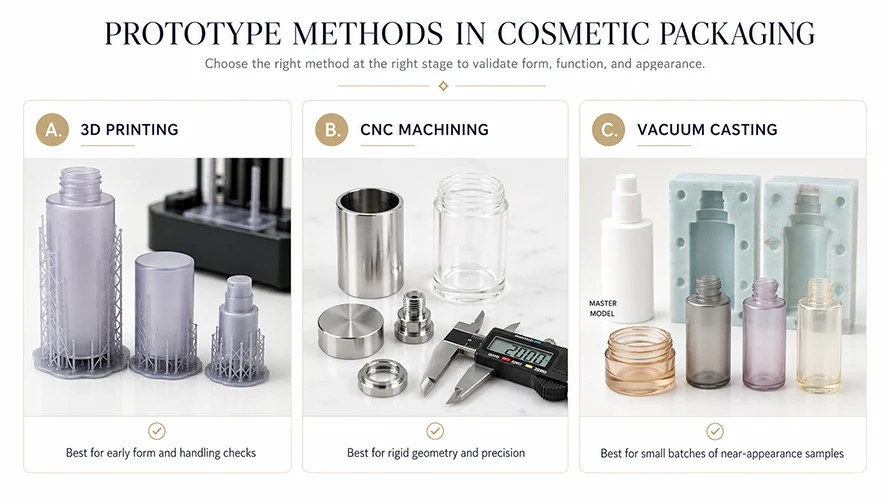
3D printing creates a physical part directly from digital geometry. Common technologies used in packaging development include SLA 3D printing, PolyJet, MJF, SLS, and FDM, although the best process depends on the required surface, detail, strength, transparency, and budget.
3D printing is useful for:
- Reviewing shape and proportions
- Checking handling and ergonomics
- Identifying obvious assembly conflicts
- Comparing several design concepts
- Reviewing actuator or closure movement
- Producing presentation samples
- Supporting early engineering discussions
A 3D print supports form and approximate-fit evaluation. Its accuracy depends on the printing process, build direction, post-curing, support removal, surface finishing, geometry, and material.
It does not normally confirm:
- Final resin behavior
- Molded shrinkage
- Production tolerances
- Sealing performance
- Snap-fit life
- Thin-wall flexibility
- Long-term chemical resistance
- Decoration adhesion
- Blow-molded wall distribution
Names such as “ABS-like” or “PP-like” describe selected characteristics of a printing resin. They do not mean the printed material will behave exactly like injection-molded ABS or PP.
CNC machining
CNC machining removes material from a solid plastic or metal block to produce a precise physical component.
It is useful when the project needs:
- Tight geometric control
- Rigid components
- Flat sealing or interface surfaces
- Metal sleeves or decorative parts
- Acrylic or PMMA display models
- Precision inserts
- A material feel closer to a solid production part
CNC machining can provide more precise geometry than many general-purpose printing methods. It may also use actual engineering plastics or metals.
However, a machined part still does not reproduce the complete behavior of an injection-molded or blow-molded component. It does not show molding flow, weld lines, gate effects, molded shrinkage, thin-wall flexibility, or production economics.
Use CNC machining as a precision engineering check, not as proof of production performance.
Silicone molding and vacuum casting
The vacuum casting process typically starts with a high-quality master model. A silicone mold is created around the master, and polyurethane material is then cast into the mold to produce a small number of copies.
This method is useful when a project requires:
- Several similar samples
- Multiple color options
- Transparent or translucent appearance
- Soft or rigid sample variations
- Small-run assembly review
- Customer presentation sets
- Near-appearance models
Vacuum casting can be a practical bridge between a single printed model and metal tooling.
However, polyurethane casting material is not the same as the final injection-molding resin. The process cannot confirm molded production repeatability, final shrinkage, chemical compatibility, or tool behavior.
It is most useful for appearance, handling, approximate fit, and selected short-term functional checks.
Prototype and bridge tooling
Prototype tooling, rapid tooling, and bridge tooling are terms used for lower-volume or simplified tools that produce parts through a production-related process.
Depending on the component and supplier, this may include:
- Aluminum injection molds
- Simplified steel molds
- Replaceable mold inserts
- Single-cavity molds
- Limited-life tools
- Rapidly manufactured mold components
The terminology is not universal. The project record should state:
- Tool material
- Forming process
- Number of cavities
- Expected tool life
- Intended sample quantity
- Planned resin
- Decoration route
- Questions the trial needs to answer
Prototype tooling is useful when actual molded materials and production-related geometry are more important than the lowest possible sample cost.
It may help evaluate:
- Molded shrinkage
- Snap fits
- Threads
- Wall thickness
- Part stiffness
- Assembly
- Basic sealing geometry
- Surface quality
- Early process behavior
It does not automatically confirm final mass-production capability, especially when the prototype tool differs from the planned production mold.
Prototype injection molding
Prototype injection molding produces parts using an injection mold and the selected thermoplastic resin.
For cosmetic packaging, it may be used for:
- Jars
- Caps
- Closures
- Pump components
- Airless bottle components
- Compacts
- Stick mechanisms
- Applicators
- Overcaps
- Decorative outer shells
Compared with printed or cast models, prototype injection-molded parts provide stronger evidence about:
- Actual material stiffness
- Molded shrinkage
- Component interfaces
- Snap engagement
- Thread performance
- Assembly force
- Surface defects
- Decoration feasibility
- Part deformation
The sample still needs defined inspection and test criteria. A small prototype mold or single trial does not prove long-term process capability.
Prototype blow molding and bottle trials
Blow-molded cosmetic packaging requires a separate prototype path because the bottle body is created through air pressure, material distribution, mold contact, and controlled cooling.
Depending on the package, the intended process may be:
- Extrusion blow molding, or EBM
- Injection blow molding, or IBM
- Injection stretch blow molding, or ISBM
This is particularly relevant for:
- PE squeeze bottles
- Tottle bottles
- Shampoo bottles
- Lotion bottles
- PET bottles
- Multilayer barrier bottles
- Flexible dispensing bottles
A 3D-printed bottle can support early review of shape, handling, footprint, and approximate capacity. It cannot reproduce:
- Blow-molded wall distribution
- Squeeze recovery
- Shoulder and base formation
- Neck accuracy
- Drop behavior
- Environmental stress cracking
- Transparency
- Material orientation
- Multilayer structure
- Production repeatability
These questions require a bottle produced through the intended or a representative blow-molding process.
A prototype or production-intent bottle trial may help evaluate:
- Bottle weight
- Capacity
- Wall-thickness distribution
- Neck dimensions
- Paneling
- Top-load resistance
- Squeeze force
- Recovery after dispensing
- Drop performance
- Filling behavior
- Closure fit
- Visual consistency
For multilayer bottles, the trial may also need to confirm layer distribution and barrier construction.
Prototype Methods at a Glance
| Prototype method | Best used for | Main limitation |
|---|---|---|
| 3D render | Design direction, proportions, colors, artwork | No physical or functional evidence |
| Appearance mockup | Shelf impression and visual approval | Does not confirm engineering performance |
| Decorated stock sample | Artwork, finish, stock-pack evaluation | Limited to an existing structure |
| 3D printing | Form, handling, approximate fit, early movement | Does not represent final resin or molding process |
| CNC machining | Precise rigid geometry and metal or solid-plastic parts | Does not reproduce molded behavior |
| Vacuum casting | Small batches of near-appearance samples | Cast polyurethane differs from final resin |
| Prototype tooling | Early molded parts using production-related processes | May differ from final production tooling |
| Injection-mold trial | Actual molded component behavior | Requires tooling and controlled evaluation |
| Blow-mold trial | Bottle wall distribution, squeeze, neck and drop behavior | Requires a process-specific bottle tool |
How the Prototype Path Changes by Packaging Type
The best method depends on the packaging format and its highest-risk feature.
Airless pump bottles
Airless packaging combines several interacting components, including the bottle, actuator, pump engine, piston or pouch, closure, gasket, and product path.
A render or appearance mockup can approve the visual direction. A printed outer shell may help review handling and component layout.
However, dispensing performance should be tested with the intended airless system and formula.
Relevant checks may include:
- Priming
- Dose per stroke
- Evacuation rate
- Residual product
- Actuation force
- Leakage
- Piston movement
- Formula viscosity
- Storage orientation
- Repeated-use performance
An existing airless pump bottle can provide a faster testing route than developing a completely new pump system, but the selected formula and configuration still need their own evaluation.
PE squeeze bottles and tottle bottles
For squeeze packaging, the bottle wall is part of the dispensing function.
A rigid 3D-printed model may show the shape but cannot reproduce the squeeze force or recovery of a blow-molded PE bottle.
Testing should consider:
- Resin grade
- Bottle weight
- Wall distribution
- Number of layers
- Squeeze force
- Recovery speed
- Closure flow path
- Orifice size
- Formula viscosity
- Storage orientation
- Paneling and deformation
For a tottle bottle, the stability of the cap-down position and the interaction between bottle flexibility, closure, and formula are especially important.
PET and PETG bottles
Clear packaging places greater emphasis on transparency, wall quality, stress, surface defects, and decoration.
A clear printed model may support an early visual review, but it rarely matches the optical quality and material orientation of a production bottle.
Prototype evaluation may need to cover:
- Clarity
- Wall thickness
- Neck finish
- Base stability
- Drop performance
- Stress cracking
- Color consistency
- Filling temperature
- Decoration adhesion
- Closure torque
The forming method matters. PET bottles produced through ISBM behave differently from thick-wall injection-molded PETG or other rigid clear components.
Cosmetic jars and compacts
Jars and compacts often depend on precise interfaces, closure engagement, hinge behavior, insert fit, and perceived weight.
3D printing or CNC machining can help review:
- Overall dimensions
- Opening diameter
- Wall proportions
- Insert layout
- Hinge position
- Mirror location
- Hand feel
Molded samples are usually needed to evaluate:
- Thread engagement
- Snap force
- Hinge durability
- Warpage
- Sealing surfaces
- Liner compression
- Actual material feel
- Decoration performance
Pumps, droppers, and applicators
Dispensing components have small internal parts and tight functional relationships. A visual model may show the external design, but the dispensing path normally requires working production components.
Relevant variables include:
- Output per actuation
- Dip-tube length
- Formula viscosity
- Spring and valve behavior
- Orifice size
- Actuation force
- Closure torque
- Gasket material
- Product-contact materials
- Return and shutoff behavior
A working pump assembled into a printed outer package may support an early concept review, but it does not validate a newly designed pump engine.
How Does a Prototype Move Into Tooling?
Tooling release should be based on a documented engineering handoff, not only on visual approval.
Before cutting the mold, the project team should confirm:
- Approved CAD geometry
- Intended materials
- Product-contact materials
- Component interfaces
- Critical dimensions
- Tolerances
- Capacity
- Neck and closure details
- Finish intent
- Decoration areas
- Assembly sequence
- Open technical risks
- Test requirements
- Approval responsibilities
A good-looking render is not a tooling release. An appearance mockup is not an engineering sign-off.
Once the design enters tooling, the project may use several trial and approval checkpoints.
What Do T0, T1, and T2 Mean?
T0, T1, and T2 usually refer to mold-trial and revision rounds, but their exact meaning varies between suppliers.
A common interpretation is:
T0: First parts produced from the initial mold build
T1: Parts produced after the first correction round
T2: Parts produced after additional tool or process revisions
Some suppliers begin with T1 rather than T0. Some use more trial rounds. Others separate dimensional approval, appearance approval, decoration approval, and assembly approval.
Do not rely on the label alone.
For each round, record:
- Trial date
- Resin and color
- Machine and process
- Sample quantity
- Tool changes
- Dimensional results
- Visual defects
- Assembly results
- Test results
- Open issues
- Required corrections
- Approval status
Our tooling and manufacturing support connects mold development with molding, decoration, assembly, testing, and production handoff.
Pre-Production Samples, Pilot Runs, and Golden Samples
These terms describe project checkpoints rather than prototype manufacturing methods.
Their order may differ depending on the supplier and product.
Pre-production sample
A pre-production sample represents an agreed packaging configuration before full production release.
It may include:
- Approved resin
- Approved color
- Approved decoration
- Intended components
- Intended assembly
- Agreed formula or fill
- Final artwork
A pre-production sample is an important checkpoint, but it does not guarantee mass-production performance unless the production process and inspection controls are also validated.
Pilot run
A pilot run produces a limited quantity under planned or near-planned production conditions.
It may be used to evaluate:
- Molding stability
- Assembly sequence
- Decoration consistency
- Filling-line interaction
- Packing method
- Inspection criteria
- Operator instructions
- Process yield
A pilot run provides process learning under stated conditions. It does not guarantee every future batch.
Golden sample
A golden sample is an approved reference used to compare later production output.
The project should define:
- Who approves it
- Which production stage it represents
- Whether it covers structure, color, decoration, function, or all four
- How it is stored
- How long it remains valid
- Whether duplicate reference samples are required
For complex packaging, one golden sample may not be enough. Separate references may be needed for molded color, decoration, assembly, dispensing, or filled-pack appearance.
How Do Formula, Dispensing, Decoration, and Filling Affect the Plan?
The packaging risk determines the required test plan.
Formula compatibility
Meaningful compatibility testing should use:
- The intended formula
- Intended product-contact materials
- Intended pump or closure
- Intended gasket and liner
- Planned fill volume
- Defined storage conditions
- Defined test periods
- Agreed acceptance criteria
An appearance prototype made from printing resin or cast polyurethane should not be used to approve long-term compatibility with a production formula.
Compatibility testing may include accelerated aging and real-time observation. The appropriate temperature, duration, orientation, and evaluation method depend on the formula and packaging system.
Dispensing performance
Dispensing tests should define:
- Formula viscosity
- Dose target
- Number of priming strokes
- Actuation speed
- Actuation force
- Storage orientation
- Temperature
- Test interval
- Number of cycles
- Acceptable dose variation
Pump output from one formula should not be assumed to apply to another.
A high-viscosity cream, low-viscosity serum, oil, lotion, gel, and powder each create different dispensing conditions.
Component fit and sealing
Fit validation may include:
- Thread engagement
- Closure torque
- Snap force
- Liner compression
- Gasket contact
- Pump crimp or lock
- Bottle-neck dimensions
- Seal-surface flatness
- Leakage
- Vacuum or pressure response
A printed fit check can identify obvious geometry problems, but final approval should use samples representative of the intended material and manufacturing process.
Decoration validation
Decoration approval should identify the actual process, not only the visual result.
Examples include:
- Silk-screen printing
- Hot stamping
- Heat transfer
- In-mold labeling
- Spray coating
- Metallization
- Anodizing
- Frosting
- Laser marking
- Label application
The test plan may include:
- Artwork position
- Color tolerance
- Adhesion
- Rub resistance
- Scratch resistance
- Chemical resistance
- Edge quality
- Registration
- Curing
A screen rendering cannot approve a printed and cured surface.
Filling-line validation
Filling-line trials should consider:
- Formula temperature
- Formula viscosity
- Fill speed
- Target fill volume
- Foaming
- Dripping
- Neck dimensions
- Closure placement
- Torque
- Pump insertion
- Crimping
- Labeling
- Coding
- Conveyor stability
- Throughput
A line trial validates the agreed setup under the tested conditions. It does not automatically validate different factories, machines, formulas, or future process settings.
For production and quality context, ISO 22716 provides cosmetics GMP guidance for production, control, storage, and shipment. It is not a prototype-validation standard and does not approve a specific packaging and formula combination.
Distribution testing should use a defined protocol appropriate to the shipping unit and expected distribution route. ASTM D4169 provides one framework for evaluating shipping units through a sequence of distribution-related tests, but it is not a universal approval standard for every cosmetic package.
Stock Packaging vs Custom-Mold Packaging
Stock and custom packaging follow different prototype paths.
Stock packaging path
A stock packaging project uses an existing bottle, jar, pump, cap, tube, or applicator.
The structure and mold already exist, so the project can focus on:
- Component selection
- Formula compatibility
- Pump or closure fit
- Decoration
- Artwork
- Filling
- Assembly
- Transport packaging
A typical path may be:
- Select stock components.
- Request standard samples.
- Confirm the component combination.
- Apply sample decoration.
- Fill with the intended formula.
- Run compatibility and dispensing checks.
- Approve pre-production samples.
- Complete a pilot or first-production review.
Stock packaging is usually faster because the main forming tools already exist.
Custom-mold path
A custom-mold project adds design engineering and tooling development.
A typical path may include:
- Design brief
- 3D render
- Appearance mockup
- CAD development
- 3D-printed or CNC prototype
- Engineering revision
- Tooling release
- Mold trial
- T0, T1, or later revisions
- Decoration trial
- Assembly and function checks
- Pre-production sample
- Pilot run
- Golden sample
- Production release
The exact order depends on the packaging type and project risk.
We provide cosmetic packaging design services for structure, materials, prototype planning, tooling preparation, and production handoff.
What Should a Brand Prepare Before Requesting a Prototype?
A supplier can only select the right prototype method when the project inputs are clear.
Prepare the following information.
Formula context
Provide:
- Product type
- Viscosity
- Key ingredients
- Alcohol, oil, solvent, acid, or active content
- Light or oxygen sensitivity
- Filling temperature
- Storage requirements
- Intended shelf life
A complete formulation may be protected under confidentiality, but the packaging supplier still needs enough material-risk information to plan testing.
Capacity and packaging format
Define:
- Nominal fill volume
- Overflow capacity if relevant
- Bottle, jar, tube, compact, stick, or airless format
- Upright or inverted use
- Size range
- Target dimensions
- Travel-size requirements
Components
Identify:
- Pump
- Cap
- Closure
- Applicator
- Dropper
- Liner
- Gasket
- Dip tube
- Piston
- Pouch
- Inner jar
- Refill component
Include known thread, neck, or interface details.
Use conditions
Explain:
- How the consumer opens the product
- How often it is used
- How it is stored
- Whether it is carried in a bag
- Whether it is used in a shower
- Whether it is exposed to heat, cold, humidity, or sunlight
- Whether it is intended for one-handed use
Artwork and finish direction
Provide:
- Artwork files
- Logo size
- Branding position
- Color references
- Finish references
- Decoration method preferences
- Required claims or regulatory text
- Barcode and batch-code area
A structured cosmetic packaging design brief helps align these inputs before sampling begins.
Required prototype quantity
The best method may change depending on whether you need:
- One internal review sample
- Three management-approval samples
- Ten filling-line samples
- Thirty customer-test units
- A small trade-show batch
- A pilot production run
The question each sample must answer
Do not request “a prototype” without defining its purpose.
State whether the sample needs to confirm:
- Appearance
- Dimensions
- Approximate fit
- A specific movement
- Pump output
- Formula interaction
- Decoration
- Filling
- Assembly
- Transport
- Production consistency
Acceptance criteria
Define how the decision will be made.
Examples include:
- Approved dimension range
- Maximum leakage
- Dose per stroke
- Acceptable actuation force
- Approved color tolerance
- Print-position tolerance
- Required drop height
- Allowed weight loss
- Required number of cycles
- Approved reference sample
Without acceptance criteria, two teams may review the same sample and reach different conclusions.
How Long Does Cosmetic Packaging Prototyping Take?
Prototype lead time depends on the method and project readiness.
The main variables include:
- CAD availability
- Number of components
- Geometry complexity
- Sample material
- Required surface quality
- Transparency
- Decoration
- Sample quantity
- Revision rounds
- Tooling method
- Testing scope
- Formula availability
A render or simple appearance mockup is usually faster than a multi-part functional prototype. A printed model is usually faster than CNC machining, vacuum casting, or prototype tooling. Molded and blow-molded samples require additional preparation because the forming process and tool must be established.
Lead time should be discussed by stage rather than as one number for the entire project.
What Affects Cosmetic Packaging Prototype Cost?
The main cost drivers are:
- Number of parts
- Part size
- Geometry complexity
- Prototype method
- Sample quantity
- Material
- Surface finishing
- Transparency
- Painting or coating
- Decoration
- Assembly
- Tooling
- Engineering revisions
- Testing requirements
One appearance model costs less than a small set of production-intent, decorated, filled, and tested samples.
The lowest-cost method is not always the most economical decision. A cheap visual prototype cannot remove a sealing, compatibility, or manufacturing risk. The correct method is the least expensive one capable of answering the actual project question.
Conclusion
Cosmetic packaging prototyping is not one sample and not one technology.
A render answers a visual question. A 3D print supports early form and approximate-fit review. CNC and vacuum casting provide different levels of precision and sample quantity. Prototype tooling and mold trials provide stronger information about actual materials and manufacturing behavior. Blow-molded bottle trials are required when wall distribution, squeeze recovery, neck accuracy, and bottle performance matter.
The correct process moves from low-cost visual decisions toward more representative physical, material, tooling, and production evidence.
Start by identifying the risk you need to remove. Then choose the simplest prototype method that can answer that question without claiming more than the sample can prove.
Frequently Asked Questions
What is the difference between a cosmetic packaging mockup and a prototype?
A mockup is mainly used to review appearance, artwork placement, color direction, and shelf impression. A prototype is a physical sample used to evaluate structure, approximate fit, or a defined function. Neither term automatically means the sample uses final materials or production processes, so the supplier should state exactly how it was made.
Is a 3D-printed cosmetic package the same as the final package?
No. A 3D print supports early evaluation of shape, handling, and approximate fit. It does not confirm production tolerances, sealing surfaces, snap-fit durability, blow-molded flexibility, decoration performance, or the behavior of the final molded resin.
Can a 3D-printed prototype test formula compatibility?
Usually not for final approval. Printed resins normally differ from the intended product-contact materials. Meaningful compatibility testing should use the proposed production materials, pump, closure, gasket, liner, and other formula-contact components under defined test conditions.
Can a prototype test pump output?
A working packaging assembly can support pump-output testing when it uses the intended pump, formula, dip tube, closure, and storage conditions. A visual or printed pump model cannot validate output. Dose results from one formula should not be assumed to apply to another.
What do T0, T1, and T2 samples mean?
They usually refer to early mold-trial and revision rounds. T0 often means the first parts from a new tool, while T1 and T2 indicate later samples after corrections. The naming is not universal, so the project record should define what each round includes and what was approved.
What is a pre-production sample?
A pre-production sample is a controlled packaging configuration reviewed before full production release. It may include the planned resin, color, decoration, components, assembly, and artwork. It is an approval checkpoint, but it does not replace production-process validation or ongoing quality control.
What is a golden sample?
A golden sample is an approved reference used to compare later production output. The project should define who approved it, which characteristics it represents, how it is stored, and whether separate references are needed for molded color, decoration, assembly, or function.
Does prototype approval guarantee mass-production performance?
No. Prototype approval provides evidence under the conditions tested. Pilot production and process validation add stronger production evidence, but future batches still require defined material controls, inspections, testing, and acceptance criteria.
Do stock cosmetic packages need prototyping?
Yes, although the process is usually shorter. A stock package may still need decoration samples, formula compatibility testing, pump or closure checks, filling-line review, and pre-production approval. Existing tooling reduces structural-development risk but does not remove formula or process risk.
What should a brand provide before requesting a prototype?
Provide formula context, fill volume, packaging format, required components, use conditions, artwork, decoration direction, sample quantity, target tests, acceptance criteria, and the person responsible for approval. These inputs allow the supplier to choose a prototype method that answers the correct project question.