Syrup Pump Guide: How to Match Neck Finish, Output and Bottle Fit

Founder of UKPACK, chief packaging engineer and designer with 18 years of experience, and Red Dot Award winner. I work on cosmetic packaging structure, material selection, mold feasibility, decoration processes, and leak-risk control, helping brands turn packaging ideas into reliable production-ready solutions. See my senior packaging engineer qualification.
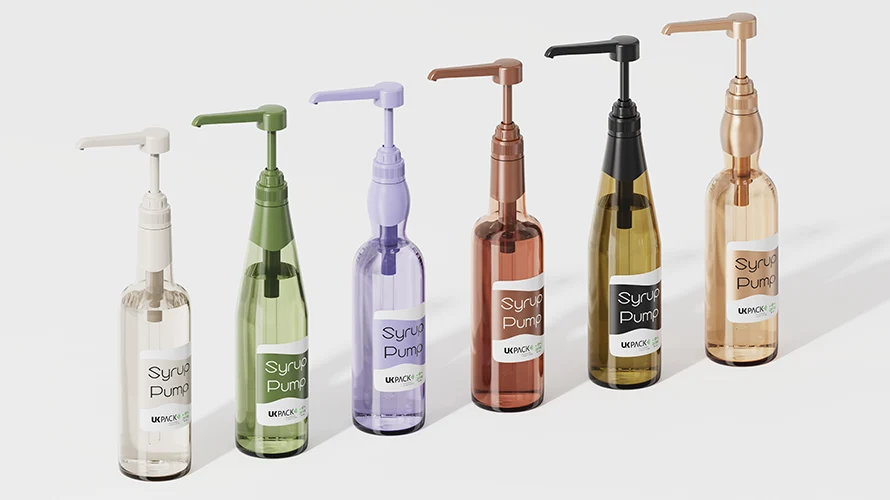
A syrup pump is the screw-on dispensing pump that turns a bottle of flavored syrup, sauce, or concentrate into a controlled, measured pour. Press once, get a set dose. The reason it matters more than it looks: the pump has to match three things at the same time, the bottle neck it screws onto, the syrup’s thickness, and the dose you want per press. Get one wrong and you get drips, clogs, short pours, or a pump that will not fit at all.
Most of that decision comes down to numbers a retail listing never shows you: the neck finish code, the output per stroke, and the viscosity range. This syrup pump guide walks through all three, gives you a brand-by-brand bottle fit chart, and shows the output and test data a manufacturer actually builds to.
Key takeaways
- A syrup pump is defined by three specs: neck finish (does it fit the bottle), output per stroke (how much per press, commonly 3.5 to 10 ml), and viscosity range (how thick a syrup it can move without clogging).
- Neck finish is the fit test. Most 750 ml café bottles use a 28 mm neck but split between 28/400 (Torani, Upouria) and 28/410 (DaVinci, Jordan’s Skinny), while Monin glass uses 31/410. Always confirm the exact code.
- One pump is about 1/4 fl oz (7.4 ml), or roughly 1.5 tsp. So “2 pumps” is about 1/2 fl oz and “3 pumps” about 3/4 fl oz.
- Match output to the recipe, not the bottle size, and match the viscosity rating to your thickest syrup, not your thinnest.
- A production pump is a spec part: output held to within ±10%, primed in under 6 strokes, and cycle-tested past 1,000 actuations.
What Is a Syrup Pump?
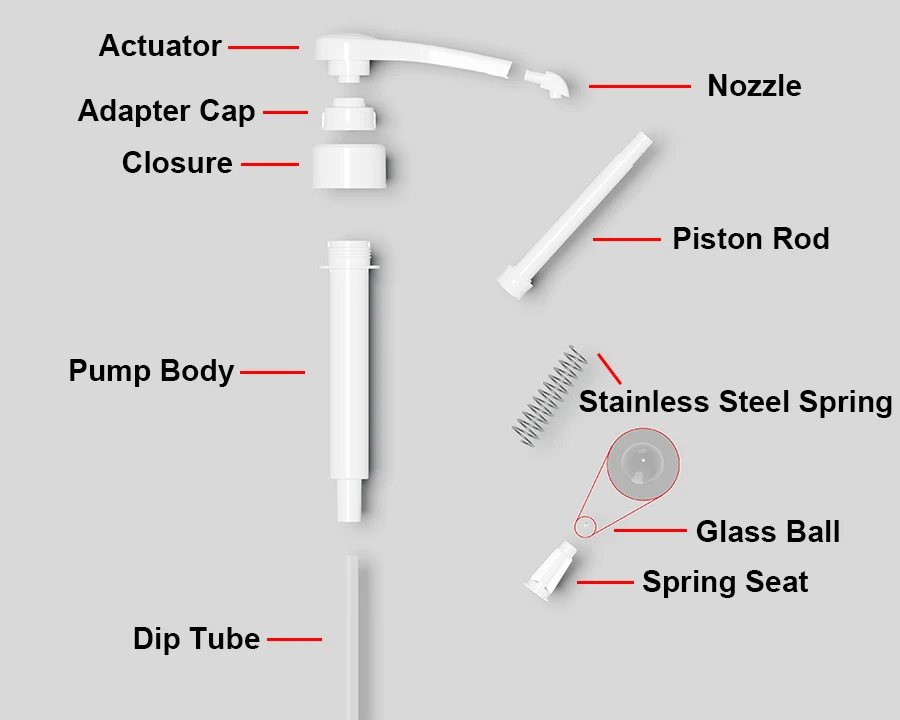
A syrup pump is a manual dispensing pump that fits onto a syrup or sauce bottle and delivers a fixed amount of liquid each time you press the head. It replaces free-pouring, so every drink or dessert gets the same dose without a measuring cup.
Mechanically it is simple and reliable. A dip tube runs to the bottom of the bottle, a spring-loaded piston sits inside the pump chamber, and a closure screws onto the bottle neck. Pressing the head drives liquid up the tube and out the spout; releasing it lets the spring reset and refill the chamber. Because the working parts are a spring and a piston, a well-made pump handles thousands of cycles.
The part that trips people up is that “syrup pump” is not one universal object. Pumps differ by the bottle neck they fit, the volume they push per stroke, and the syrup thickness they can handle. Those three specs are the whole decision, and the rest of this guide takes them one at a time.
How a Syrup Pump Dispenses (and How to Read “2 Pumps”)
Every syrup pump is calibrated to an output per stroke, the fixed volume it moves each press. Common outputs sit between 3.5 ml and 10 ml, and most standard café pumps land around 1/4 fluid ounce. That single number is what makes recipes repeatable: staff never measure, the pump does.
Here is how the common outputs convert, so a recipe written in “pumps” translates to ounces, teaspoons, and tablespoons:
| Output per stroke | ≈ fl oz | ≈ tsp | ≈ tbsp | 2 pumps | 3 pumps |
|---|---|---|---|---|---|
| 3.5 ml | 0.12 oz | 0.7 tsp | 0.24 tbsp | ~7 ml | ~10.5 ml |
| 5 ml | 0.17 oz | 1 tsp | 0.34 tbsp | ~10 ml | ~15 ml |
| 7.4 ml | 0.25 oz | 1.5 tsp | 0.5 tbsp | ~14.8 ml | ~22.2 ml |
| 8 ml | 0.27 oz | 1.6 tsp | 0.54 tbsp | ~16 ml | ~24 ml |
| 10 ml | 0.34 oz | 2 tsp | 0.68 tbsp | ~20 ml | ~30 ml |
Most standard café syrup pumps are calibrated to about 1/4 fl oz, roughly 7.4 ml, per pump. So one pump is close to 1.5 teaspoons (about 1/2 tablespoon), two pumps is about 1/2 fl oz, and three pumps is about 3/4 fl oz.
In production, that output is not a rough figure. On our UKS10 syrup pumps it is held to within ±10% of the rated dose, verified by dispensing 10 full strokes into a measuring cup, weighing them, and dividing by 10, checked at line startup and once per shift. A 10 ml pump therefore delivers roughly 9 to 11 ml per press. That tolerance is exactly why standardizing on one output across a multi-flavor line keeps the dosing consistent no matter which bottle is on the counter.
What About Torani, Monin, and Starbucks Pumps?
Café chains and syrup brands calibrate pumps to a fixed dose so recipes stay consistent. In-store, Starbucks uses proprietary pumps set to a standard amount per push. At home, a Starbucks, Torani, or Monin syrup bottle takes a bottle pump matched to its neck finish, and those necks are not all the same, which the next section maps out in full. For brand-specific dosing, our breakdown of how much one pump of Torani syrup dispenses and how many pumps of syrup an Italian soda takes works through the recipe math.
Neck Finish and Bottle Fit (The Number That Decides Everything)
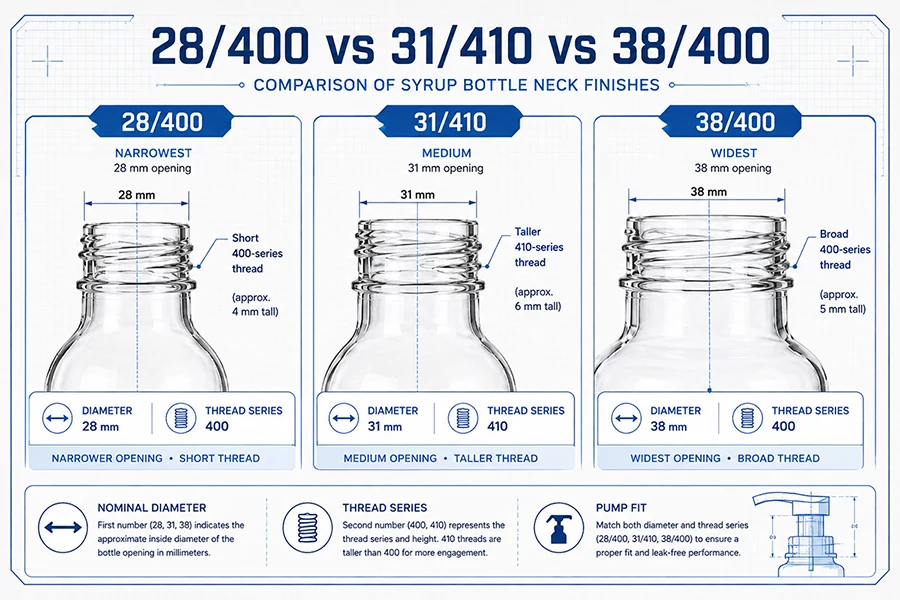
Before output or color, a pump has to physically fit the bottle. That fit is set by the neck finish, a two-part code like 28/400. The first number is the neck’s outer diameter in millimeters; the second (400, 410) describes the thread style and height. A pump built for one finish will not seat correctly on another, no matter how good it is.
Here is how the popular syrup and creamer brands line up, which is where most sourcing mistakes happen:
| Brand & bottle | Neck finish | Standard output | UKPACK pump |
|---|---|---|---|
| Torani, 750 ml glass | 28/400 | ~7.4 ml (1/4 oz) | 28/400 pump, 5 to 10 ml |
| DaVinci Gourmet, 750 ml glass | 28/410 | ~7.4 ml | 28/410 pump |
| DaVinci Gourmet, larger bottle | 38/400 | 10 ml | 38/400 pump |
| Jordan’s Skinny, 750 ml | 28/410 | ~7.4 to 8 ml | 28/410 pump |
| Upouria, 750 ml PET | 28/400 | ~7.4 to 8 ml | 28/400 pump |
| Monin, 700 to 750 ml glass | 31/410 | ~7.4 ml | 31/410 universal, 5 or 10 ml |
| Monin, 1 L plastic | 28/400 | ~7.4 ml | 28/400 pump, 5 to 10 ml |
| 1883 Maison Routin, 1 L glass | 1883-specific / snap-on | ~7.4 ml | Universal pump, 10 ml |
| 1883 Maison Routin, 1 L PET | 28/410 (some snap-on) | ~7.4 ml | Universal pump, 10 ml |
| Starbucks / Fontana, 1 L | 28/400 | ~7.4 ml | 28/400 pump, 3.5 to 4 ml |
| Starbucks, glass / foodservice | 38/400 | ~5 ml | 38/400 pump, 5 ml |
| Coffee Mate, 1.5 L creamer | 38/400 (TE cap) | 5 ml | 38/400 creamer pump, 5 ml, tamper-evident |
| Fabbri Mixybar (custom program) | Universal fit | 10 ml | UKS10 custom, 10 ml |
Two things are worth pulling out. First, the popular 750 ml café bottles are close but not identical: Torani and Upouria use 28/400, while DaVinci and Jordan’s Skinny use 28/410, and Monin glass bottles use 31/410. Second, larger 1 L and creamer bottles may use 38/400, brand-specific neck finishes, or snap-on connections, as seen with some 1883 Maison Routin bottles.
Once you know your bottle’s finish, explore our range of syrup pump dispensers to compare compatible models and output options. Our engineers can also confirm compatibility if you are unsure. One detail that often causes sourcing errors is that bottles with the same nominal neck diameter may still use different threads. A 28 mm bottle, for example, may require either a 28/400 or 28/410 pump depending on the bottle design or production run. For volume orders, confirm the full neck-finish code or send us a bottle sample rather than relying on diameter alone. Our guide to bottle neck finishes and thread sizes explains how to identify and measure the specification.
Matching Output and Viscosity to Your Syrup
Two syrups that look similar can behave very differently in a pump. Viscosity, measured in centipoise (cP), is the deciding factor. A thin coffee syrup might sit near a few hundred cP; a chocolate sauce, honey, or fruit purée can run into the thousands. Pumps are rated for a viscosity range, and pushing a thick syrup through a pump built for thin liquid is where clogging, short pours, and hand fatigue come from.
- Thin syrups (flavored coffee, simple syrup, beverage bases): flow easily. Almost any output works; choose based on the dose you want.
- Medium syrups (caramel, some fruit syrups): benefit from a wider dip tube and a slightly larger output so the pour stays smooth.
- Thick syrups and sauces (chocolate, purée, condiments): need a pump designed for high viscosity, usually with a larger bore and stronger spring. A standard thin-syrup pump will struggle.
This is also the honest answer to a common question: the difference between a sauce pump and a syrup pump is mostly bore size, spring strength, and viscosity rating, not appearance. If your product sits at the thick end, a dedicated design matters. For sauces like ketchup, mayonnaise, or BBQ, a purpose-built sauce pump dispenser handles the flow and portioning better than a syrup pump will.
In development work, the step that saves the most trouble is testing the pump with the finished syrup rather than water. Viscosity, sugar content, and temperature all shift how a pump performs, and a sample run surfaces clogging or drip issues before a production order.
Head Styles, Closures, and Tamper-Evidence
Once fit and flow are settled, the pump’s head and closure decide how it looks on the counter and how it survives shipping.
Head styles
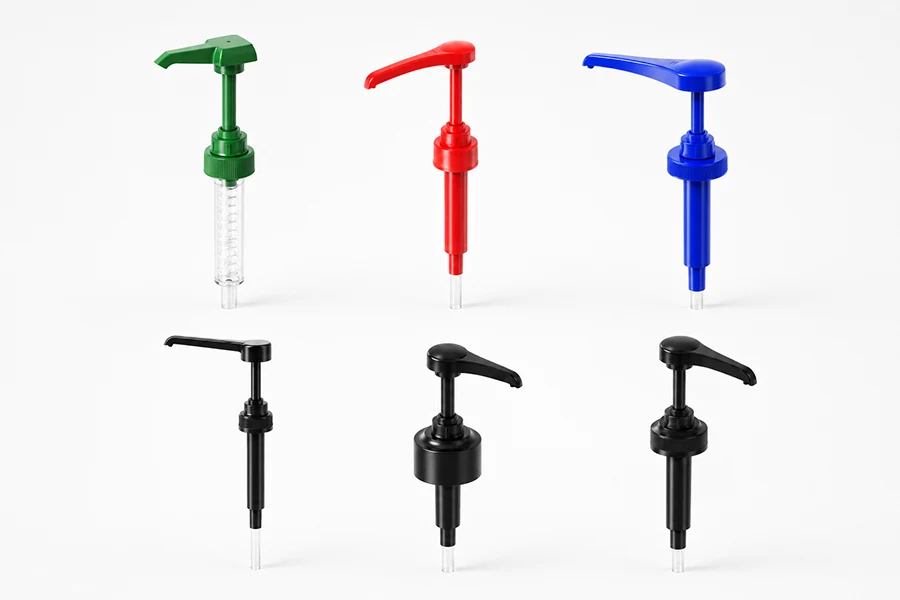
Pump heads vary in shape and size, from standard and square to large, narrow, and medium-duty profiles. The choice is partly ergonomic (a larger head is easier to press in a busy café) and partly aesthetic (a slim head suits a premium retail bottle). Head style does not change the output; it changes the feel and the shelf presence.
Closure and surface finish
Closures come smooth, ribbed, or double-layer, in glossy, matte, or metallic surfaces. Ribbed closures grip better with wet hands; smooth and metallic finishes read more premium on a retail shelf. This is where branding lives, through color matching, logo printing, laser engraving, or hot stamping.
Tamper-evident and drip-resistant options
For retail syrup and anything shipped filled, a tamper-evident cap signals the pump has not been used, and a drip-resistant spout keeps the counter clean between pours. Both matter more for packaged retail products than for back-of-house café use, where pumps are installed once and stay on the bottle. Liquid creamers are a common tamper-evident case: a 1.5 L Coffee Mate bottle pairs a 38/400 pump with a locking, tamper-evident closure.
Materials, Food Safety, and How the Pump Is Tested
Because a syrup pump comes into direct and repeated contact with beverages, material selection and compliance testing are essential. UKPACK food-grade syrup pumps use a PP pump body and an LDPE dip tube, with material specifications and heavy-metal controls available for review. For volume sourcing, ask for compliance documentation that matches your target market: applicable US food-contact requirements, as outlined in the FDA’s Packaging & Food Contact Substances (FCS) overview, and EU conformity under Regulation (EC) No. 1935/2004 and Regulation (EU) No. 10/2011 for plastic food-contact components. Buyers selling in both markets should request supporting declarations, material specifications and relevant test reports for each regulatory system.
How UKPACK Tests a Syrup Pump
Retail listings rarely publish how a pump actually performs. These are the specs our UKS10 syrup pumps are built and tested to:
| Tested spec | Standard | How it is verified |
|---|---|---|
| Output accuracy | Within ±10% of rated output (a 10 ml pump delivers ~9 to 11 ml/stroke) | 10 full strokes into a measuring cup, weighed, divided by 10; checked at startup and once per shift |
| Priming | Full output in under 6 strokes from new | Stroke-to-prime test |
| Durability | Over 1,000 actuations | Cycle/durability test |
| Leak resistance | No leak after 24 hours inverted, bottle at least 80% full and capped | Inversion leak test (vacuum test available) |
| Materials | PP pump body, LDPE dip tube, free of heavy metals | Food-contact material control |
| Quality level | AQL Critical 0.65 / Major 1.5 / Minor 4.0 | GB2828.1 sampling |
That last row is the practical reason two pumps quoted as the “same” can differ in price. The gap is usually spring quality, wall thickness, and the sampling level the supplier inspects to, the parts that decide whether the pump still dispenses cleanly after a few thousand cycles.
How to Choose the Right Syrup Pump
Pulling the decisions together, here is the order that avoids rework:
- Confirm the neck finish first. Measure your bottle or read its finish code. This eliminates most of the catalog immediately.
- Set the output per stroke. Base it on your target dose per press, not the bottle size.
- Check viscosity. Match the pump’s cP rating to your thickest syrup, not your thinnest.
- Choose head and closure. Ergonomics for foodservice, shelf appeal for retail.
- Decide on tamper-evidence. Required for most packaged retail syrup and creamer, optional for back-of-house.
- Confirm food-contact certification for every market you sell in.
- Test on a sample with the real syrup before committing to a production quantity.
Buying Syrup Pumps in Bulk or Custom (OEM)
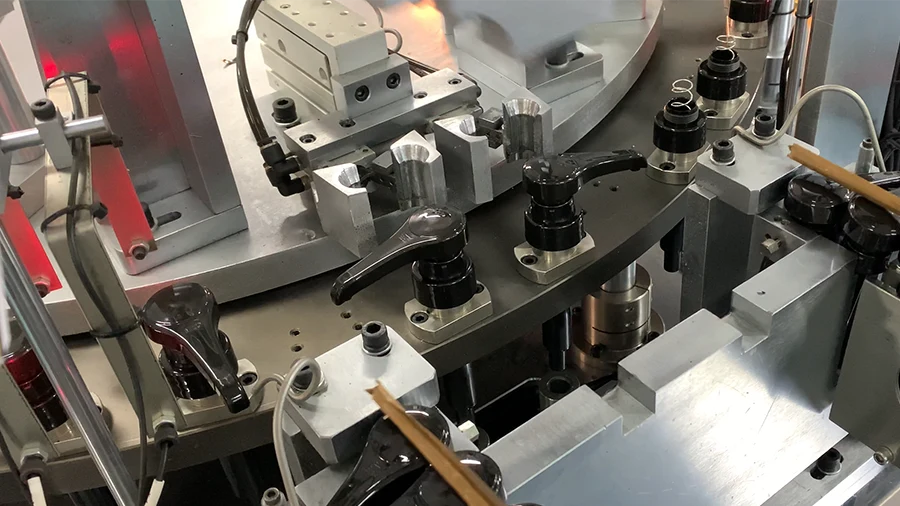
Sourcing pumps at volume is a specification conversation, not a shopping trip. The faster you can hand a supplier the exact spec, the faster you get an accurate quote and a usable sample. Send these six things up front:
- Neck finish (or the bottle you are fitting, so the supplier can confirm)
- Output per stroke you need (for example 5 ml or 10 ml)
- Syrup type and viscosity, or a sample of the actual product
- Closure and head style, plus any branding (color match, logo, finish)
- Tamper-evident or drip-resistant requirements
- Target order quantity and timeline
Custom work typically covers Pantone color matching, logo printing or engraving, closure and surface finish, and output tuning; a fully proprietary design can also include a custom neck fit. Most projects do not start from scratch: they take a proven pump engine and add branding. For the Fabbri Mixybar syrup program, we adapted our UKS10 engine to deliver consistent 10 ml shots with a universal bottle fit and on-brand printing, which is faster and lower-risk than tooling a new pump from the ground up.
How to Prime, Use, and Clean a Syrup Pump
A new or refilled pump needs priming: press the head several times to pull syrup up the dip tube until it dispenses fully. A quality pump does this quickly, our UKS10 pumps are specified to prime in under 6 strokes, and the first press or two coming up short is normal, not a defect.
For cleaning, flush the pump with warm water and pump it through until the water runs clear, then use a mild detergent for sugary or oily syrups that leave residue in the spout and tube. Sugar dries and hardens in narrow channels, so a pump left uncleaned is the most common cause of a “clogged” pump that is otherwise fine. In busy operations, keeping a spare pump per flavor lets staff swap and soak rather than stop service.
Because the working parts are a plastic body and a metal spring, a quality syrup pump has a long service life, tested to over 1,000 actuations, so refilling the bottle and pumping again is the normal case, not a stretch. The parts that eventually wear are the spring and the seal, which is another reason to confirm both on a sample before a bulk order.
Conclusion: Fit First, Then Flow, Then Finish
A syrup pump looks like a commodity and behaves like a spec part. The pumps that fail on the counter almost always failed the match: wrong neck finish, output that does not suit the recipe, or a viscosity rating too low for the syrup. Work the decision in order, fit to the bottle, output to the dose, viscosity to the syrup, then head, closure, tamper-evidence, and certification, and the pump becomes the part of the setup nobody has to think about.
If you are choosing pumps for a syrup line, a café rollout, or a private-label product, share your bottle neck finish, target output, syrup type, and order quantity, and our team can match a stock model or plan a custom one, including samples with your syrup before you commit to production.
FAQs
What is the difference between a sauce pump and a syrup pump?
Mostly bore size, spring strength, and viscosity rating. Syrup pumps are tuned for thinner liquids like flavored coffee syrups and simple syrup. Sauce pumps have a wider bore and stronger spring to move thick products like chocolate, ketchup, or BBQ sauce without clogging. They can look similar, but pushing a thick sauce through a thin-syrup pump causes short pours and jams.
How much syrup does one pump dispense?
Most standard café pumps are calibrated to about 1/4 fl oz per press, roughly 7.4 ml, which is close to 1.5 teaspoons or half a tablespoon. Common outputs run from 3.5 ml to 10 ml. So on a 10 ml pump, two pumps is about 20 ml and three pumps is about 30 ml. In production the output is held to within ±10% of the rated dose.
Does a Torani or DaVinci pump fit a Monin bottle?
Not directly. Torani uses a 28/400 neck and DaVinci a 28/410, while Monin’s 700 to 750 ml glass bottle uses 31/410 and its 1 L plastic bottle uses 28/400. Because the diameters and threads differ, match the pump to the specific bottle rather than assuming one café pump fits all.
Will one syrup pump fit all bottles?
No. Fit is set by the bottle’s neck finish (for example 28/400, 28/410, 31/410, or 38/400). A “universal” pump seats on several common finishes as a convenience, but for a single bottle type at volume, a finish-specific pump seals and dispenses more reliably. Confirm the finish or test on a sample.
Are syrup pumps food safe?
A food-grade syrup pump uses food-contact-approved materials, typically a PP body and an LDPE dip tube, specified free of heavy metals. For international sales, look for both US (FDA) and EU (Regulation (EC) No. 1935/2004) food-contact documentation, since a pump in direct contact with syrup must meet the rules of every market it ships to.
What is the minimum order for custom syrup pumps?
Bulk and OEM syrup pumps carry a minimum order quantity that varies with customization level, and lead times split between sample turnaround and production. Confirm neck finish, output, viscosity, closure, and branding with the supplier to get an accurate quote and timeline.