Four Types of Packaging That Prevent Tampering with Medicine (2025 Complete Guide)

Founder of UKPACK, chief packaging engineer and designer with 18 years of experience, and Red Dot Award winner. I work on cosmetic packaging structure, material selection, mold feasibility, decoration processes, and leak-risk control, helping brands turn packaging ideas into reliable production-ready solutions. See my senior packaging engineer qualification.

Imagine this. You buy a bottle of medicine that looks perfectly fine from the outside. But what if someone had opened it, swapped the contents, and sealed it back? That single thought is enough to make any consumer hesitate. In the pharmaceutical world, trust begins with packaging.
Tampering with medicine is not only a crime; it can be a matter of life and death. A famous case in 1982, when several bottles of Tylenol were found laced with cyanide, led to multiple deaths and forced the entire industry to rethink how medicines are packaged. From that moment, tamper-evident packaging became the new standard for protecting consumers.
So what exactly does tamper-evident packaging mean?
In simple terms, it is a type of packaging that shows visible evidence if someone tries to open or alter it. You can immediately tell if a seal is broken or a wrapper is torn. The goal is not just to prevent tampering, but to make any attempt obvious to the end user.
According to the U.S. FDA under regulation 21 CFR 211.132, all over-the-counter (OTC) human drug products must have one or more tamper-evident features that make unauthorized access detectable. Similar regulations exist under the European Medicines Agency (EMA) and the World Health Organization (WHO), which require safety measures to ensure product integrity throughout distribution.
In this guide, we’ll look at the four main types of packaging that prevent tampering with medicine, explain how each one works, and explore additional safety features like child-resistant and unit-dose packaging. Whether you’re a pharmaceutical manufacturer, a packaging engineer, or simply curious about how your medicine stays safe, this article will help you understand the science and purpose behind every seal and closure.
Regulatory Framework and Global Standards
Pharmaceutical packaging is not only a design choice. It is a matter of public health, product integrity, and legal compliance. Around the world, regulators set strict packaging rules to make sure medicines reach consumers exactly as they left the manufacturer. These rules define how tamper-evident and child-resistant features must be applied to protect patients and maintain trust.
1. U.S. FDA Regulations (21 CFR 211.132)
In the United States, the Food and Drug Administration (FDA) regulates packaging for over-the-counter (OTC) human drug products under 21 CFR 211.132.
The rule requires each package to include at least one tamper-evident feature that makes unauthorized access clearly visible to consumers.
Common examples include foil seals, shrink bands, and film wrappers.
The regulation also states that these features must stay intact through normal handling, shipping, and storage. If the seal is broken or the wrapper is torn, it must be easy for a consumer to recognize.
This requirement became mandatory after several high-profile product tampering cases, helping to restore consumer trust in OTC medicines.
2. EMA and the Falsified Medicines Directive (Directive 2011/62/EU)
Across Europe, the European Medicines Agency (EMA) enforces the Falsified Medicines Directive (Directive 2011/62/EU).
The law focuses on preventing falsified or altered medicines within the pharmaceutical supply chain.
To comply, every medicine package in the EU must have:
- A unique serial number (for tracking and verification)
- A safety seal (to show visible evidence of tampering)
These features allow pharmacists, distributors, and patients to verify authenticity and detect any attempt at interference.
Together, they reduce counterfeiting risks and enhance transparency across the European market.
3. WHO Good Manufacturing Practices (GMP)
On a global level, the World Health Organization (WHO) defines how pharmaceutical packaging should ensure product safety and traceability.
Its Good Manufacturing Practices (GMP) guidelines, especially Annex 2 of Technical Report Series 986, describe how packaging operations must prevent contamination, tampering, and mix-ups.
These GMP principles are adopted by many national authorities around the world.
They require proper labeling, sealed containers, and documented traceability through every step of manufacturing and distribution.
By following WHO standards, pharmaceutical companies can align with globally recognized quality systems.
4. ISO 15378:2017 Packaging Quality Standards
In addition to national and international health agencies, ISO 15378:2017 sets quality requirements for manufacturers of primary packaging materials like vials, bottles, and blister packs.
This ISO standard integrates pharmaceutical GMP principles with ISO 9001 quality management systems.
For packaging suppliers, ISO 15378 certification demonstrates that their materials meet global safety, cleanliness, and traceability expectations.
It also ensures consistency across international supply chains, making it easier for pharmaceutical brands to verify compliance when sourcing from multiple countries.
Global Regulations Overview
| Authority / Organization | Region | Main Regulation / Standard | Focus Area | Key Requirement |
|---|---|---|---|---|
| FDA | United States | 21 CFR 211.132 | OTC human drugs | Tamper-evident feature required on all OTC drug packages |
| EMA | European Union | Directive 2011/62/EU | Prescription & OTC drugs | Safety seals and unique serialization codes |
| WHO | Global | GMP Main Principles – TRS 986 Annex 2 | Manufacturing & packaging | Prevent contamination and tampering during production |
| ISO | International | ISO 15378:2017 | Packaging materials | Quality-management systems for pharma packaging suppliers |
Key Takeaways
- FDA requires visible tamper-evident features for all OTC medicines in the U.S.
- EMA mandates serialization and safety seals under the Falsified Medicines Directive.
- WHO promotes packaging integrity through its GMP guidelines.
- ISO 15378 ensures global quality consistency for pharmaceutical packaging materials.
The Four Main Types of Tamper-Evident Packaging for Medicines
Tamper-evident packaging is designed to make any unauthorized opening or alteration clearly visible.
Pharmaceutical companies use several types of packaging to protect medicines from contamination and maintain consumer trust.
Here are the four most common types used across the industry today.
1. Blister Packs

Blister packs are one of the most recognized forms of tamper-evident packaging.
Each tablet or capsule is sealed inside an individual plastic cavity covered by a layer of aluminum foil.
If the foil is punctured or torn, the consumer can easily see that the product has been opened.
Key Benefits:
- Prevents contamination and moisture damage
- Easy to identify tampering
- Provides unit-dose control for better safety and dosing accuracy
Common Applications:
- Over-the-counter pain relievers, allergy tablets, and vitamin supplements.
Materials Used:
- PVC or PVDC plastic, aluminum foil, and heat-sealed coatings.
Blister packs are especially popular for solid oral medications because they combine convenience, visibility, and safety in a compact design.
2. Induction Seals (Foil Seals)

Induction seals are aluminum foil layers applied to the mouths of bottles or containers.
During packaging, an electromagnetic induction process heats and bonds the foil to the container’s rim, creating a strong airtight seal.
Once opened, the seal cannot be resealed without visible damage — providing clear proof of tampering.
Key Benefits:
- Excellent barrier against air, moisture, and leakage
- Provides clear evidence of opening
- Extends product shelf life
Common Applications:
- Syrups, liquid antibiotics, capsule bottles, and nutritional supplements.
How It Works:
An induction coil generates an electromagnetic field that heats the foil layer, melting a polymer coating underneath so it adheres firmly to the container.
This ensures the medicine remains secure until first use.
3. Shrink Bands and Heat Seals
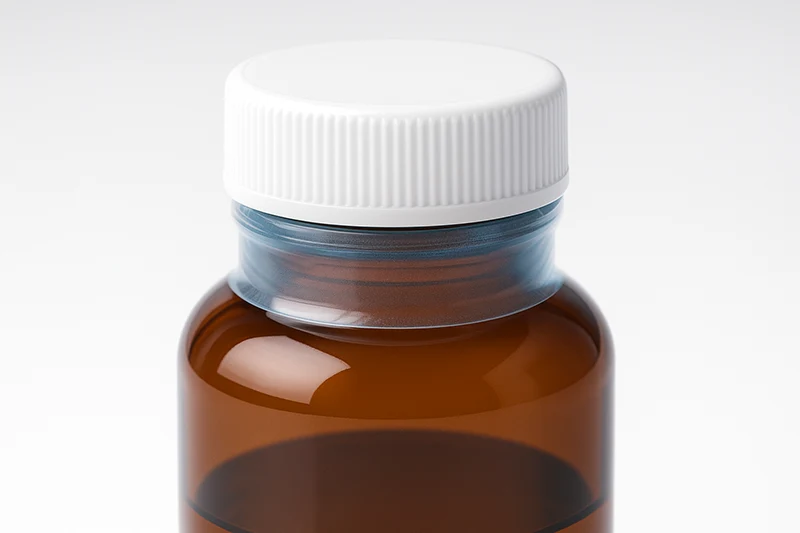
Shrink bands are thin plastic sleeves placed around the neck or cap of a bottle.
When heat is applied, the band shrinks tightly around the closure, forming a visible, tamper-evident barrier.
If someone tries to remove or open the cap, the band tears — showing immediate signs of tampering.
Key Benefits:
- Highly visible to consumers
- Inexpensive and easy to apply
- Suitable for a wide range of container shapes
Common Applications:
- Liquid medicines, cough syrups, vitamin bottles, and topical creams.
Shrink bands can also be printed with brand logos or safety messages such as “Do not use if seal is broken,” enhancing consumer awareness.
4. Film Wrappers and Tear-Off Strips

Film wrappers are transparent plastic films that completely cover a product or carton.
They often include tear-off strips that make it clear when the package has been opened for the first time.
Once torn, the wrapper cannot be reattached without leaving visible damage.
Key Benefits:
- Prevents dust, dirt, and moisture
- Shows clear evidence of tampering
- Cost-effective and suitable for secondary packaging
Common Applications:
- Medicine boxes, multi-pack cartons, and overwrapped blister packs.
Material Options:
- Polypropylene (BOPP), polyethylene, and biodegradable shrink films for eco-friendly designs.
Comparison Table — Four Tamper-Evident Packaging Types
| Type | Visible Evidence | Common Applications | Material | Cost Level |
|---|---|---|---|---|
| Blister Pack | Broken foil seal | Tablets and capsules | PVC + Aluminum | Medium |
| Induction Seal | Torn foil liner | Liquid medicines, capsule bottles | Foil + Polymer coating | High |
| Shrink Band | Broken plastic band | Syrups, vitamin bottles | PVC / PETG film | Low |
| Film Wrapper | Torn outer film or strip | Cartons, boxed medicines | BOPP / PE film | Low |
Additional Safety Features — Child-Resistant and Unit-Dose Packaging
Tamper-evident packaging is designed to protect consumers from intentional interference,
but pharmaceutical safety does not stop there.
To provide full protection, manufacturers often combine it with child-resistant and unit-dose systems.
These features serve different purposes, yet work together to make medicine packaging safer and more reliable.
1. Child-Resistant Packaging

Child-resistant packaging is not about tamper prevention.
Instead, it protects children from accidentally opening or swallowing medicines that could cause harm.
This concept became mandatory after multiple household poison incidents in the 1970s.
In the United States, the Poison Prevention Packaging Act (PPPA) under 16 CFR 1700 requires that many prescription and over-the-counter drugs be packaged in child-resistant containers.
These packages are designed so that adults can open them easily, while children cannot.
Common Mechanisms:
- Push-and-turn caps
- Squeeze-and-turn closures
- Locking snap lids or slide tabs
These designs make it physically challenging for a child to open the container, but they remain convenient for adult patients.
Example Combination:
A prescription bottle may use an induction seal (for tamper evidence) plus a push-and-turn cap (for child resistance).
This dual protection ensures that the product is safe from both external tampering and accidental ingestion.
2. Unit-Dose and Unit-of-Use Packaging

Unit-dose packaging means that each individual dose of a medicine is sealed separately.
This method ensures that the drug’s integrity remains intact until the exact moment of use.
Benefits of Unit-Dose Systems:
- Reduces contamination and dosing errors
- Improves traceability and recordkeeping in hospitals
- Simplifies medication dispensing for healthcare professionals
- Provides built-in tamper-evident protection
Typical Formats:
- Blister packs (one tablet per cavity)
- Pouch or sachet packs for powders or liquids
- Pre-filled syringes and inhalers
Unit-dose packaging also supports patient compliance by making it easier to track which doses have been taken.
For example, hospital staff can scan or record each package’s code to maintain safety and accountability.
How These Features Work with Tamper-Evident Systems
Child-resistant and unit-dose packaging are not substitutes for tamper-evident systems, they are complementary safety layers.
| Feature | Primary Purpose | How It Supports Tamper Protection | Typical Combination |
|---|---|---|---|
| Child-Resistant Packaging | Prevents accidental opening by children | Adds physical barrier to access | Induction seal + locking cap |
| Unit-Dose Packaging | Ensures integrity of each single dose | Provides visual proof of opening | Blister packs or sachets |
| Tamper-Evident Packaging | Shows visible signs of interference | Alerts consumers to potential tampering | Shrink band + film wrapper |
How These Packaging Types Work Together
No single packaging method can protect a medicine completely on its own.
Modern pharmaceutical packaging relies on multiple layers of safety, combining tamper-evident, child-resistant, and unit-dose systems.
Each layer plays a different role — and together, they form a unified shield that protects the medicine and the consumer.
1. The Layered Protection Concept
Think of medicine packaging like a multi-level defense system.
Each layer adds a different type of security and verification:
| Protection Layer | Function | Examples |
|---|---|---|
| Primary Layer | Directly protects the product inside | Blister cavity, foil seal, or induction liner |
| Secondary Layer | Protects the container and adds visual security | Shrink band, film wrapper, or locking cap |
| Tertiary Layer | Ensures traceability and transport safety | Tamper-evident carton seals, shipping box tape |
2. Example — The Tylenol Incident and Industry Reform
The 1982 Tylenol cyanide poisoning case changed the entire pharmaceutical industry. After several bottles of Extra-Strength Tylenol were found laced with cyanide, seven people died, and public confidence collapsed overnight.
In response, the FDA introduced strict tamper-evident packaging regulations (21 CFR 211.132). Manufacturers began combining induction seals, shrink bands, and film wrappers on the same bottle — so any attempt to open, reseal, or replace the contents would be immediately visible to consumers.
This event is now one of the main reasons multi-layer tamper protection is standard across all OTC medicines today. It also inspired new design principles used in food, beverage, and cosmetic packaging industries.
3. Typical Combination Systems
Most pharmaceutical packaging today uses dual or triple safety systems, balancing compliance, cost, and convenience.
Common Combinations:
- Induction Seal + Child-Resistant Cap: Used for liquid medications and prescription bottles.
- Blister Pack + Carton Film Wrapper: For solid oral tablets with outer packaging integrity.
- Shrink Band + Tamper-Evident Label: For large containers or supplements that require quick verification.
Each combination offers different benefits: visual proof, mechanical resistance, and contamination prevention.
The goal is always the same — to give patients visible confidence that their medicine has not been tampered with.
4. Why a Layered Approach Builds Trust
Consumers today expect visible safety cues before using any medical product. A sealed cap, an intact film, or a clean foil surface tells them the product is safe. When multiple layers are present, that reassurance becomes stronger.
For pharmaceutical brands, combining these systems is not only a regulatory requirement but also a trust-building strategy. It shows responsibility, transparency, and care — all essential to maintaining long-term brand credibility.
Choosing the Right Packaging for Compliance
Selecting the right packaging for a pharmaceutical product is not just about cost or appearance. It is a matter of compliance, functionality, and patient safety. Each type of medicine — whether tablet, liquid, or capsule — requires a specific packaging combination that meets regulatory standards while ensuring consumer confidence.
The key to compliance is understanding how tamper-evident, child-resistant, and unit-dose systems can work together. A thoughtful choice helps prevent contamination, improves shelf stability, and ensures your packaging meets FDA, EMA, and ISO expectations.
1. Factors to Consider Before Selecting a Packaging System
Before choosing a packaging design, pharmaceutical companies should evaluate:
- Drug Form and Sensitivity – Does the medicine require airtight protection or moisture resistance?
- Regulatory Region – Are you selling in the U.S., EU, or other markets with different standards?
- User Profile – Is the product meant for children, adults, or hospital use?
- Distribution Chain – How will the medicine be stored, shipped, and handled?
- Recycling and Sustainability Goals – Are the materials recyclable or eco-certified?
By balancing these factors, manufacturers can choose packaging that meets both compliance and consumer usability.
2. Recommended Packaging Combinations
The following table provides general guidance on which tamper-evident and safety features best suit each medicine type:
| Drug Form | Recommended Tamper-Evident System | Additional Safety Feature | Example Application |
|---|---|---|---|
| Tablets | Blister pack with aluminum foil seal | Unit-dose format for accurate dosing | Pain relievers, allergy medicine |
| Capsules | Induction seal with shrink band | Child-resistant locking cap | Vitamins, probiotics |
| Liquids / Syrups | Induction seal + heat-shrink neck band | Child-resistant cap with safety label | Cough syrups, antibiotics |
| Powders / Granules | Film wrapper with tamper strip | Resealable pouch or foil sachet | Oral rehydration salts, supplements |
| Injectables | Sealed glass vial with tamper ring | Sterile secondary carton with traceable label | Vaccines, hospital-use injections |
This chart is a starting point. Each pharmaceutical product should be tested under Good Manufacturing Practice (GMP) guidelines to verify that the packaging provides adequate protection under real-world conditions.
3. Why Compliance Matters
Failing to meet packaging regulations can lead to product recalls, fines, or loss of consumer trust. Regulatory agencies such as the FDA and EMA often inspect packaging facilities to ensure tamper-evident and child-resistant systems are properly implemented.
Compliance also demonstrates brand responsibility. When patients see a sealed cap or intact blister foil, they immediately recognize your brand’s commitment to safety. That trust can make a lasting difference in competitive healthcare markets.
4. Partnering with a Trusted Packaging Supplier
For many pharmaceutical brands, achieving compliance can feel complex.
That’s where a specialized packaging manufacturer can help.
A partner like UKPACK offers end-to-end services including:
- Material selection and barrier testing
- Regulatory-compliant packaging design
- Tamper-evident and child-resistant customization
- Rapid prototyping and production validation
With the right expertise, you can meet FDA and EMA standards without sacrificing design, usability, or cost efficiency.
Common Mistakes in Pharma Packaging Design
Even though the pharmaceutical industry operates under strict regulation, packaging errors still happen — and they can cost companies time, money, and credibility.
Understanding the most common mistakes helps manufacturers design packaging that’s not only compliant but also trusted by patients and regulators alike.
Below are some of the most frequent design pitfalls and how to avoid them.
1. Using the Wrong Materials
Choosing unsuitable materials is one of the biggest risks in packaging design.
Using plastics or foils that react with the product can lead to chemical contamination or moisture migration, shortening shelf life and compromising safety.
Examples of poor choices:
- Non-barrier plastics used for hygroscopic tablets
- Reactive adhesives or inks in contact with the drug
- Thin foil seals that tear too easily
Best practice:
Always test materials under Good Manufacturing Practice (GMP) and ISO 15378 standards to ensure compatibility, stability, and durability.
2. Ignoring Visible Tamper-Evident Features
Many brands design beautiful packaging but forget that safety must be immediately visible. If a consumer cannot clearly tell whether a package has been opened, the tamper-evident system has failed.
Typical issues:
- Weak shrink bands that can be removed intact
- Induction seals hidden under deep caps
- No “Do not use if seal is broken” label
Best practice:
Design packaging so that tampering leaves obvious evidence, even from a distance. Combine multiple visible indicators such as foil breaks, torn bands, or color-change stickers for extra assurance.
3. Misunderstanding Regulations
Some manufacturers assume that packaging standards are the same worldwide — they are not. The FDA, EMA, and WHO each have distinct requirements for tamper-evident and child-resistant systems.
Common misunderstandings:
- Treating child-resistant closures as tamper-evident (they serve different purposes)
- Ignoring serialization and traceability rules in the EU
- Failing to include required safety labeling
Best practice:
Study regional regulations such as FDA 21 CFR 211.132 and EU Directive 2011/62/EU. If exporting globally, adopt a packaging system that meets or exceeds the strictest standard among your target markets.
4. Overcomplicating the User Experience
A package that’s too hard to open can frustrate patients and lead to misuse. Child-resistant caps or seals that require excessive force may cause elderly users to spill or damage the medicine.
Typical design flaws:
- Extremely tight locking caps
- Multi-step opening mechanisms
- Poorly placed tear strips on film wrappers
Best practice:
Balance safety and usability. Conduct real-world usability tests with your target demographic — especially seniors or patients with limited dexterity — before mass production.
5. Ignoring Sustainability and Recycling Requirements
Sustainability is now part of compliance. Some countries, especially in the EU, have regulations encouraging recyclable or mono-material packaging. Ignoring these can lead to penalties or loss of brand reputation.
Examples:
- Mixed-material blisters that are hard to recycle
- PVC shrink bands instead of PETG or compostable alternatives
Best practice:
Choose eco-friendly materials like PP, PETG, or aluminum that maintain safety while reducing waste. Highlight your sustainable compliance on product labeling — it reinforces both responsibility and innovation.
Conclusion
Packaging is more than just a container — it’s a system of protection, efficiency, and communication. By understanding the three levels of packaging — primary, secondary, and tertiary — businesses can design smarter solutions that keep products safe, reduce costs, and strengthen brand trust.
- Primary packaging protects and communicates directly with the consumer.
- Secondary packaging organizes and markets products for retail and shipping.
- Tertiary packaging secures bulk shipments and streamlines global distribution.
When these three layers are coordinated, you gain more than protection: you unlock efficiency, sustainability, and long-term customer loyalty.
If you’re a brand owner, packaging engineer, or procurement manager, now is the time to rethink your packaging strategy. A well-designed packaging system can reduce waste, meet compliance, and give your products a competitive edge in the marketplace.
Need help choosing the right packaging for your business?
Contact us at UKPACK for custom solutions tailored to your product, industry, and sustainability goals.
FAQs About Tamper-Evident Packaging
Curious about how tamper-evident packaging actually works in the pharmaceutical industry?
Here are some of the most common questions brands and consumers ask — answered in clear, practical language.
1. What is tamper-evident packaging in pharmaceuticals?
Tamper-evident packaging is a design that makes it clear when a medicine has been opened or altered.
It helps consumers see visible signs of interference — such as broken seals, torn bands, or punctured foil — before using the product.
The goal is to ensure that every package a patient opens is authentic, safe, and untouched.
2. Why is tamper-evident packaging important for medicines?
It prevents contamination, counterfeiting, and accidental misuse.
By showing visible proof of tampering, it builds consumer trust and protects pharmaceutical companies from liability or recall risks.
In many regions, like the U.S. and EU, tamper-evident packaging is a legal requirement for over-the-counter drugs.
3. What types of tamper-evident packaging are commonly used in medicine?
The most common types include blister packs, induction seals, shrink bands, and film wrappers.
Each provides a different form of protection — from single-dose control to visible sealing around bottles or cartons.
Many manufacturers combine two or more systems for multi-layer protection.
4. How is tamper-evident packaging different from child-resistant packaging?
They serve different purposes.
Tamper-evident packaging alerts consumers to possible interference,
while child-resistant packaging prevents children from accidentally opening medicine containers.
Most pharmaceutical bottles use both systems together for full safety and compliance.
5. What are the regulatory standards for tamper-evident packaging?
In the United States, the FDA 21 CFR 211.132 rule defines tamper-evident packaging requirements for over-the-counter human drugs.
In Europe, the EMA’s Falsified Medicines Directive (2011/62/EU) requires safety seals and unique identifiers.
Globally, standards such as WHO GMP and ISO 15378:2017 ensure consistent manufacturing and traceability.