Cosmetic Jar Market Size, Trends, and Bulk Sourcing Guide (2026)

Founder of UKPACK, chief packaging engineer and designer with 18 years of experience, and Red Dot Award winner. I work on cosmetic packaging structure, material selection, mold feasibility, decoration processes, and leak-risk control, helping brands turn packaging ideas into reliable production-ready solutions. See my senior packaging engineer qualification.
- How Big Is the Global Cosmetic Jar Market?
- Plastic vs. Glass vs. PCR: Which Jar Materials Are Gaining Share?
- Cosmetic Jar Structures and Closure Types Growing Fastest
- What Does EU PPWR Require for Cosmetic Jars in 2026 vs. 2030?
- US Stock Distributors vs. China OEM Factories for Bulk Cosmetic Jars
- Common Cosmetic Jar Sourcing Mistakes
- Cosmetic Jar Procurement Checklist
- Final Selection Rule
- Frequently Asked Questions
- Sources & Regulatory References
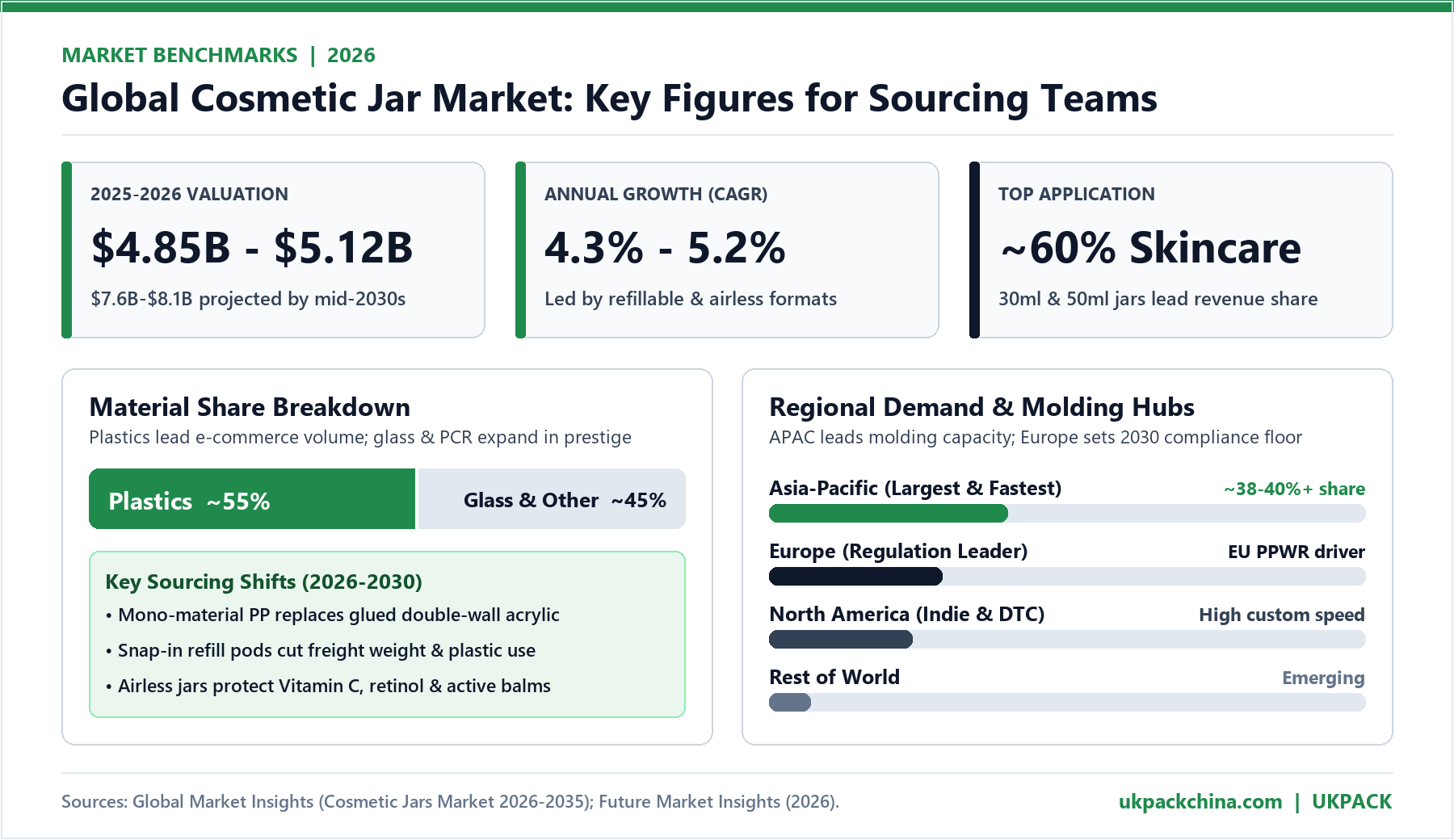
The global cosmetic jar market is valued at approximately $4.85 billion to $5.12 billion in 2025–2026 and is projected to grow at a 4.3%–5.2% CAGR, reaching $7.6 billion to $8.1 billion by the mid-2030s. Plastics (PP, PET, and acrylic) hold roughly 55% of volume, skincare accounts for ~60% of demand, and new skincare launches are moving rapidly toward refillable, mono-material, and airless jar systems.
Core Sourcing Rule: Formula chemistry sets your inner jar resin. Sales channel and 2030 EU recyclability rules set your outer jar structure.
Turning market data into a safe purchase order requires answering four practical questions. You need to know which resin survives active ingredients and parcel shipping, how closure design controls leakage, what EU PPWR requires in August 2026 versus January 2030, and when to shift from a stock distributor to a direct OEM factory.
Key Takeaways
- Market scale: Global cosmetic jar sales sit near $4.85B–$5.12B in 2025–2026, led by 30ml and 50ml skincare jars.
- Material reality: Plastics hold ~55% share for e-commerce weight savings; high-ratio PCR-PP carries a muted undertone that pairs best with mid-to-deep Pantone tones.
- EU PPWR timing: General duties (heavy metals <= 100 mg/kg, EU DoC, technical files, EPR framework) entered application August 12, 2026; binding Grades A–C (>= 70% recyclability) and minimum PCR rules take effect January 1, 2030.
- Sourcing threshold: Regional stock distributors fit small trials under 3,000 units; direct custom manufacturing at UKPACK starts at a 10,000-piece MOQ with 10–15 days for custom samples and 30–50 days for bulk runs.
How Big Is the Global Cosmetic Jar Market?
Market researchers publish slightly different valuations depending on scope. Some studies count only primary jar bodies, while others include custom closures, inner discs, and multi-pass decoration. Recent estimates from Global Market Insights place the baseline at $4.85 billion with a 5.2% CAGR through 2035. Future Market Insights tracks a $4.8B–$5.0B base growing at 4.3% CAGR, with plastics near 55% share and skincare near 60%.
| Market Dimension | 2025–2026 Industry Benchmark | What It Means for Sourcing Teams |
|---|---|---|
| Global Market Size | $4.85B – $5.12B (broader cosmetic packaging sits around $31B–$47B) | Steady baseline demand. Differentiation comes from functional structures and compliance readiness rather than generic white stock jars. |
| Projected Growth (CAGR) | 4.3% – 5.2% through the mid-2030s ($7.6B–$8.1B forecast) | Plan jar platforms for a 3–5 year lifecycle across the January 2030 EU recyclability cutoff. |
| Leading Material Share | Plastics ~55% (PP, PET, acrylic); glass expanding in prestige retail | Plastic controls e-commerce freight weight and breakage; glass serves heavy luxury positioning where parcel shipping is secondary. |
| Dominant Application | Skincare ~60% (face creams, eye creams, balms, masks); hair care & color make up the balance | Active creams (Vitamin C, retinol, acids, rich balms) demand tighter oxygen barriers and formula-compatibility validation. |
| Top-Selling Capacities | 30ml – 50ml lead revenue share; 5g–15g for eye/travel; 100g–200g for body scrubs & butters | 30ml and 50ml stock mold libraries are the deepest in the industry, reducing upfront tooling risk. |
| Regional Dynamics | APAC ~38%–40%+ (largest & fastest-growing); Europe sets eco-regulations; North America leads indie/DTC velocity | Design to European compliance specs early, and work with mature APAC molding clusters (such as Zhejiang, China) for tooling speed and unit economics. |
Three structural patterns show up repeatedly in incoming skincare packaging briefs:
- Volume concentrates around standard hero sizes. Most new facial skincare briefs start with a 30ml or 50ml primary jar, paired with a 15ml eye jar or 150g–200g body jar.
- Sales channel splits container specs. Brick-and-mortar prestige retail still favors thick-walled glass and heavy acrylic, while Amazon, TikTok Shop, and D2C fulfillment prioritize lightweight PP and shatter-resistant PET.
- Functional formats are replacing basic open jars. Established and scaling brands are shifting sensitive creams into refillable pods, mono-material PP structures, and finger-free airless jars instead of adding more generic open screw jars.
Global Packaging Groups vs. Specialized OEM Factories
Supply capacity in the cosmetic jar market splits into two tiers. Global packaging conglomerates (such as Berry Global, HCP Packaging, Albéa Group, Gerresheimer, and Quadpack) anchor multi-continent, high-volume contracts for multinational beauty groups.
Specialized OEM/ODM manufacturers in mature Asian molding hubs (including Zhejiang, China) serve growing DTC, indie, and mid-market brands. These factories give buyers direct packaging engineering access, faster custom sampling, manageable custom MOQs, and flexible decoration turnarounds without enterprise overhead.
Plastic vs. Glass vs. PCR: Which Jar Materials Are Gaining Share?
On the factory floor, jar material selection is a four-way trade-off between formula chemistry, shipping weight, shelf handfeel, and recyclability. A resin that looks impressive on a retail counter can still craze, warp, or eat up parcel-freight margin once production scales.
| Jar Material | Market Role | Key Advantages | Factory Reality & Trade-Offs | Best Skincare Fit |
|---|---|---|---|---|
| PP (Polypropylene) | Workhorse (~55% plastic core) | Strong chemical resistance against oils and acids; lightweight; supports mono-material single-stream recycling. | Semi-opaque/matte natural finish; lacks glass-like clarity unless paired with an outer shell. | Active creams, body scrubs, balms, mono-material eco lines, refill pods. |
| Double-Wall Acrylic (PMMA Outer + PP Inner) | Prestige plastic | Heavy, glass-like clarity and high-gloss presence without glass breakage in transit. | Permanently glued double-wall builds are difficult to separate for recycling; outer PMMA is sensitive to strong essential oils and alcohol. | Luxury facial creams where glass freight weight is prohibitive. |
| PET | Clear mid-tier | High clarity, shatterproof, widely recognized Resin #1 code, pairs cleanly with PP or aluminum lids. | Lower heat resistance (avoid hot-pour balms above ~50°C–55°C); limited barrier for oxygen-sensitive actives. | Body butters, hair masks, bath salts, transparent gel creams. |
| Glass | Luxury & clean beauty | Inert chemical barrier, heavy prestige handfeel, established glass recycling streams. | Heavy shipping weight inflates air/D2C freight; breakage risk requires costlier protective carton dividers. | High-margin prestige creams and essential-oil-heavy balms sold mainly in retail. |
| PCR-PP / PCR-PET | Compliance-driven eco tier | Reduces virgin resin use; supports retailer sustainability scorecards and 2030 EU PCR rules. | Higher PCR ratios (50%–100%) carry a grayish or warm base tint; batch-to-batch color tolerance is wider than virgin resin. | Clean beauty and EU-bound brands preparing early for 2030 PCR mandates. |
Use this material matrix as a sourcing starting point, not a substitute for 4 to 12 week formula compatibility and thermal stability testing.
Engineering Note on PCR Color Matching: Pure snow-white brightness is unrealistic in 100% PCR-PP because recycled resin carries a natural undertone. For high PCR ratios, specify mid-to-deep Pantone shades, earthy tones, or an opaque coating. This controls visible tint variance across production lots while adding UV shielding for light-sensitive actives.
Buyers comparing glass cosmetic jars against PP often underestimate total landed cost. Amber and acid-etched frosted glass demand higher furnace energy, secondary frosting passes, thicker corrugated dividers, and more air or parcel freight weight than injection-molded PP. Unless a product sells mainly in high-margin retail stores, heavy glass frequently compresses unit margins on D2C orders.
When comparing stock structures across PP, PET, acrylic, and airless formats before locking a BOM, review UKPACK's custom cosmetic jars from 5g sample pots to 200g body jars. You can also check our breakdown of types of cosmetic jars by neck and wall structure.
Cosmetic Jar Structures and Closure Types Growing Fastest
Resin selection alone does not determine shelf performance or transit survival. Across export orders to North America, Europe, and Australia, five structural and closure decisions account for most custom development briefs.
Refillable Inner-Pod Jars
Refillable cosmetic jars separate lasting shelf weight from single-use plastic. The customer keeps a heavy outer shell (acrylic, PETG, glass, or thick-walled PP) and snaps in a lightweight recyclable PP refill pod. Refill cups lower freight weight on repeat orders and encourage buyers to purchase refills directly from the original brand.
In UKPACK's Clae 50ml refillable airless jar project (built on the UKC42A platform), a compact matte-brown housing paired with a swappable PP inner cartridge helped protect a rich tallow balm from daily air exposure. UKPACK has also delivered snap-in refillable jar formats for brands such as The Beauty Crop, balancing repeat shelf presence with lower per-refill resin weight.
Airless Jars Replacing Open Cream Jars
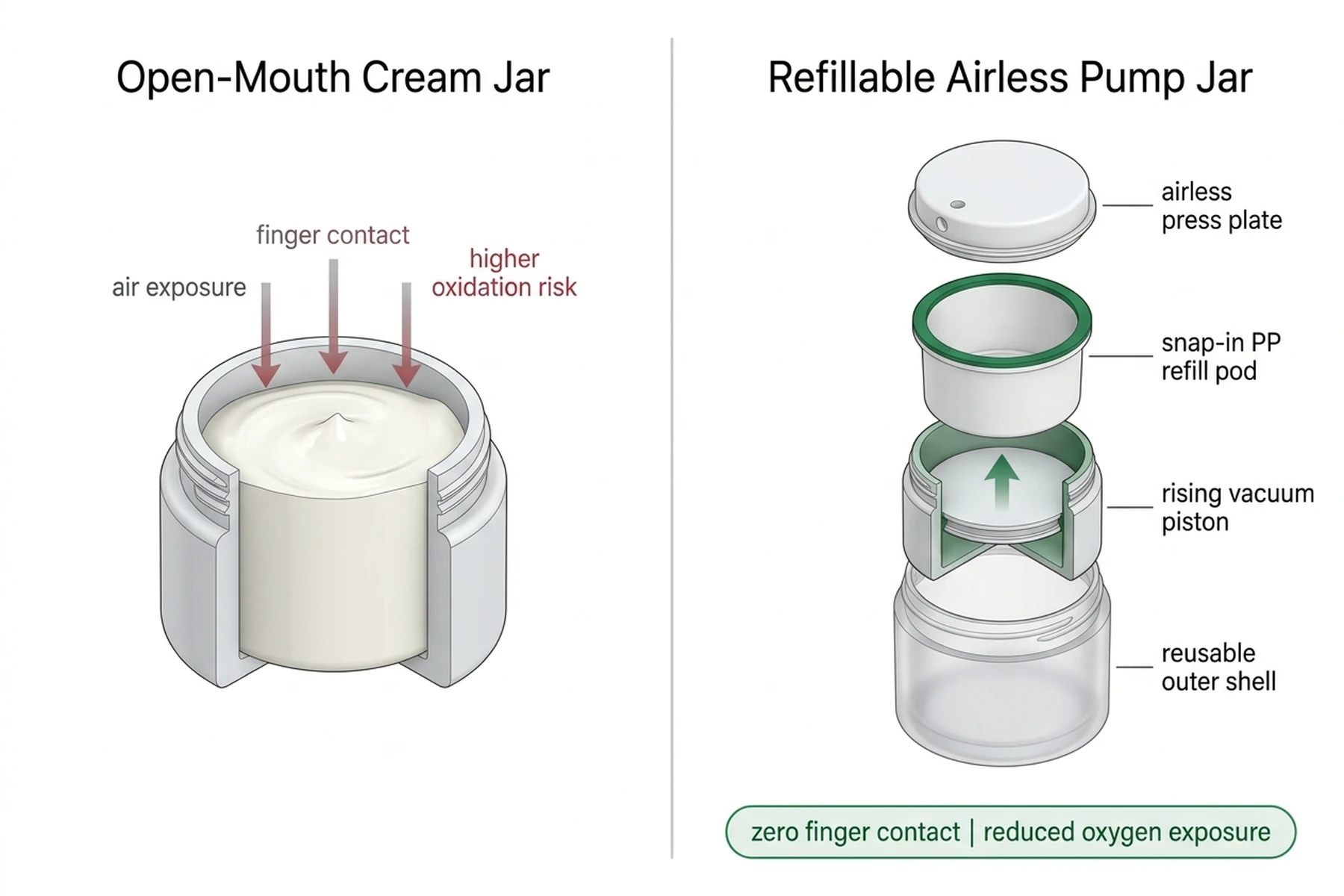
Open-mouth cream jars expose the entire top surface of a formula to oxygen and skin bacteria on every use. For Vitamin C, retinol, peptides, and low-preservative clean beauty creams, repeated opening accelerates oxidation and color shift long before the jar runs out.
Airless cosmetic jars (including 15ml, 30ml, and 50ml UKC42 / UKC42C / UKA74 designs) operate much like a wide-bore syringe turned upside down. Each press on the top dispensing plate creates vacuum suction that pulls an internal piston upward from the base. This design keeps fingers out of the cream, reduces daily air exposure, and leaves less wasted product stuck to the jar shoulders. For a mechanical walkthrough of piston sealing and priming, see our guide on what an airless jar is and how it works.
High-Viscosity Filling Note: Thick balms and heavy creams (such as tallow or anhydrous butter) require extra attention in airless jars. Validate bottom-fill versus top-fill line compatibility, degassing to prevent trapped air pockets, and piston-priming resistance with filled samples before approving bulk orders.
Drop-Resistant PP Jars and Stock-Mold Customization
D2C and marketplace fulfillment expose jars to repeated parcel drops and vibration. Brands shipping high e-commerce volume increasingly pair shatter-resistant PP cream jars with Pantone color injection, silk-screen printing, hot stamping, spray frosting, and electroplating to deliver crisp retail aesthetics without glass breakage rates.
Opening a proprietary multi-component mold (base, inner cup, cap, and sealing disc or airless engine) adds substantial upfront tooling cost, plus T1/T2 mold trial cycles and tolerance debugging. In relative unit economics, single-wall PP sits at the lowest tier, followed by clear PET, double-wall acrylic, and finally multi-part refillable airless jars. Most scaling skincare brands launch on existing 30ml and 50ml stock molds with custom finishes first, then invest in private tooling only after retail sell-through confirms repeat volume.
Screw Caps, Inner Discs, and Airless Press Plates
Closure engineering controls leak rates and automated capping stability just as much as jar wall resin:
- Continuous-thread screw caps with PE foam or induction liners: Standard across wide-mouth cosmetic cream jars for moisturizers, masks, and body scrubs. Match liner composition directly to oil and essential-oil load.
- Pull-tab inner dust discs (shives): Prevent viscous creams from smearing into cap threads during transit and protect clean first-open presentation.
- Airless press plates: Replace screw-off lids on sensitive active formulas, isolating cream beneath a sealed dispensing top for metered one-press use.
Validate Structure Before Tooling: Comparing a standard PP cream jar, double-wall acrylic jar, or refillable airless jar against formula viscosity and landed cost? Use UKPACK's 3F Services (Free Design, Free Mockup, and Free Visual Rendering) to review geometry and mold feasibility before committing to tooling.
What Does EU PPWR Require for Cosmetic Jars in 2026 vs. 2030?
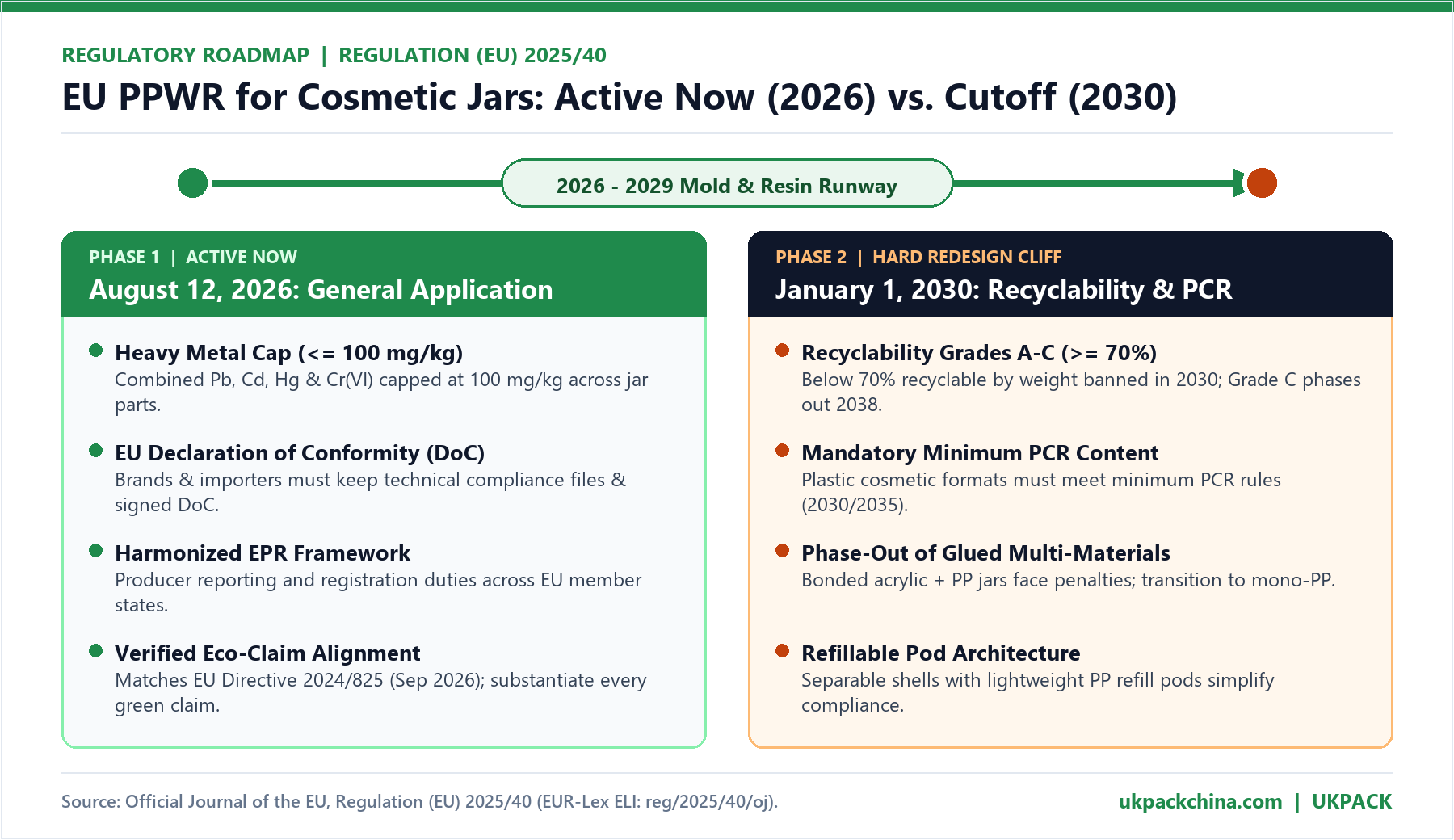
The EU Packaging and Packaging Waste Regulation (PPWR), Regulation (EU) 2025/40, entered general application on August 12, 2026. Separating legal duties active right now from the January 1, 2030 redesign cutoff prevents rushed packaging changes while keeping European shipments compliant. For a clause-by-clause walkthrough, see our EU PPWR cosmetic packaging guide.
| Compliance Milestone | Effective Date | What Applies to Cosmetic Jars | Action Required for Brands & Importers |
|---|---|---|---|
| Phase 1: PPWR General Application | August 12, 2026 (Active Now) | Heavy metal cap (combined lead, cadmium, mercury, hexavalent chromium <= 100 mg/kg); substance restrictions; mandatory EU Declaration of Conformity (DoC) and technical documentation; EPR compliance framework. (EU anti-greenwashing rules under Directive (EU) 2024/825 also apply from September 27, 2026.) | Collect material declarations, heavy-metal compliance files, and DoC support from your jar manufacturer; remove unsubstantiated "eco-friendly" or "100% recyclable" label claims. |
| Phase 2: Recyclability Grades & PCR Cutoff | January 1, 2030 (Hard Cutoff) | Binding Recyclability Performance Grades A–C (Grade A >= 95%, Grade B >= 80%, Grade C >= 70% recyclable by weight; packaging below 70% cannot be placed on the EU market, and Grade C phases out in 2038); mandatory minimum PCR content thresholds for plastic formats (scaling higher in 2035/2040). | Use 2026–2029 to transition glued multi-material jars into sustainable cosmetic packaging builds such as mono-material PP or separable refillable pods, and qualify vetted PCR resin sources. |
Outside PPWR, skincare brands shipping to North America and Europe need primary packaging backed by standard safety and audit documentation:
- United States: Primary labeling aligned with the FDA Cosmetics Labeling Guide and 21 CFR Part 701 (product identity, net weight, ingredient declaration, and tamper-resistant rules where applicable), plus MoCRA Section 609 domestic address, phone, or electronic contact details for adverse event reporting.
- European Union: Regulation (EC) No 1223/2009 (cosmetic product safety files), REACH (Regulation (EC) No 1907/2006) chemical compliance, and heavy-metal limits.
- Retailer & Factory Audits: Major beauty retailers routinely request ISO 9001:2015 quality management certification and amfori BSCI social compliance audits. UKPACK publishes current audit documentation on its company certificates page.
US Stock Distributors vs. China OEM Factories for Bulk Cosmetic Jars
Selecting the right supply tier depends on SKU volume, decoration scope, and landed unit cost. Brands buying empty cosmetic jars in bulk typically compare regional stock distributors against direct China OEM manufacturers.
| Sourcing Factor | Regional Stock Distributors (US / EU) | Direct OEM Manufacturer (UKPACK, China) |
|---|---|---|
| Order Volume Fit | Test runs and small launches under 3,000 pcs per SKU | Commercial custom production starting at 10,000 pcs MOQ per SKU |
| Customization Scope | Blank white, clear, or amber stock jars plus stick-on labels | Custom Pantone injection colors, silk-screen, hot stamping, frosting, electroplating, PCR ratios, and refillable or airless structures |
| Landed Unit Cost | Higher unit price due to distributor warehousing and reseller margin; no import freight setup | Lower factory-direct ex-works unit cost; budget separately for ocean/air freight, import tariffs, and FOB vs. DDP trade terms |
| Turnaround Time | 3–7 days domestic dispatch for unprinted stock | 10–15 days custom sampling; 30–50 days bulk manufacturing (plus transit) |
| Best Brand Stage | Early lab trials, pop-up launches, or emergency stock bridge | Scaling DTC brands, retail rollouts, and contract fillers locking consistent batch quality |
Use this sourcing split as a baseline, then compare full landed quotes (ex-works price, freight, tariffs, breakage, and label labor) at your exact annual SKU volume.
Bridging the 3,000–9,999 unit gap: Brands sitting between distributor volumes and a 10,000-piece custom run usually skip custom Pantone resin on the first order. Instead, they run neutral stock-color molds with high-grade wrap labels, or consolidate multiple shade SKUs onto one shared jar body and cap color to reach the 10,000-piece molding threshold cleanly.
Pre-Shipment QC and Compatibility Tests
Visual inspection of a single desk sample never catches production-line failures. Consistent jar quality depends on three control stages inside UKPACK's cosmetic packaging manufacturing workflow. Incoming checks verify resin and masterbatch lots, in-process checks track wall thickness, weight, thread dimensions, flow lines, and color tolerance (Delta-E), and final AQL functional tests qualify jars for automated filling:
- Airtightness & Vacuum Sealing Test: Verifies that inner sealing discs, screw threads, and airless pistons hold seal integrity under air-freight pressure changes without oil weeping or leakage.
- Cap Torque Limit Test: Confirms closures tighten consistently on high-speed capping heads so caps resist transit back-off while remaining easy for consumers to open.
- Decoration Durability Test (Alcohol Rub & Tape Adhesion): Checks silk-screen ink, hot stamping, and spray coatings against oily hands, fragrance solvents, and carton abrasion.
- Drop & Impact Resistance Test: Evaluates filled jars for base cracking, cap pop-off, or shoulder fractures during D2C parcel shipping.
- Dispensing & Pump Cycle Life Test (Airless Jars): Tests vacuum priming, stroke resistance, dosage consistency, and evacuation rate across the jar's life cycle.
- Formula & Thermal Compatibility Testing (Brand Lab + Supplier): Fill production-material blank jars with the actual cream or balm and run accelerated thermal stability checks (typically 4 to 12 weeks) before approving mass production, especially for essential-oil, acidic, or SPF formulas.
Test With Your Formula First: Planning a 10,000+ unit skincare launch? Request UKPACK pre-production test samples so your formulation lab can validate compatibility, torque, alcohol-rub durability, and drop performance before mass production.
Common Cosmetic Jar Sourcing Mistakes
Most bulk packaging delays and product recalls come from four avoidable specification gaps during RFQ and sampling.
Treating Glued Double-Wall Acrylic as 2030 EU Compliant
Permanently bonded PMMA-over-PP jars look thick and luxurious on shelf, yet sorting facilities cannot easily separate the two resins. If your SKU targets European retail over a three-to-five-year lifecycle, specify a separable refillable pod or mono-material PP build now so you avoid forced re-tooling before January 1, 2030.
Judging High-Ratio PCR Colors on a Computer Screen
Digital Pantone swatches never show how recycled PP resin shifts light tones toward gray or warm beige. Always approve physical color chips molded in your exact target PCR percentage and lock an agreed Delta-E batch tolerance before mass injection begins.
Ordering Airless Jars Without Filled Viscosity Trials
An airless jar that primes smoothly with a light gel lotion can stall or trap air pockets when filled with anhydrous tallow balm or dense body butter. Run filled trials on your contract filler's exact dosing nozzle (bottom-fill versus top-fill) and test vacuum priming after shipping vibration before signing off on bulk production.
Comparing Ex-Works Unit Prices Without Landed Total Cost
A low ex-works factory quote on heavy frosted glass or thin-walled stock plastic hides downstream expenses. Model ocean or air freight, import tariffs (FOB vs. DDP), corrugated divider cartons, D2C breakage claims, and filling-line reject rates before selecting a supplier.
Cosmetic Jar Procurement Checklist
Before issuing a deposit or opening a sample order, confirm every technical item in this procurement evidence table:
| Buyer Question | Evidence to Request Before Ordering |
|---|---|
| Is the resin safe for my formula pH, oils, and fill temperature? | Resin grade datasheet (PP, PET, PMMA, glass), hot-pour heat limit (especially for PET above ~50°C–55°C), and blank production-resin jars for 4–12 week lab compatibility tests. |
| Will this jar pass 2026 and 2030 EU PPWR rules? | Heavy-metal test documentation (<= 100 mg/kg combined limit), EU PPWR Declaration of Conformity (DoC) support, component separation structure for Grades A–C (>= 70%), and verified PCR source paperwork. |
| How will custom color and artwork hold up across repeat batches? | Physical Pantone color chips molded in the target resin (including PCR ratio), agreed Delta-E range, and alcohol-rub plus tape-adhesion test results on decorated samples. |
| Will the closure survive air freight and automated capping? | Vacuum-sealing test protocol, recommended cap torque range, liner material spec matched to formula oils, and dust-disc fit confirmation. |
| Are factory audits and certifications current? | Valid ISO 9001:2015 and amfori BSCI certificates, REACH and Regulation (EC) No 1223/2009 material compliance files, plus AQL inspection standards. |
| What is the full landed cost and schedule to my filler? | Written MOQ per SKU (standard 10,000 pcs for custom OEM), custom sampling window (10–15 days), bulk lead time (30–50 days), tooling terms if custom, and itemized FOB vs. DDP freight and tariff estimates. |
Avoid RFQs that ask only for a "50ml luxury skincare jar price." Sharing capacity, viscosity, decoration method, target market, and trade terms up front lets factories return accurate mold options and comparable quotes on the first round.
Final Selection Rule
Specify cosmetic jars as a formula-closure-compliance system, not a catalog container. In a $5 billion cosmetic jar market, the brands that protect both unit margins and European retail eligibility align PP, refillable pod, or airless structures with 2030 EU PPWR Grades A–C (>= 70%) and disciplined pre-production validation before placing bulk orders.
If you are planning a custom skincare jar line of 10,000+ units, review UKPACK's client packaging case studies to compare production formats. Then reach out through cosmetic packaging design services with your target capacity, formula viscosity, decoration direction, target market (US/EU), and launch window to confirm sample fees, courier options, and 3D structure review.
Frequently Asked Questions
How big is the global cosmetic jar market in 2026?
The global cosmetic jar market is valued at roughly $4.85 billion to $5.12 billion in 2025–2026, depending on whether custom closures and secondary decoration are included. Industry forecasts project steady 4.3% to 5.2% CAGR, bringing total valuation to $7.6 billion–$8.1 billion by the mid-2030s.
Which material holds the largest share of the cosmetic jar market?
Plastics (led by PP, PET, and acrylic) hold approximately 55% of global cosmetic jar share because they balance shatter resistance, lower shipping weight for e-commerce, and flexible customization. Glass remains strong in prestige retail skincare, while PCR-PP and mono-material PP designs represent the fastest-growing sustainable alternatives.
Did EU PPWR ban non-recyclable cosmetic jars in August 2026?
No. EU PPWR (Regulation (EU) 2025/40) entered general application on August 12, 2026, activating heavy-metal limits (<= 100 mg/kg), EU Declarations of Conformity, technical documentation, and EPR rules. The binding Recyclability Performance Grades A–C (>= 70% recyclable by weight) and mandatory minimum PCR percentages take legal effect on January 1, 2030.
Why are skincare brands switching from open cream jars to airless jars?
Open-mouth cream jars expose formulas to air and finger bacteria on every use, accelerating oxidation in active ingredients like Vitamin C, retinol, and natural balms. Airless cosmetic jars dispense measured doses via an internal vacuum piston without finger contact, supporting cleaner dispensing and helping reduce daily air exposure and leftover waste.
What is the typical MOQ and lead time for custom cosmetic jars from an OEM factory?
For customized cosmetic jars featuring custom Pantone color-matching and printing or surface finishes, UKPACK's standard MOQ is 10,000 pieces per SKU. Custom sampling typically takes 10 to 15 days, and custom bulk manufacturing requires 30 to 50 days depending on structural complexity and decoration processes.
Should skincare brands buy empty cosmetic jars from a US distributor or an OEM factory?
Buy from a regional US or EU stock distributor when you need fewer than 3,000 blank stock jars quickly for small test runs. Switch to a direct OEM manufacturer like UKPACK once volumes reach 10,000 pieces per SKU and you need custom Pantone colors, direct decoration, refillable or airless structures, and lower ex-works unit costs.
Sources & Regulatory References
- Global Market Insights – Cosmetic Jars Market Size & Forecast (2026–2035)
- Future Market Insights – Cosmetic Jars Market Share & Growth Analysis
- Official Journal of the EU – Regulation (EU) 2025/40 on Packaging and Packaging Waste (PPWR)
- Official Journal of the EU – Regulation (EC) No 1223/2009 on Cosmetic Products
- Official Journal of the EU – REACH Regulation (EC) No 1907/2006
- U.S. FDA – Cosmetics Labeling Guide
- eCFR – Title 21, Part 701: Cosmetic Labeling