Cosmetic Packaging Materials: Types & How to Choose

Founder of UKPACK, chief packaging engineer and designer with 18 years of experience, and Red Dot Award winner. I work on cosmetic packaging structure, material selection, mold feasibility, decoration processes, and leak-risk control, helping brands turn packaging ideas into reliable production-ready solutions. See my senior packaging engineer qualification.

Cosmetic packaging materials fall into a few families: clear and semi-clear plastics like PET, PETG, AS, and acrylic; opaque workhorses like PP and PE; decorative and structural resins like ABS; metals like aluminum; glass; natural outer materials like bamboo and wood; and the sustainable variants built on top of them, including PCR (post-consumer recycled) plastic and biobased resins. The right choice is rarely about the material alone. It is about how that material behaves once your formula is inside it, how it survives decoration and shipping, and whether it fits your recycling story and your filling line. This guide explains each material, where it works, where it fails, and how to match it to a project.
What Counts as a “Cosmetic Packaging Material”?
It helps to separate three layers before comparing resins.
- Primary packaging touches the formula directly: the bottle, jar, tube, closure, pump, dropper, or airless piston. This is where material choice matters most, because the material and the formula sit in contact for months.
- Secondary packaging is the carton, sleeve, or box.
- Tertiary packaging is the shipper and transit protection.
This guide focuses on primary packaging materials, because that is where most sourcing mistakes happen. A carton can be swapped late in a project. A bottle material that reacts with your fragrance or actives cannot.
The Main Cosmetic Packaging Materials at a Glance
Use this as a starting map, then read the material sections for the tradeoffs behind each row.
| Material | Look | Common formats | Formula fit (general) | Decoration | Recyclability signal | Relative cost |
|---|---|---|---|---|---|---|
| PP | Opaque/translucent, matte-friendly | Jars, caps, pumps, deodorant, tubes | Very broad, chemical resistant | Print, label, needs surface prep | RIC 5, increasingly accepted | Low |
| PE (HDPE/LDPE) | Opaque, soft to rigid | Lotion bottles, tottles, tubes, bulbs | Broad, good moisture barrier | Print, label | RIC 2 / RIC 4 | Low |
| PET | High clarity, glass-like | Bottles, jars | Broad, good for water-based | Print, label, shrink | RIC 1, widely accepted | Low to medium |
| PETG / PCTG | High clarity, thick-wall feel | Droppers, lip gloss tubes, jars | Broad, holds clarity | Print, hot stamp, coat | Varies locally | Medium |
| AS / SAN | Glass-like, rigid | Jars, caps, overcaps | Better for low-reactivity | Print, coat | Limited curbside | Medium |
| ABS | Opaque, tough | Caps, closures, compacts | Outer/decorative, not direct contact | Excellent for metallizing | Limited curbside | Medium |
| Acrylic (PMMA) | Premium thick wall, deep gloss | Cream jars, compacts, caps | Best as outer wall | Spray, electroplate, print | Rarely curbside | Medium to high |
| Aluminum | Metallic, opaque | Tubes, deodorant, sticks, bottles | Good with internal lacquer | Print, anodize, emboss | Widely recyclable | Medium to high |
| Glass | Premium, inert | Serum, dropper, fragrance bottles | Excellent, chemically inert | Print, frost, coat | Widely recyclable | High (weight, breakage) |
| Bamboo / Wood | Natural, warm | Caps, sleeves, overshells | Outer layer only, not a barrier | Laser, print, hot stamp | Depends on construction | Medium to high |
| PCR | Off-white or variable | Same as base resin | Same as base resin | Print, label (color varies) | Depends on base resin | Medium |
| Biobased | Varies by resin | Selected formats | Verify per resin | Verify | Claim-dependent | Medium to high |
Types of Cosmetic Packaging Materials
Below is each material in the order a sourcing team usually meets it, from the everyday plastics to metals, natural materials, and recycled options. For each one, the point is not just what it is, but where it fits and where it fails.
PP (Polypropylene)
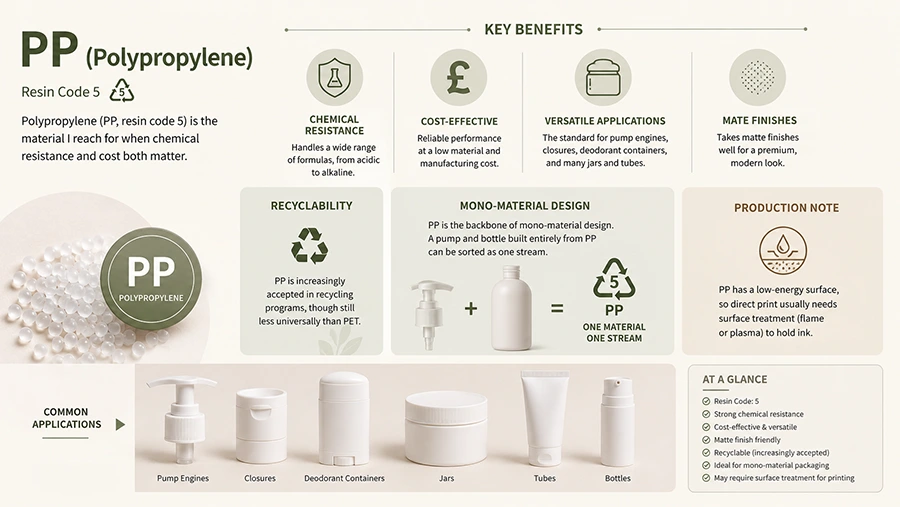
Polypropylene (PP, resin code 5) is the material I reach for when chemical resistance and cost both matter. It handles a wide range of formulas, takes matte finishes well, and is the standard for pump engines, closures, deodorant containers, and many jars and tubes. PP is increasingly accepted in recycling programs, though still less universally than PET. It is also the backbone of mono-material design, because a pump and bottle built entirely from PP can be sorted as one stream. UKPACK’s mono-material lotion pumps (24/410 and 28/410) and mono PP airless bottles in the 5 ml to 200 ml range exist for exactly this reason. The one production note: PP has a low-energy surface, so direct print usually needs surface treatment (flame or plasma) to hold ink.
PE (Polyethylene)
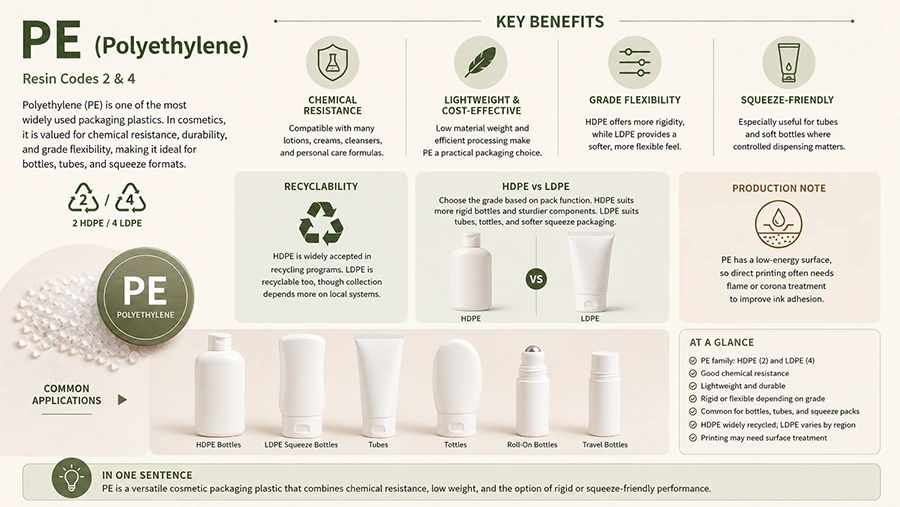
Polyethylene comes in two forms you will see constantly. HDPE (high-density polyethylene, resin code 2) is opaque, tough, and chemically resistant, the classic choice for lotion bottles, shampoo bottles, and tottle bottles. LDPE (resin code 4) is soft and squeezable, used for tubes and for dropper bulbs. PE has an excellent moisture barrier and low cost, but poor clarity and a lower-end surface feel, so it is chosen for function rather than for a premium clear look.
PET (Polyethylene Terephthalate)
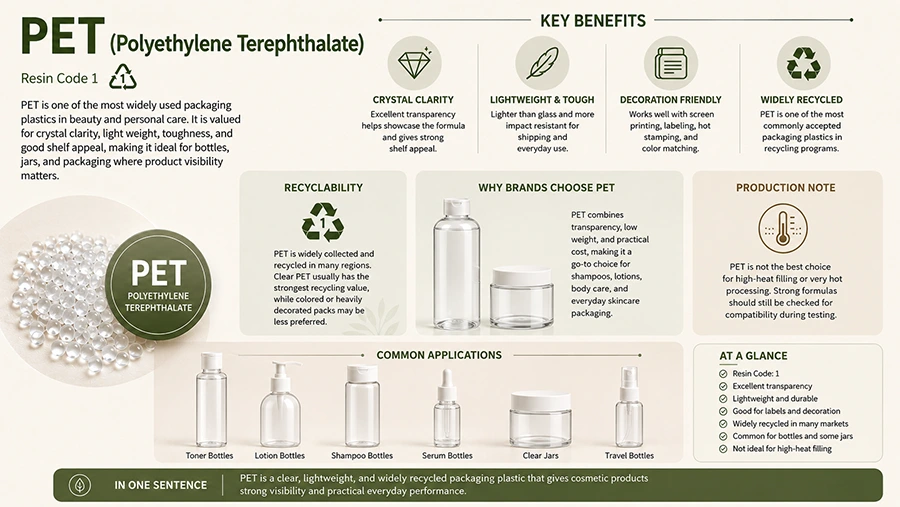
PET gives glass-like clarity at a fraction of the weight, and it carries resin identification code 1, one of the two plastics most widely accepted in curbside recycling. It has a good barrier for water-based products and suits toners, mists, serums in bottles, and many liquid formulas. It is one of the most recycling-friendly and cost-effective clear plastics, which is why it is so common in cosmetic bottles.
PETG and PCTG (Copolyesters)
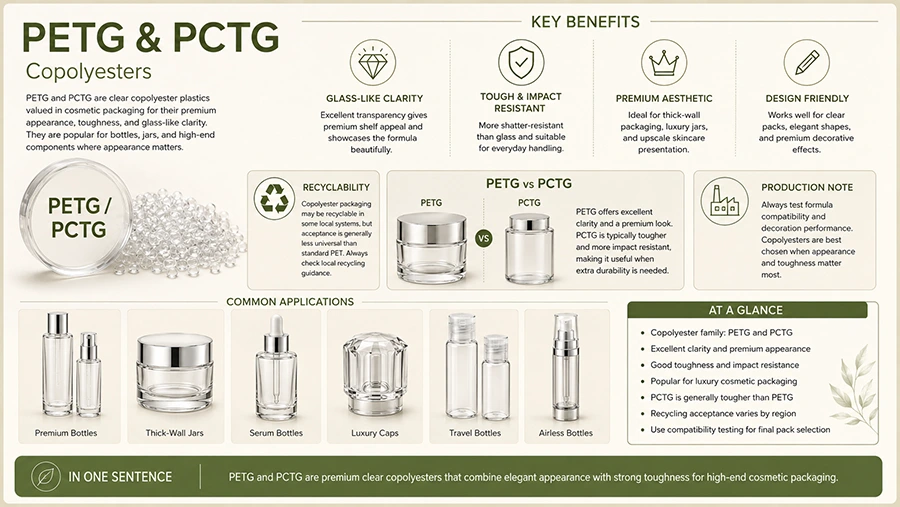
PETG is the modified cousin of PET. It holds clarity in thicker walls and complex shapes and adds impact resistance, which is why it dominates high-clarity dropper bottles and lip gloss tubes. PCTG and PCTA are related copolyesters with even better clarity and chemical resistance. In my experience, PETG is the safe default when a brand wants a “glass look” in plastic without the breakage risk. UKPACK uses high-clarity PETG for lip gloss tubes and for fresh-keeping refillable airless bottles in 30 ml and 50 ml, precisely because the clarity holds up through molding and use.
One caution worth stating plainly: a resin code is an identification symbol, not a promise of recyclability. As the reference on the resin identification code makes clear, the number tells sorters what the resin is; it does not guarantee your local stream will accept the finished pack, especially once decoration and multiple components are added.
PMMA (Acrylic)
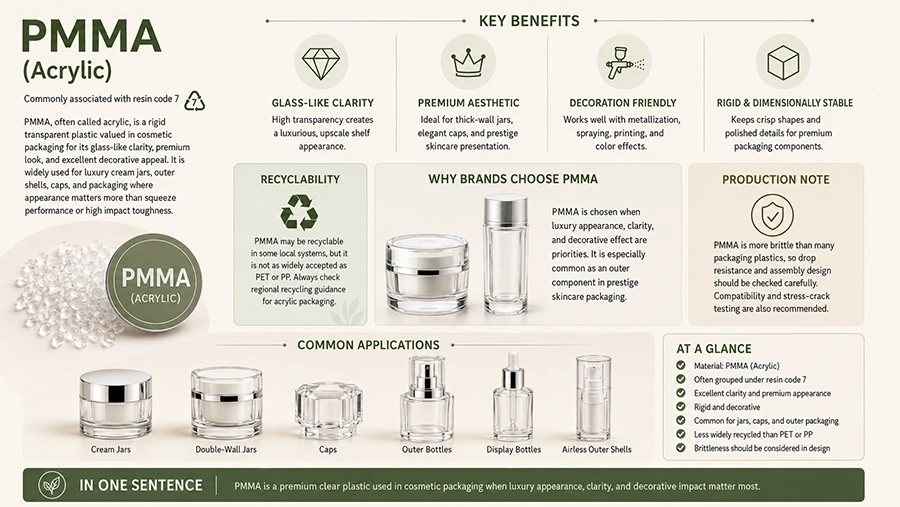
Acrylic is chosen for shelf presence: deep, glossy, heavy-feeling walls that read as luxury, especially in cream jars, compacts, and caps. The tradeoff is honest to name. Acrylic is prized for the outer wall and premium hand feel, not for direct contact with aggressive or high-fragrance formulas, and it is rarely accepted in curbside recycling. A common, smart structure is a thick acrylic outer jar with a PP inner cup: the shopper sees premium acrylic, the formula sits against compatible PP.
AS / SAN (Styrene Acrylonitrile)
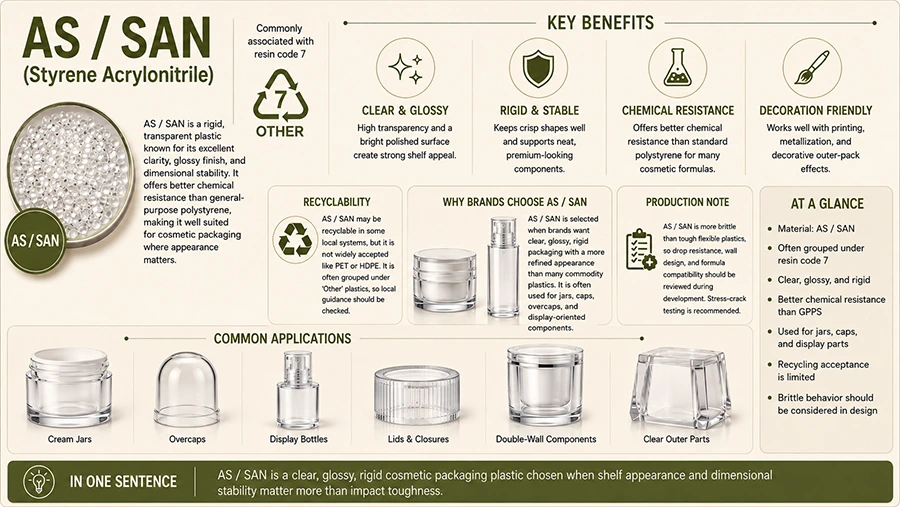
AS, also written SAN, offers glass-like clarity and high rigidity with better chemical and heat resistance than plain polystyrene. It is common for jars, caps, and overcaps, and for clear components where a hard, bright, transparent look is wanted. Like acrylic, it is a display material more than a broad direct-contact material, and it is limited in curbside recycling.
ABS (Acrylonitrile Butadiene Styrene)
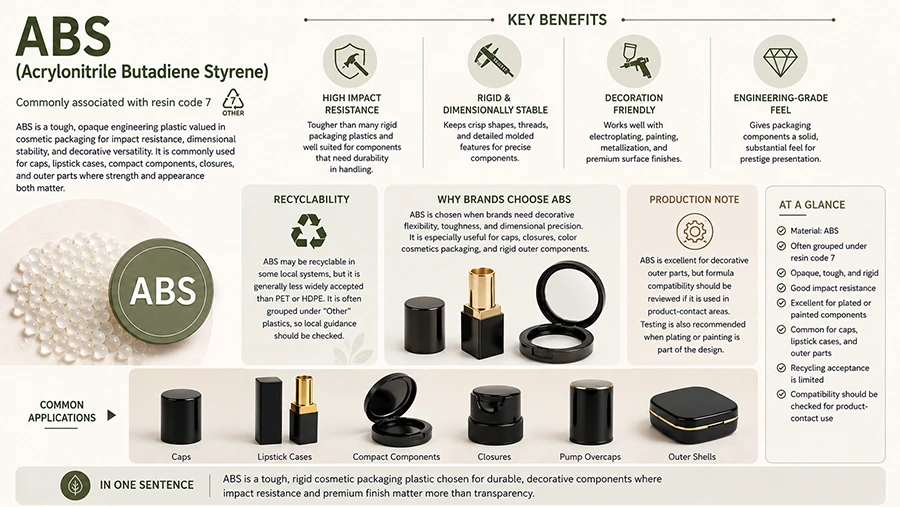
ABS is a tough, opaque engineering plastic with an excellent surface for decoration. It is the go-to base for caps, closures, compacts, and decorative components that will be metallized or electroplated, because it holds a smooth, high-quality plated finish. ABS is a structural and decorative material, not a direct formula-contact material, so it usually appears as the outer or mechanical part of a pack.
Aluminum
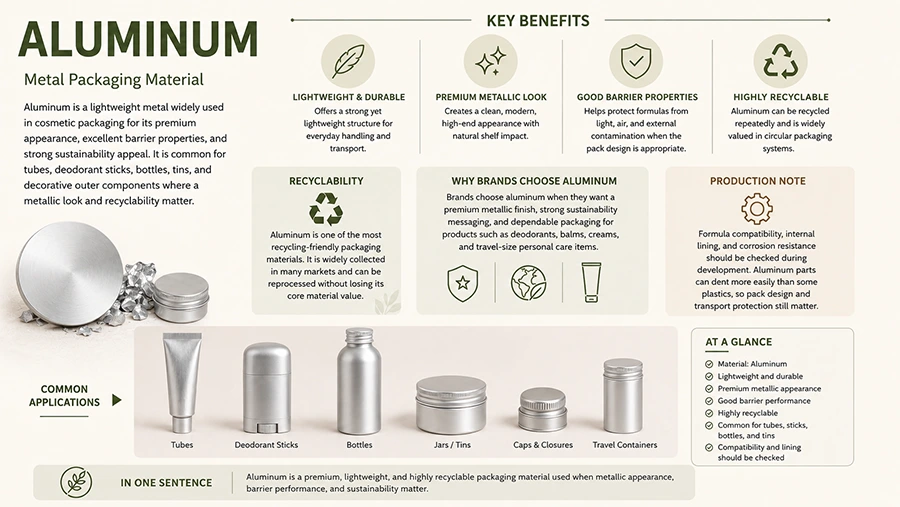
Aluminum is light, fully opaque (useful for light-sensitive formulas), and widely recyclable. For cosmetics it almost always needs an internal lacquer or liner so the metal does not contact the formula directly, and the surface can dent, so cap fit and wall gauge need checking. It is common for tubes, deodorant containers, sunscreen sticks, and some bottles, and it takes anodizing and embossing for a premium metallic finish.
Glass is chemically inert, which makes it the reference standard for fragrance, high-active serums, and essential-oil-heavy formulas that can attack some plastics. It is widely recyclable and reads as premium. The costs are literal: weight (which raises shipping footprint), breakage risk on the filling line and in transit, and a higher unit price. For many brands, glass is used on the hero serum or fragrance and paired with plastic elsewhere in the range.
Glass
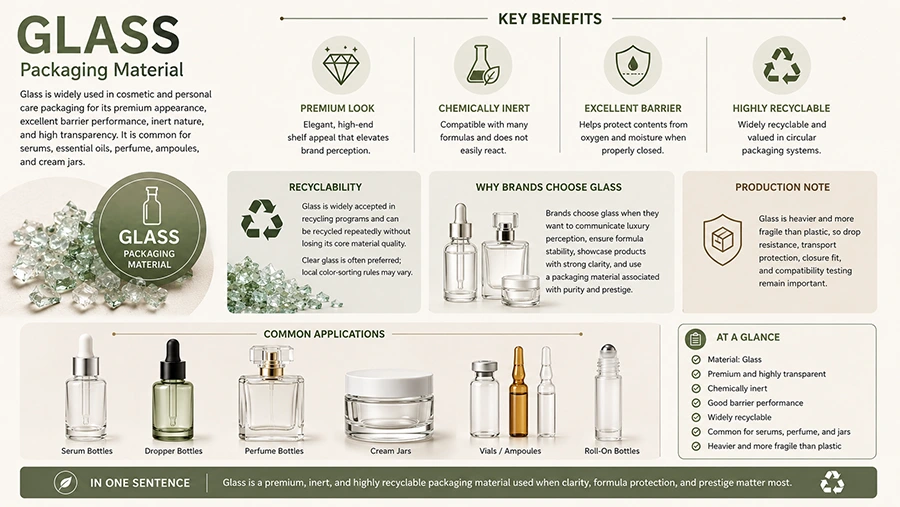
Glass is chemically inert, which makes it the reference standard for fragrance, high-active serums, and essential-oil-heavy formulas that can attack some plastics. It is widely recyclable and reads as premium. The costs are literal: weight (which raises shipping footprint), breakage risk on the filling line and in transit, and a higher unit price. For many brands, glass is used on the hero serum or fragrance and paired with plastic elsewhere in the range.
Bamboo and Wood
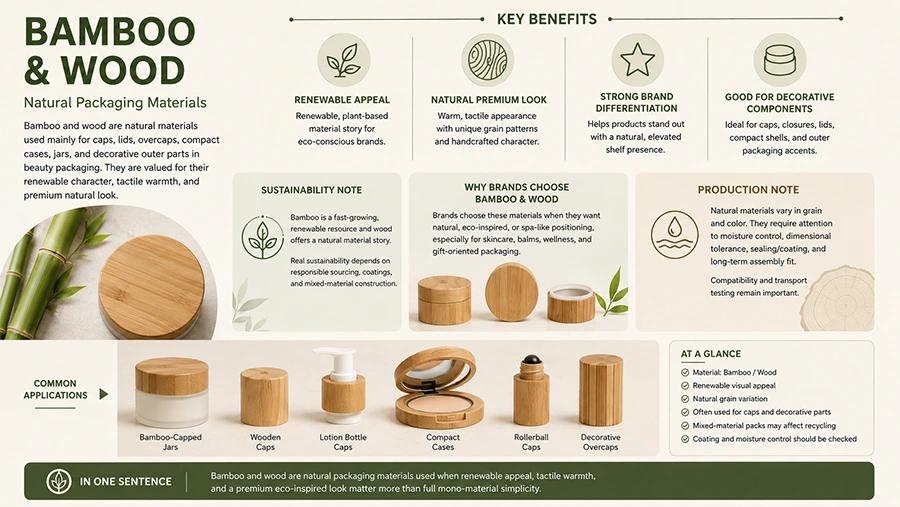
Bamboo and wood deliver a natural, warm, premium cue that plastic cannot fake. In almost every case they are an outer layer: a bamboo cap, sleeve, or overshell wrapped around a plastic inner cup or bottle that actually holds the formula, because untreated wood is not a barrier and can absorb moisture. Two things need attention: the inner component still drives compatibility and recyclability, and a bamboo-over-plastic part is harder to separate for recycling, so the “natural” look and the sustainability claim are not automatically the same thing. Sourcing, finish, and moisture sealing all need review before committing.
PCR (Post-Consumer Recycled) Plastic
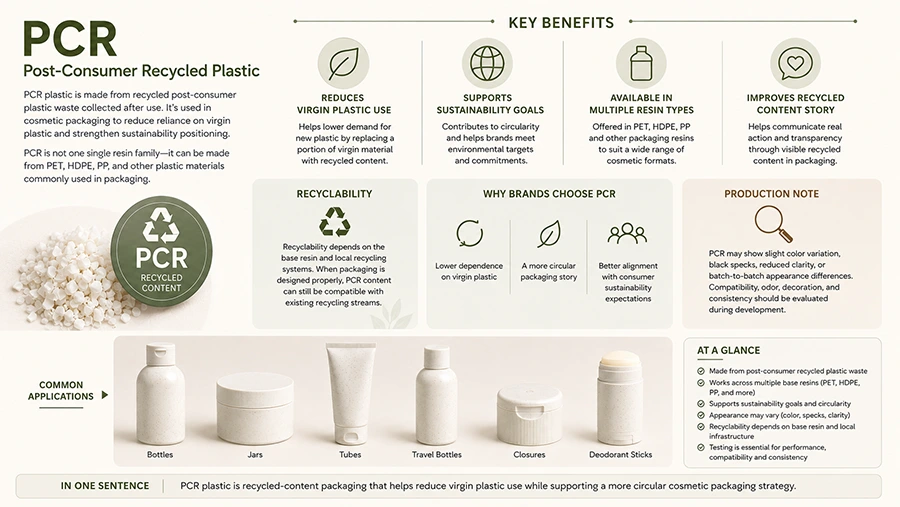
PCR is not a new resin, it is recycled content in a familiar one, such as PCR PP or PCR PET. It behaves close to virgin resin, but recycled content often shifts color and can add slight variation, so a bright white or perfectly clear target may need a lower PCR level or an opaque design. Confirm the realistic percentage for the pack type and region before committing artwork. Certificates such as GRS support a recycled-content claim for a specific material and scope; they do not make an entire pack “100% recyclable.” For the wider decision, our guide on how to choose sustainable cosmetic packaging goes deeper, and UKPACK’s sustainable cosmetic packaging options compare PCR, mono-material, and refillable systems.
Biobased Plastics
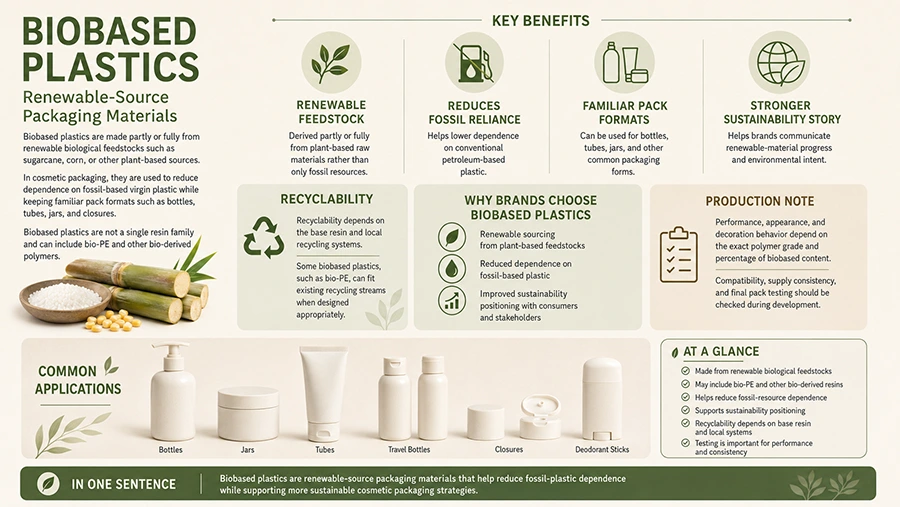
Biobased resins replace some fossil feedstock with renewable sources, for example bio-PE from sugarcane. Claims here need the most caution, because “biobased” is not the same as “biodegradable” or “compostable,” and the standard and region matter. Treat biobased as a feedstock story to be verified per resin and formula, not as a blanket environmental claim.
How Material Choice Interacts With Your Formula
Material compatibility is where a good-looking pack quietly fails. The container and the formula sit in contact for months, so the material has to live with what is inside it.
- Essential oils, high fragrance load, and some actives can craze, cloud, or stress-crack certain plastics (acrylic and styrenics are more vulnerable). Glass, and often PP, are safer starting points for these formulas.
- Anhydrous and oil-based formulas behave differently from water-based ones on barrier and permeation.
- Volatile or scent-critical formulas need a material and closure that limit evaporation and scent migration over shelf life.
- Particulates and exfoliants affect pump and valve choice as much as the container material.
- Air- and oxidation-sensitive formulas (many vitamin C serums, retinol, and preservative-light “clean” formulas) often push the decision toward an airless system rather than an open jar, regardless of the wall material. UKPACK’s airless pump bottles exist for this problem: less air contact during daily use, with the material chosen on top of that structure.
The practical rule I give every brand: run a compatibility test with your actual formula, not water, before you lock the material. Appearance can pass while a slow interaction, weight loss, panel deformation, or fragrance change only shows up weeks later.
Decoration and Finish: What Each Material Will (and Won’t) Take
Decoration should be chosen after the material and shape, because the material sets the limits. UKPACK’s decoration methods, screen printing, hot stamping, labeling, spray and gradient coating, electroplating, color injection, and shrink film, each pair better with some materials than others.
- ABS and acrylic take metallizing and electroplating beautifully; PP needs surface treatment before it will hold direct print.
- Curved, tapered, ribbed, and very small packs shrink the printable area, so intricate artwork may need labels instead of direct print.
- PCR and natural-color resins introduce slight color variation, which affects color matching and can make a precise Pantone target harder.
- Products handled with oily or wet hands (sunscreens, shower products, lip items) need decoration that resists rub-off, so hot stamping or a protective coating may beat a simple print.
How to Choose the Right Cosmetic Packaging Material
Here is the sequence our engineering team uses, in order. Following it prevents most late-stage surprises.
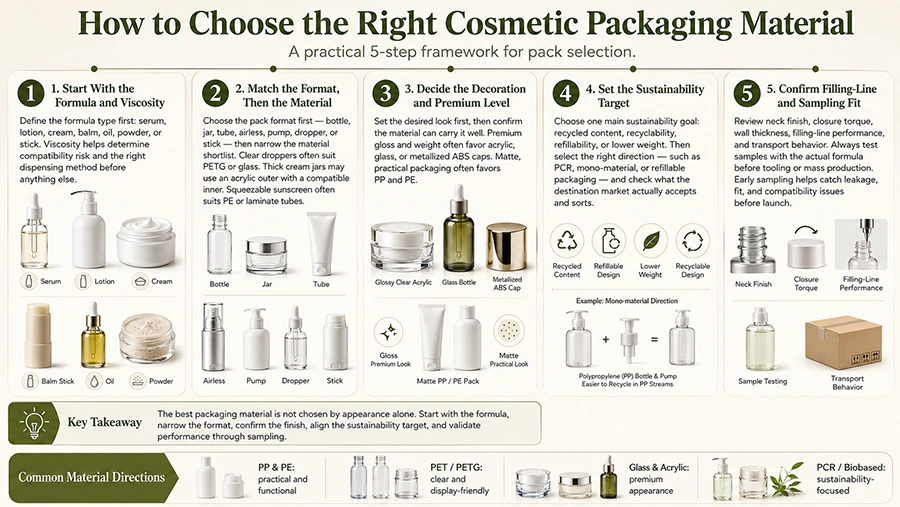
1. Start With the Formula and Viscosity
Define the formula type (serum, lotion, cream, balm, oil, powder, stick) and viscosity first. This decides compatibility risk and dispensing method before anything else.
2. Match the Format, Then the Material
Bottle, jar, tube, airless, pump, dropper, or stick: the format narrows the material shortlist. A high-clarity dropper points to PETG or glass; a thick cream jar points to acrylic outer with a compatible inner; a squeezable sunscreen points to a PE or laminate tube.
3. Decide the Decoration and Premium Level
Set the look, then confirm the shortlisted material can carry it. Premium gloss and weight favor acrylic, glass, or a metallized ABS cap; matte and practical favor PP and PE.
4. Set the Sustainability Target and Check Regional Reality
Pick one primary sustainability goal (recycled content, recyclability, refillability, or lower weight), then choose PCR, mono-material, or refillable accordingly, and check what your destination market actually sorts and accepts.
5. Confirm Filling-Line and Sampling Fit
Check neck finish, closure torque, wall thickness, and how the pack behaves on the filling line and in transit. Then sample with the formula before tooling or mass production. Many brands only discover a leakage, fit, or compatibility problem after the first filling trial, which is exactly the problem sampling is meant to catch early.
Conclusion
If you are preparing a packaging brief, the fastest way to narrow materials is to share the formula type, target capacity, preferred look, decoration direction, and sustainability goal so a manufacturer can shortlist options with you. UKPACK’s cosmetic packaging design services can compare stock and custom-mold routes, material and decoration tradeoffs, and sampling paths, and you can browse cosmetic packaging formats to see how these materials look in bottles, jars, and tubes before you commit.
One last compliance note: whatever material you choose, the packaging still has to meet labeling and safety rules in your selling market. In the US, cosmetic labeling is regulated by the FDA under the Federal Food, Drug, and Cosmetic Act and the Fair Packaging and Labeling Act, so confirm label area and requirements alongside the material decision.
What is the most common cosmetic packaging material?
What is the most common cosmetic packaging material?
Plastic is the most common, and within plastics, PET and PP are the two most widely used. PET gives high clarity for bottles and is one of the most recycling-accepted plastics (resin code 1), while PP is valued for chemical resistance and is standard for caps, pumps, and jars (resin code 5).
What is the best cosmetic packaging material?
There is no single best material, only the best fit for a formula. Match the material to the formula’s compatibility needs, the format, the decoration and premium level, the sustainability goal, and the filling line. A fragrance suits glass, a matte practical jar suits PP, a high-clarity dropper suits PETG or glass.
Which cosmetic packaging materials are recyclable?
Glass and aluminum are widely recyclable, and among plastics PET (code 1) and increasingly PP (code 5) are the most accepted. Acrylic, AS, and code 7 plastics are rarely accepted in curbside programs. A resin code identifies the resin, it does not guarantee your local stream accepts the finished, decorated pack.
Is PCR plastic safe for cosmetics?
PCR versions of standard resins such as PCR PP and PCR PET are used in cosmetic packaging, but recycled content can affect color and slight variation, and food-contact or direct-contact suitability depends on the source and grade. Confirm the realistic PCR level and the intended use with your manufacturer before finalizing.
What material is best for an essential-oil or natural formula?
Glass is the safest default because it is chemically inert, and PP is often a workable plastic option. Some essential oils and high-fragrance loads can stress or cloud acrylic and styrenic plastics, so run a real compatibility test with the actual formula before committing.