Why Spray Bottles Stop Working: Causes, Fixes & Prevention

Founder of UKPACK, chief packaging engineer and designer with 18 years of experience, and Red Dot Award winner. I work on cosmetic packaging structure, material selection, mold feasibility, decoration processes, and leak-risk control, helping brands turn packaging ideas into reliable production-ready solutions. See my senior packaging engineer qualification.
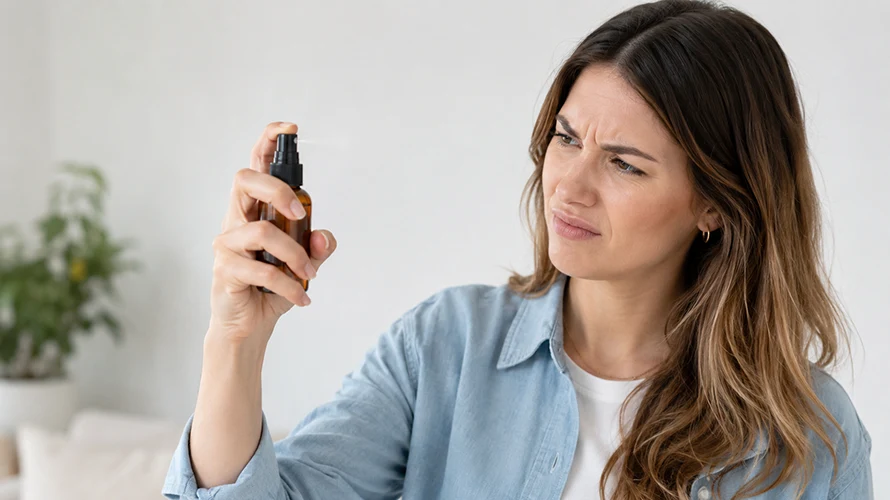
Spray bottles stop working when liquid can no longer move smoothly from the bottle to the nozzle. The most common causes are a clogged nozzle, blocked or loose dip tube, air leakage, weak pump pressure, damaged seals, a stuck trigger, or a formula that is too thick, oily, powdery, or incompatible with the sprayer. Many problems can be fixed by cleaning, flushing, or replacing the sprayer. For brands, the better solution is to test the full package with the real formula before production.
Quick Diagnosis: What Your Spray Bottle Symptom Means
The fastest way to understand why a spray bottle stops working is to match the symptom with the most likely failure point. A bottle that sprays air, leaks, drips, or produces a weak mist usually needs a different check.
| Symptom | Likely Cause | Quick Check | What to Do |
|---|---|---|---|
| No spray at all | Locked nozzle, clogged nozzle, blocked dip tube, stuck pump | Check lock position, nozzle opening, dip tube connection and trigger movement | Unlock the sprayer, soak and flush the nozzle, reconnect or replace the dip tube |
| Weak mist | Partial clog, air leakage, low pump pressure, formula too thick | Spray warm water through the pump and check closure tightness | Clean the nozzle, tighten the closure, test with the actual formula |
| Spray comes out unevenly | Residue in nozzle or damaged spray orifice | Look for dried formula, mineral buildup or side-spraying | Soak, rinse and flush gently; replace sprayer if the orifice is damaged |
| Bottle sprays air but no liquid | Loose, cracked, blocked or short dip tube | Remove sprayer and inspect tube fit and length | Reattach, clear or replace the tube |
| Works only when tilted | Dip tube too short or cut at the wrong angle | Check whether the tube reaches the lowest liquid point | Use the correct tube length and cut angle |
| Drips after spraying | Worn valve, seal issue, poor formula match | Check nozzle, gasket and formula viscosity | Replace worn parts and confirm formula compatibility |
| Leaks around the neck | Poor closure fit, damaged gasket, wrong torque | Check cap tightness, gasket and bottle neck | Tighten correctly or replace incompatible components |
| Trigger is hard or stuck | Dried residue, spring failure, piston damage | Press and release the trigger several times | Flush the pump; replace if spring, piston or trigger is damaged |
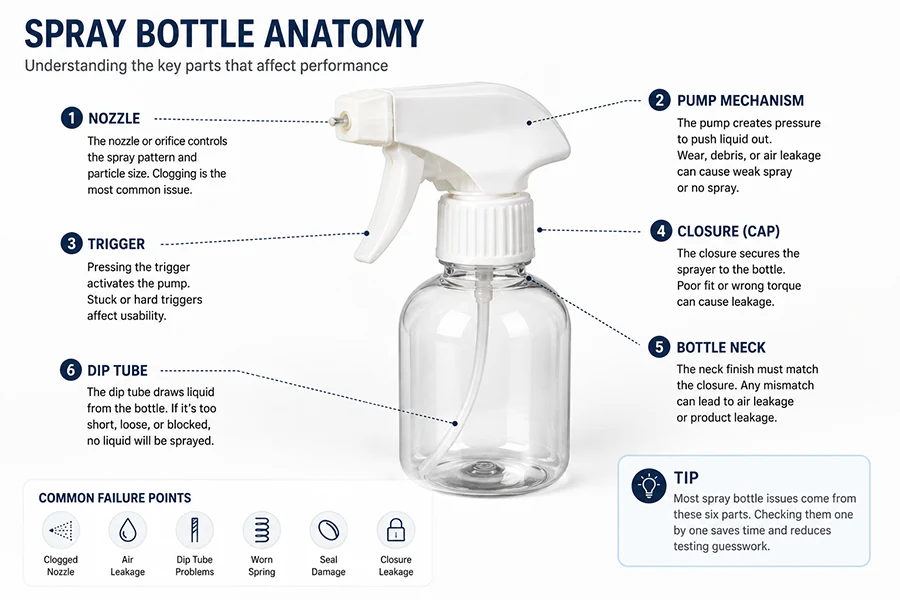
For a single bottle, the issue may be simple cleaning. If the same symptom appears across many samples, the packaging specification should be reviewed before bulk production.
The 6 Most Common Failure Points in Spray Bottles
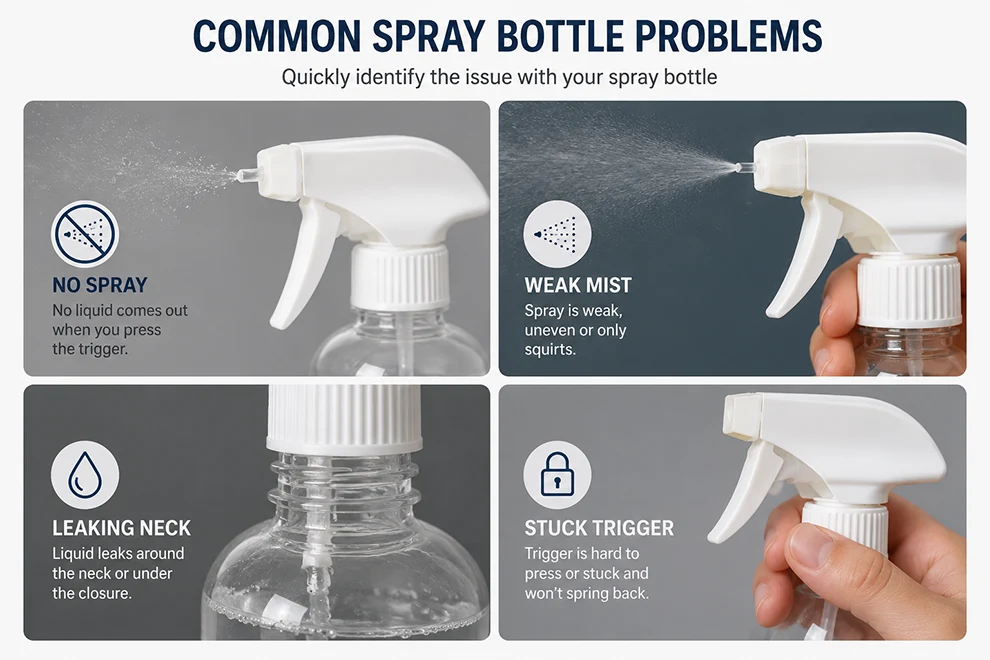
A spray bottle depends on several small parts working together: nozzle, actuator, piston, spring, seal, closure and dip tube. If one part is blocked, worn, loose or mismatched with the liquid, the sprayer may stop working.
1. Clogged Nozzle
The nozzle has a very small opening that shapes the spray. Dried formula, minerals, powders, shimmer particles, oils or thick residue can block this opening.
A clogged nozzle often causes no spray, side spray, spitting or an uneven mist. If the spray pattern changes after several uses, residue buildup is usually the first thing to check.
2. Blocked or Loose Dip Tube
The dip tube pulls liquid from the bottle into the pump. If it is loose, cracked, bent, blocked or too short, the pump may pull air instead of liquid.
For brands, dip tube length and cut angle should be checked with the actual bottle shape. A round-bottom or travel-size bottle may require a specific tube angle to reduce leftover liquid and improve dispensing.
3. Air Leakage Around the Closure or Seal
A spray bottle needs suction and pressure. If air enters through the closure, gasket or neck area, the pump may lose pressure and produce a weak spray.
Leakage around the neck can come from a loose cap, damaged gasket, poor neck finish match or incorrect closure torque. This is why sealing tests matter before confirming production.
4. Stuck Trigger or Pump Mechanism
A trigger can stick when dried liquid builds up inside the pump, or when the spring, piston or internal valve is damaged. Sticky formulas and crystallizing ingredients can make this problem appear faster.
If the trigger does not return after pressing, cleaning may help. If the spring or piston is damaged, replacement is usually the only reliable fix.
5. Formula Incompatibility
Some liquids are harder to spray than others. Oils, alcohol-rich formulas, powders, shimmer, high-viscosity skincare and certain hair care formulas can affect spray pattern, sealing performance and pump movement.
A sprayer that works with water may still fail with the real formula. Formula compatibility should be tested before production.
6. Wrong Sprayer Type
Fine mist sprayers, spray pump bottles and trigger sprayers are not interchangeable. Each type has a different output, spray pattern and pressure design.
A fine mist sprayer may be suitable for toner or facial mist, while a trigger sprayer may be better for larger coverage. A compact spray pump bottle may fit travel, sanitizer, fragrance or personal care use.
How to Fix a Spray Bottle That Stops Working
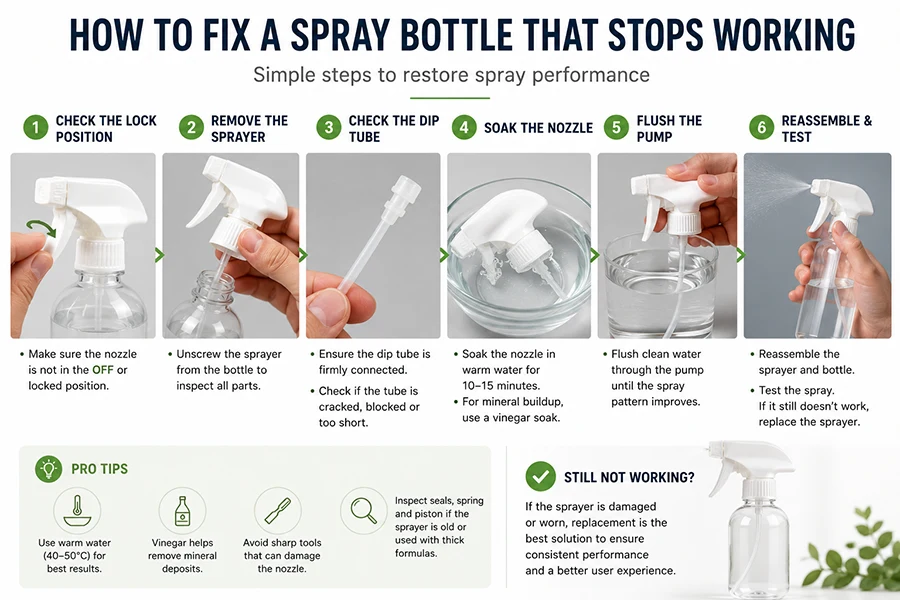
Many spray bottle problems can be fixed by restoring the liquid path from the dip tube to the nozzle. Start with simple checks, then move to cleaning and replacement if needed.
Unclog the Nozzle
First, check whether the nozzle is in the locked position. Some sprayers have an open-close or twist-lock design. If the nozzle is locked, it may feel like the bottle is broken even when the pump is fine.
If the nozzle is open but still does not spray, remove the sprayer and rinse the nozzle with warm water. Soak the nozzle and pump head in warm water for several minutes to soften dried residue. Then flush the nozzle by spraying clean warm water through the pump until the pattern becomes stable.
For mineral deposits, a short vinegar soak can help dissolve buildup. After soaking, rinse thoroughly with clean water so vinegar does not remain inside the sprayer.
Avoid pushing needles, pins or sharp tools into the nozzle opening. This can damage the nozzle orifice and permanently change the spray pattern. If the orifice is enlarged or deformed, the sprayer should be replaced.
For production, brands should test whether the formula dries at the nozzle after repeated use or storage. If residue forms quickly, the sprayer type or formula compatibility should be reviewed.
Clear or Replace the Dip Tube
Remove the sprayer and check whether the dip tube is firmly connected. If the tube is loose, the pump may pull air instead of liquid. Reattach it securely and test again.
Next, inspect the tube for blockage. Rinse it with warm water and make sure liquid can pass through freely. If the tube is cracked, bent, hardened or blocked by dried formula, replace the sprayer or tube assembly.
Also check tube length. The dip tube should reach close to the bottom of the bottle without being crushed or curled in a way that blocks flow. The cut angle matters too. An angled cut helps prevent the tube from sealing flat against the bottle base.
Before production, dip tube length should be confirmed with the final bottle, closure and fill volume. Testing only a standard tube length may leave too much product inside the bottle or cause spray failure at low liquid levels.
Restore Pump Pressure
If the nozzle and tube are clear but the spray is weak, the pump may not be building pressure. Tighten the closure and check whether the gasket is present and seated correctly.
Prime the sprayer by pressing the trigger several times. If the bottle has been unused for a long period, air may be inside the pump chamber. Flushing warm water through the sprayer can help restore movement.
If the pump works with water but not with the formula, the issue may be viscosity or ingredient compatibility. A formula that is too thick, oily or particle-heavy may reduce pump pressure and weaken the mist.
For production, pump output per stroke should be tested with the actual formula. A stable sprayer should deliver consistent output from the first press through repeated use.
Fix a Stuck Trigger
A stuck trigger is often caused by dried residue inside the pump mechanism. Remove the sprayer, soak the pump head in warm water, then press the trigger repeatedly while flushing clean water through the system.
If the trigger is slow to return, sticky ingredients may be affecting the piston or spring. If the trigger does not rebound at all, the spring, piston or internal valve may be damaged.
Do not force the trigger aggressively. Excessive force can break the actuator or damage internal pump parts. If normal cleaning does not restore smooth movement, replace the sprayer.
For brands, repeated press cycle testing can reveal whether the trigger remains smooth after extended use. This is especially important for products used daily, such as facial mists, hair care sprays and personal care liquids.
When Cleaning Is Not Enough
Cleaning is not enough when the spring, seal, piston, trigger or nozzle orifice is physically damaged. It is also not enough when the formula is incompatible with the sprayer design.
Replace the sprayer if:
- The trigger does not rebound after cleaning
- The spring feels broken or weak
- The bottle leaks after tightening
- The nozzle opening is damaged
- The pump sprays water but fails with the actual formula
- Dripping continues after flushing
- Multiple samples show the same failure
For packaging projects, repeated failure should be treated as a specification issue, not just a cleaning issue. The solution may require a different sprayer, gasket, dip tube, bottle neck, material or testing process.
Packaging and Logistics Cost
Packaging cost includes inner bags, trays, dividers, cartons, labels, pallets, and export packing. Bottles with high-gloss or decorated surfaces usually need stronger protection.
Logistics cost depends on carton size, product volume, shipping method, and destination. Plastic bottles are lightweight, but they can take up a lot of shipping space.
Carton design should protect the product and control shipping volume at the same time.
Why Some Formulas Make Spray Bottles Fail Faster
A water test can confirm that a sprayer moves liquid, but it does not prove the sprayer will work with the final formula. Real formulas may contain oils, alcohol, powders, shimmer, fragrance, active ingredients, thickeners or polymers that behave very differently from water.
Oils can leave residue inside the pump or affect sealing parts. Alcohol-rich formulas may require material compatibility checks. Powders and shimmer particles can collect at the nozzle and cause clogging. Thicker skincare formulas may weaken mist quality or create spitting. Hair care formulas may include conditioning agents or film-forming ingredients that dry around the nozzle.
This is why brands should test the actual filled product, not only the bottle and sprayer separately. The same sprayer may perform well with toner but fail with a thicker leave-in hair treatment or oil-based body mist.
User Fix vs Production Prevention
A user-level fix solves the immediate problem. Production-level prevention reduces the chance that the same problem appears across many finished products.
| Problem | User-level fix | Production-level prevention |
|---|---|---|
| Clogged nozzle | Warm water soak, vinegar soak for minerals, flush the nozzle | Test formula drying, particle size, spray pattern and nozzle compatibility |
| Weak spray | Tighten closure, prime pump, clean nozzle and tube | Test pump output, air leakage, gasket fit and closure torque |
| Spray air but no liquid | Reconnect or replace dip tube | Confirm tube length, cut angle and bottom reach with final bottle |
| Trigger stuck | Soak pump head, flush with warm water, avoid force | Run repeated press cycle testing with actual formula |
| Leakage around neck | Tighten closure and check gasket | Verify neck finish, gasket material, cap torque and leak testing |
| Dripping after spray | Clean nozzle and check for residue | Review valve design, formula viscosity and sprayer specification |
| Works with water but not formula | Clean and retest with original liquid | Conduct formula compatibility testing before bulk production |
For brands, the key question is not only “Can this bottle spray today?” but “Will this bottle still spray consistently after filling, shipping, storage and repeated use?”
How to Prevent Spray Bottle Failure Before Bulk Production
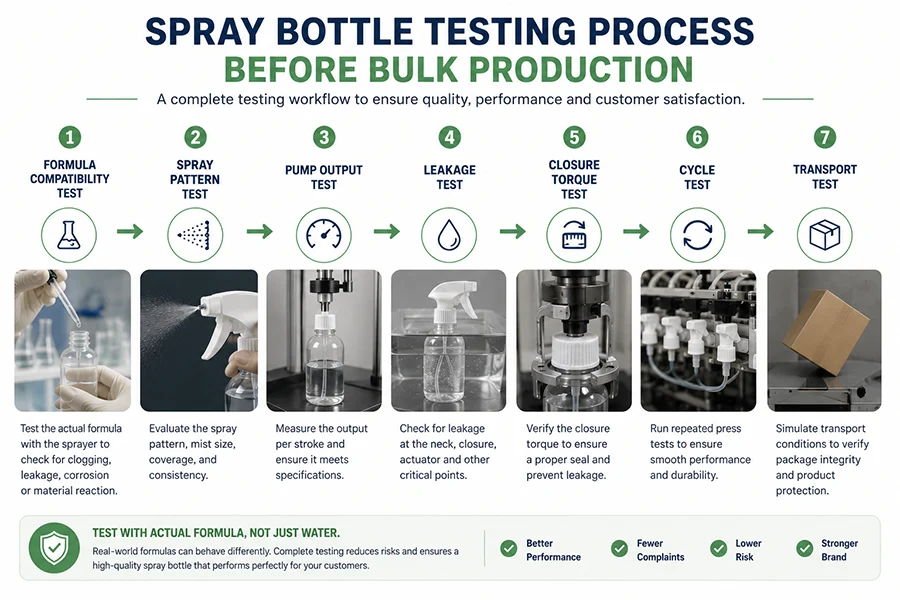
The best way to prevent spray bottle failure is to test the sprayer, bottle and formula as one complete packaging system before bulk production. A reliable spray package should maintain output, spray pattern, sealing and user comfort through real use conditions.
Important checks include:
- Formula compatibility testing with the actual product
- Spray pattern testing after repeated use
- Pump output per stroke
- Leakage testing after filling
- Closure torque testing
- Dip tube length and cut angle confirmation
- Storage and transport condition testing
- Repeated press cycle testing
- Material compatibility for oils, alcohol and active ingredients
Brands should also evaluate how the package performs at different fill levels. A bottle that sprays well when full may fail near the end if the dip tube is too short or poorly positioned.
UKPACK supports packaging projects with product development, sampling, manufacturing coordination and quality control. Learn more about UKPACK packaging manufacturing and quality management for custom packaging development.
How to Choose the Right Spray Bottle for Your Product
The right spray bottle depends on formula type, spray effect, capacity, material, closure design and decoration requirements. The goal is to match the sprayer to the product, not simply choose a bottle that looks suitable.
Consider these points:
- Formula: water-based, alcohol-based, oil-based, powder-containing or viscous
- Spray effect: fine mist, direct spray, broad coverage or stronger output
- Application: skincare, hair care, fragrance, sanitizer, personal care or travel use
- Capacity: sample, travel, retail or professional size
- Material: PET, PP or other compatible plastic components
- Closure: neck finish, gasket, torque and sealing performance
- Decoration: color matching, printing, labeling or custom finish
- Testing: leakage, output, compatibility and repeated use
A 100ml PET spray pump bottle can be suitable for travel-size, personal care and sample applications when the formula and sprayer are properly matched.
For broader product lines, working with a spray bottle manufacturer helps brands compare bottle shapes, sprayer types, materials, capacities and customization options before confirming production.
UKPACK Spray Bottle Solutions
Explore UKPACK’s custom spray bottle solutions or contact our team to discuss PET spray bottles, custom sprayers, samples and packaging requirements for your next product.
FAQ
1. Why do spray bottles stop working?
Spray bottles stop working because the spray system is clogged, leaking air, damaged or incompatible with the liquid. Common causes include clogged nozzles, blocked dip tubes, weak pump pressure, worn seals, stuck triggers and formulas that are too thick, oily or particle-heavy.
2. How do you unclog a spray bottle nozzle?
Remove the sprayer, soak the nozzle in warm water, then flush clean water through the pump until the spray pattern improves. For mineral deposits, a short vinegar soak can help. Avoid using sharp tools because they can damage the nozzle orifice.
3. Why does my spray bottle spray air but no liquid?
This usually means the dip tube is loose, cracked, blocked or too short. Check whether the tube is firmly connected to the sprayer and reaches near the bottom of the bottle. If the tube is damaged or blocked, replace it.
4. Why does my spray bottle only work when tilted?
The dip tube may be too short or cut at the wrong angle. When the bottle is tilted, the tube may temporarily reach the liquid. For production, dip tube length and cut angle should be tested with the final bottle shape.
5. Can vinegar fix a spray bottle?
Vinegar can help dissolve mineral deposits around the nozzle, especially when water hardness causes buildup. After soaking, rinse the sprayer thoroughly and flush it with clean water before using it again.
6. Why does my spray bottle work with water but not my formula?
Water is thinner and easier to spray than many real formulas. Oils, alcohol, powders, shimmer, thicker skincare products and hair care formulas can clog the nozzle, weaken the mist or affect seals. The actual formula should be tested before production.
7. When should I replace the sprayer?
Replace the sprayer when the spring, seal, piston, trigger or nozzle orifice is damaged. Cleaning may not solve broken parts, repeated leakage, permanent trigger failure or formula incompatibility.
8. What should brands test before ordering spray bottles in bulk?
Brands should test formula compatibility, spray pattern, pump output, leakage, closure torque, dip tube length, cut angle and repeated press performance. Testing should use the actual formula, not water only.