Injection Molding Bottles: A Guide to Materials, Manufacturing, and Procurement

Founder of UKPACK, chief packaging engineer and designer with 18 years of experience, and Red Dot Award winner. I work on cosmetic packaging structure, material selection, mold feasibility, decoration processes, and leak-risk control, helping brands turn packaging ideas into reliable production-ready solutions. See my senior packaging engineer qualification.
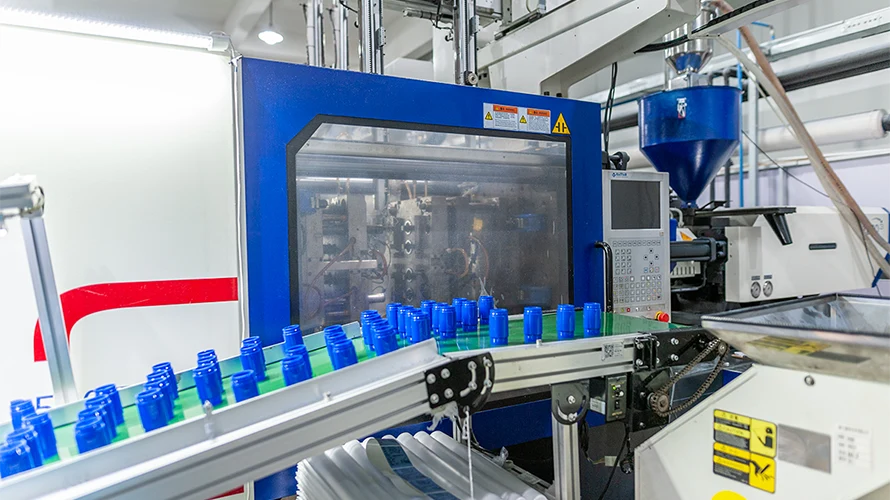
Injection molding bottles are a key part of cosmetic packaging. These plastic containers are used for lotions, creams, serums, shampoos, toners, perfumes, and many other personal care products.
They are popular because they offer a useful balance of design flexibility, stable production, and controlled cost. A bottle can be made clear or opaque, soft or rigid, simple or premium, depending on the material, mold, decoration, and matching components.
For cosmetic brands, the bottle is not just a container. It needs to protect the formula, fit the cap or pump correctly, survive filling and shipping, and still look good on the shelf.
This guide explains how injection molding bottles are made, what materials are commonly used, how quality is controlled, and what buyers should check before starting a cosmetic packaging project.
Common Materials for Injection Molding Bottles
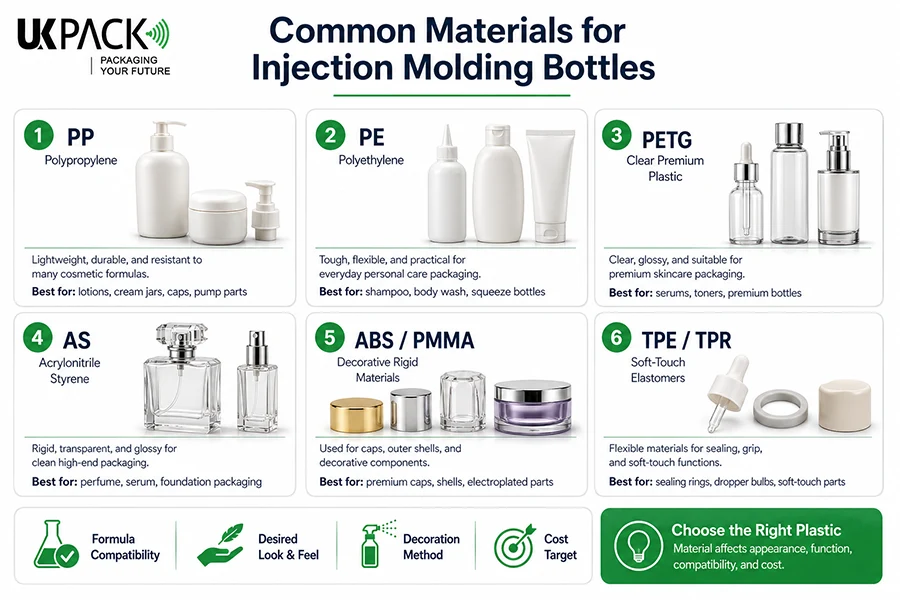
Injection molding bottles can be made from different plastics. Each material has its own balance of clarity, strength, chemical resistance, surface feel, and cost.
A low-cost shampoo bottle does not need the same material as a premium serum bottle. A cream jar does not have the same requirements as a fine mist toner bottle. The right material depends on the formula, the packaging structure, and the look the brand wants to create.
Here are the most common plastics and what makes each one suitable for different bottles.
Polypropylene (PP) Bottles
PP is one of the most widely used plastics for cosmetic bottles, jars, caps, and pump components. It is lightweight, durable, and resistant to many cosmetic formulas.
It is not the clearest plastic, but it performs well in practical packaging. That makes it a common choice for lotions, creams, haircare products, cleansing products, and cost-sensitive projects.
PP is also a strong option for brands considering mono-material structures, especially when the bottle, cap, or other matching parts can be designed with the same plastic family. See our mono-material cosmetic packaging solutions for related packaging options.
Common uses include:
- Lotion bottles
- Cream jars
- Shampoo and conditioner bottles
- Flip caps and screw caps
- Pump and closure components
The main limitation is appearance. PP usually does not give the same glass-like clarity as PETG, AS, or PMMA. It may also need additives if UV resistance is required.
Polyethylene (HDPE / LDPE / LLDPE)
Polyethylene is another common packaging material. It is often used when flexibility, impact resistance, and chemical resistance are important.
HDPE is harder and more rigid. It is often used for larger bottles, thick-wall containers, caps, and personal care packaging that needs better toughness.
LDPE and LLDPE are softer and more flexible. They are often used for squeeze bottles, tube shoulders, soft components, and sealing parts.
Polyethylene is a practical choice for body wash, shampoo, cleanser, and other products where function and cost matter more than high-end clarity.
PETG Bottles
PETG is often chosen when a brand wants clear, glossy, and more premium-looking plastic packaging. It has good transparency, good impact resistance, and works well with common decoration methods.
For skincare and beauty products, PETG is often used for toners, serums, lotions, and other formulas where the brand wants the bottle to show the product inside.
PETG can also support silk screen printing, hot stamping, labeling, and other surface decoration options. If appearance is a major part of the product positioning, PETG is usually worth considering.
The downside is cost. PETG is more expensive than PP or PE, and its heat resistance is lower than some other plastics. It is better suited for products that do not require high-temperature filling or sterilization.
AS Bottles
AS is a clear and rigid plastic. It has good gloss, high hardness, and good dimensional stability. These features make it useful for cosmetic bottles that need a sharp, transparent appearance.
AS is often used for perfume bottles, small serum bottles, foundation bottles, and transparent outer packaging components.
However, AS is more brittle than PETG. It also has weaker chemical resistance against some aggressive formulas. For this reason, formula compatibility should be checked before using AS for mass production.
Other Materials (ABS, PMMA, TPE/TPR, PLA/PBAT)
Not every injection molded cosmetic component is a bottle body. Caps, collars, shoulders, decorative shells, actuators, and inserts may use different materials.
ABS is often used for decorative parts, especially when electroplating or a metallic look is required. PMMA has excellent clarity and gloss, but it is harder and more brittle. It is often used for premium caps, outer shells, and display-style packaging parts.
TPE and TPR are soft elastic materials. They are often used for soft-touch components, sealing rings, dropper bulbs, and flexible parts.
There are also biodegradable or bio-based materials such as PLA and PBAT. These materials can support sustainability claims, but they usually need more careful testing because heat resistance, barrier performance, and long-term stability can differ from conventional plastics.
Brands looking for recyclable, refillable, or lower-impact options can also explore our sustainable cosmetic packaging solutions.
Manufacturing Process for Injection Molding Bottles
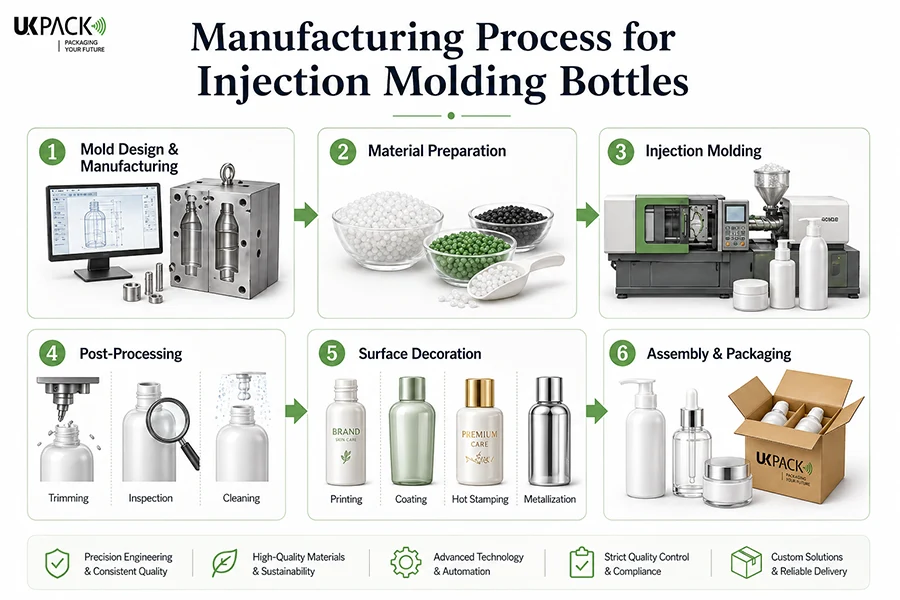
The manufacturing process starts before plastic enters the machine. A good bottle depends on tooling, material preparation, molding control, surface finishing, and assembly.
If one step is not controlled, the finished packaging may have visible defects, poor sealing, unstable dimensions, or weak component fit.
Here is how injection molding bottles are typically made.
Mold Design and Manufacturing
The mold defines the bottle shape, wall thickness, neck finish, surface quality, and production consistency. In cosmetic packaging, mold accuracy matters because the bottle must match caps, pumps, liners, inner plugs, and filling equipment.
A mold designer needs to consider draft angles, cooling channels, gate position, parting lines, venting, and ejection structure. These details affect how the plastic flows, how the part cools, and how easily it can be removed from the mold.
Mold cost is usually one of the largest early investments in a custom bottle project. But a well-built mold improves consistency and reduces problems during mass production.
For brands developing a new bottle structure from scratch, UKPACK’s Free 3F Services can help turn your idea into 3D renderings, mockups, and production-ready packaging.
Material Preparation
Plastic pellets are prepared before molding. This usually includes drying, color mixing, and sometimes adding functional additives.
Drying is especially important for transparent materials. Moisture can cause bubbles, silver streaks, weak surfaces, or poor clarity.
Color masterbatch also needs to be controlled. Cosmetic brands often need stable color across different production batches, especially for packaging sets or product families.
Injection Molding
Injection molding uses heat and pressure to form the bottle or component. The plastic is melted inside the machine barrel, then pushed into the mold cavity under pressure.
The basic process includes:
- Plasticizing: Plastic pellets are heated and melted inside the barrel.
- Injection: Molten plastic is pushed into the mold cavity.
- Holding pressure: Extra pressure is applied to reduce shrinkage.
- Cooling: The plastic cools and hardens inside the mold.
- Ejection: The finished part is pushed out of the mold.
For cosmetic bottles, the goal is not only to form the part. The bottle also needs stable dimensions, clean surfaces, accurate threads, and a neck finish that works with the selected closure or pump.
Post-Processing
After molding, parts may need trimming, polishing, or removal of gate marks. This step helps clean the part before decoration or assembly.
The inspection team may also check for burrs, flash, black spots, deformation, shrink marks, color variation, and scratches.
Standard bottles may need only basic trimming. Premium packaging with glossy, transparent, or metallized surfaces often needs stricter handling.
Surface Decoration
Surface decoration is where a simple molded bottle becomes brand packaging. Common processes include silk screen printing, hot stamping, labeling, spray coating, UV coating, electroplating, and vacuum metallization.
Each process changes the appearance, cost, and inspection standard. A one-color print is much simpler than a metallic finish or a multi-layer coating.
Decoration must also be durable. Printing and coatings should pass adhesion and abrasion tests, especially if the bottle will go through filling lines, shipping cartons, and daily consumer use.
For a deeper overview of decoration methods, see our page on surface finishes and decorations.
Assembly and Packaging
After molding and decoration, bottles are assembled with caps, pumps, sprayers, liners, dip tubes, inner plugs, or other components.
This stage is important because many packaging failures happen at the connection point. A bottle can look fine but still leak if the pump does not match the neck finish or the cap torque is not controlled.
Finished bottles are then cleaned, inspected, packed, and prepared for shipment. For decorated bottles, protective packaging helps prevent scratches and surface damage during transport.
Cost Structure of Injection Molding Bottles
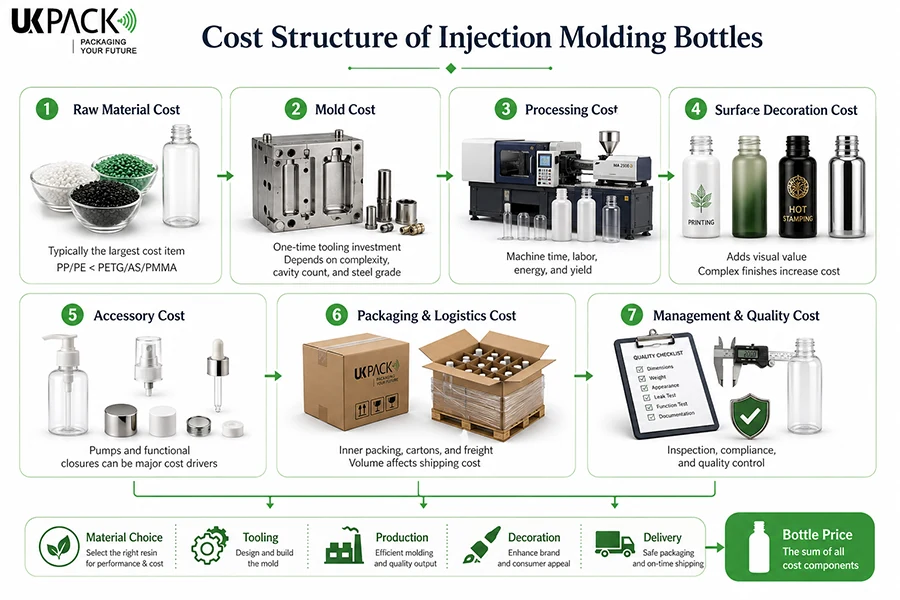
The cost of injection molding bottles is not only about plastic weight. Material, mold complexity, decoration, components, order quantity, and inspection requirements all affect the final price.
A standard PP bottle with a simple cap will cost much less than a PETG bottle with custom tooling, metallic coating, printing, and a functional pump.
These are the main cost factors buyers should understand before comparing quotes.
Material Cost
Material is usually one of the largest cost items. PP and PE are generally more economical. PETG, AS, ABS, and PMMA usually cost more.
The final material cost depends on resin type, bottle weight, transparency requirements, color additives, and market price changes.
For high-volume projects, even a small change in bottle weight can affect the total cost.
Mold Cost
Custom injection molding bottles usually require tooling. If an existing mold can be used, the project can move faster and cost less. If the bottle needs a new shape, a custom mold is required.
Mold cost depends on bottle size, part structure, cavity number, steel grade, expected mold life, and tolerance requirements.
Before paying for tooling, buyers should confirm who owns the mold, who maintains it, and whether the mold can be used only for their project.
Processing Cost
Processing cost includes machine time, labor, energy, setup, scrap rate, and production efficiency.
A bottle with stable molding conditions is easier to produce. A bottle with difficult wall thickness, poor flow, or strict appearance requirements may take more time and create a higher defect rate.
This is why a cheaper design is not always cheaper to manufacture.
Decoration Cost
Decoration can add a large cost difference. Hot stamping, electroplating, UV coating, soft-touch coating, and multi-color printing all require extra work.
Cost depends on the process, print area, number of colors, fixture requirements, yield rate, and inspection standard.
For cost-sensitive projects, it is often better to simplify decoration before reducing material quality.
Accessory Cost
Injection molding bottles often need caps, pumps, sprayers, droppers, liners, dip tubes, or inner plugs. These accessories can become a major part of the total cost.
Pump quality is especially important. A cheaper pump may reduce unit price, but it can cause leakage, poor output, or a bad user experience.
When comparing quotes, buyers should make sure the bottle, pump, cap, and decoration specifications are the same.
Packaging and Logistics Cost
Packaging cost includes inner bags, trays, dividers, cartons, labels, pallets, and export packing. Bottles with high-gloss or decorated surfaces usually need stronger protection.
Logistics cost depends on carton size, product volume, shipping method, and destination. Plastic bottles are lightweight, but they can take up a lot of shipping space.
Carton design should protect the product and control shipping volume at the same time.
Quality Control for Injection Molding Bottles
Cosmetic packaging needs strict quality control because it touches the formula and appears directly in front of consumers. A small defect can affect both product safety and brand image.
For injection molding bottles, quality control usually covers appearance, dimensions, sealing, mechanical strength, chemical safety, and dispensing function.
Here are the main areas to check.
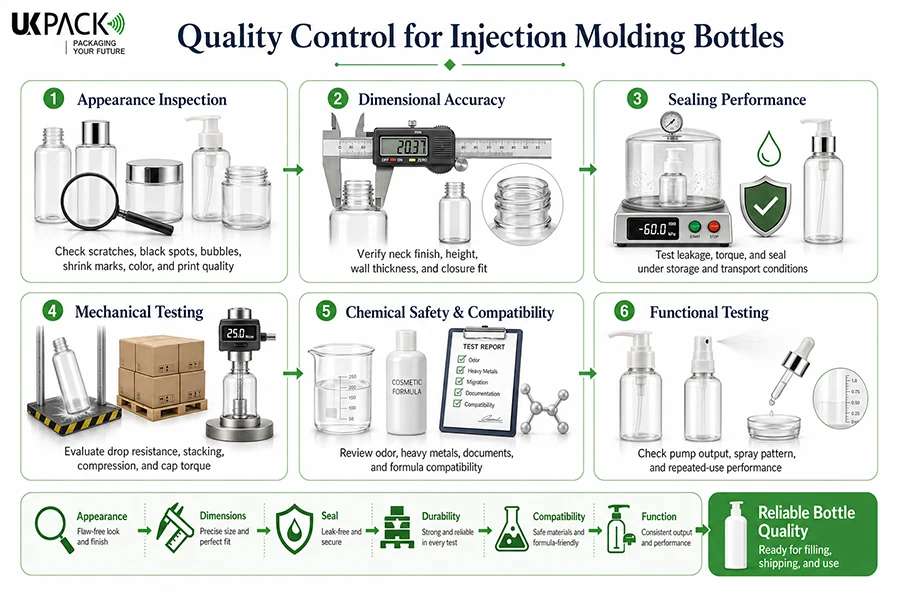
Appearance Inspection
The bottle surface should be clean and consistent. Common defects include scratches, black spots, bubbles, silver streaks, flow marks, shrink marks, deformation, burrs, and uneven color.
Transparent bottles need stricter inspection because small defects are more visible. PETG, AS, and PMMA bottles often require tighter appearance standards.
Decoration also needs to be checked for alignment, color accuracy, print sharpness, adhesion, and wear resistance.
Dimensional Accuracy
Bottle dimensions must match the technical drawing and tolerance requirements. The neck finish is especially important because it affects sealing and compatibility with caps, pumps, and liners.
Important dimensions include neck finish, thread, inner diameter, outer diameter, height, wall thickness, and closure fit.
A bottle may look correct but still fail during assembly if the dimensions are unstable.
Sealing Performance
Sealing is one of the most important quality points for cosmetic bottles. Leakage can come from poor neck accuracy, cap mismatch, liner problems, weak pump fit, or incorrect torque.
Common tests include positive pressure testing, vacuum testing, inverted storage, side leakage testing, and transport simulation.
For oils, lotions, and low-viscosity liquids, testing with the actual formula is recommended.
Mechanical Testing
Bottles need to survive filling, packing, shipping, and daily use. Mechanical testing checks whether the packaging can handle real conditions.
Common tests include drop testing, compression testing, stacking testing, cap torque testing, and pump cycle testing.
These tests matter more for export orders, e-commerce shipping, and products used in wet or high-temperature environments.
Chemical Safety and Compatibility
Cosmetic packaging should not affect the formula. Buyers may need documents related to plasticizers, heavy metals, odor, REACH, RoHS, FDA-related requirements, or other target-market standards.
Compatibility testing is also important. Some formulas may react with plastic, coating, liner, pump parts, or decoration layers. This can cause cracking, swelling, discoloration, odor, leakage, or formula instability.
For new formulas, the final packaging should be tested before mass production.
Functional Testing
For bottles with pumps, sprayers, droppers, or flip caps, function matters as much as appearance.
Common checks include pump output, spray pattern, priming time, dosage consistency, actuator feel, closure strength, and repeated-use performance.
This is especially important for skincare, toner, serum, foundation, and haircare packaging.
Technical Principles Behind Injection Molding Bottles
Injection molding is based on a simple process: melt the plastic, inject it into a mold, cool it into shape, and eject the finished part.
The real challenge is control. Temperature, pressure, speed, cooling time, mold design, and material behavior all affect the final bottle.
That is why two bottles with the same shape can perform differently if the mold, material, or process is not well controlled.
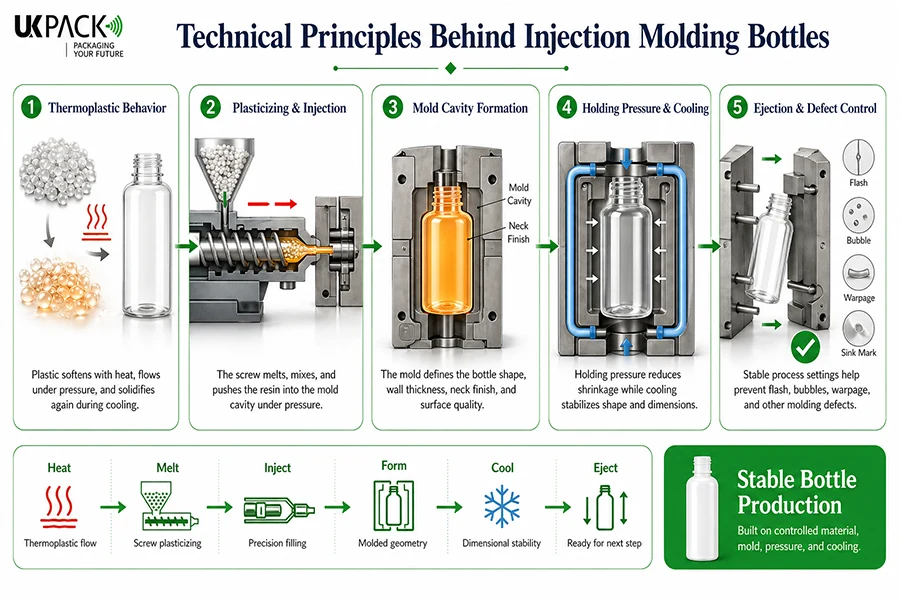
Thermoplastic Behavior
Most injection molding bottles are made from thermoplastics. These materials soften when heated and harden when cooled.
This behavior allows plastic to flow into the mold cavity and then solidify into a stable shape.
Different plastics flow and shrink differently. PP, PE, PETG, AS, ABS, and PMMA all need different molding conditions.
Plasticizing and Injection
Inside the injection molding machine, plastic pellets are heated and mixed by the screw. Once enough molten plastic is ready, the screw moves forward and injects the melt into the mold cavity.
Injection speed and pressure need to be controlled carefully. If the melt flows too slowly, the part may have short shots or flow marks. If the pressure is too high, it may cause flash, internal stress, or deformation.
Holding Pressure and Shrinkage Control
Plastic shrinks as it cools. Holding pressure pushes additional material into the cavity during early cooling, helping reduce shrink marks and improve dimensional stability.
This step is especially important for thick-wall areas, bottle shoulders, caps, and neck finishes.
Poor holding pressure control can lead to sink marks, warpage, or unstable dimensions.
Cooling and Cycle Time
Cooling usually takes the largest share of the molding cycle. The part must cool enough before ejection, or it may deform.
Cooling channel design affects both quality and production efficiency. Uneven cooling can create warpage, stress, and size variation.
For mass production, reducing cooling time without hurting part quality is one of the main ways to improve efficiency.
Defect Control
Common injection molding defects include flash, bubbles, flow lines, silver streaks, sink marks, short shots, warpage, and black spots.
These defects may come from material moisture, poor venting, incorrect temperature, unstable pressure, poor mold design, or contaminated resin.
A stable molding process depends on the right match between material, mold, machine, and process settings.
Procurement Considerations for Injection Molding Bottles
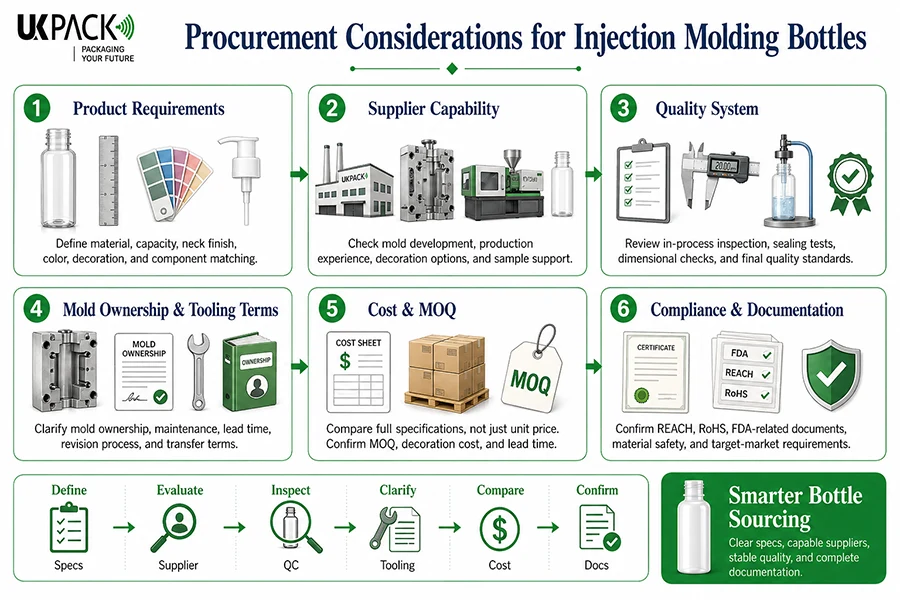
Buying injection molding bottles is not just choosing a shape and asking for a price. The buyer needs to define the product, check the supplier, confirm tooling terms, and set quality expectations early.
This is important for cosmetic packaging because the bottle must match the formula, filling process, decoration method, and target market requirements.
Here are the main points to clarify before starting a project.
Product Requirements
Start with the basic specification. This includes material, capacity, size, neck finish, color, transparency, wall thickness, surface finish, decoration method, and matching components.
For functional packaging, also define the pump type, spray type, output per actuation, sealing requirement, and closure torque.
If the bottle will be used with a specific cosmetic formula, share the formula type with the supplier so they can check material and component compatibility.
Supplier Capability
A capable supplier should understand both injection molding and cosmetic packaging use. It is not enough to only have injection machines.
Useful capabilities include mold development, material selection, surface decoration, assembly, testing, and export packaging.
For cosmetic projects, buyers should also check whether the supplier can provide samples, drawings, compliance documents, production records, and inspection reports.
Quality System
A clear quality system helps reduce risk during mass production. Buyers should ask how the supplier controls incoming material, molding parameters, in-process inspection, final inspection, and packing.
Useful checks include appearance inspection, dimensional measurement, sealing tests, drop tests, pump tests, and compatibility testing.
For larger projects, the inspection standard should be confirmed before production starts.
Mold Ownership and Tooling Terms
Custom injection molding bottles often require new molds. Before paying for tooling, buyers should clarify mold ownership, maintenance responsibility, storage conditions, and mold transfer terms.
It is also important to confirm mold life, cavity number, tooling lead time, sample revision process, and what happens if the mold needs modification.
Clear tooling terms prevent disputes later.
Cost and MOQ
MOQ depends on material, color, decoration, mold type, and production setup. Custom colors, special finishes, and new tooling usually require higher order quantities than standard products.
When comparing prices, buyers should compare the full specification, not only the unit price. A cheaper quote may use a different resin, lighter bottle weight, lower-grade pump, or simpler decoration.
A useful quotation should clearly show material, capacity, components, decoration, packing method, MOQ, lead time, and payment terms.
Compliance and Documentation
Different markets may need different documents. For cosmetic packaging, buyers may need material safety information, REACH or RoHS test reports, FDA-related documentation, heavy metal testing, or declaration documents.
The exact requirement depends on the destination market and the product formula.
It is better to confirm documentation needs before placing the order, not after production is finished.
Applications of Injection Molding Bottles
Injection molding bottles and components are used across many cosmetic and personal care categories. The best material and structure depend on the formula, dispensing method, brand positioning, and cost target.
Some products need clarity. Some need chemical resistance. Some need a precise pump. Some only need a durable and economical bottle.
Here are the most common application areas.
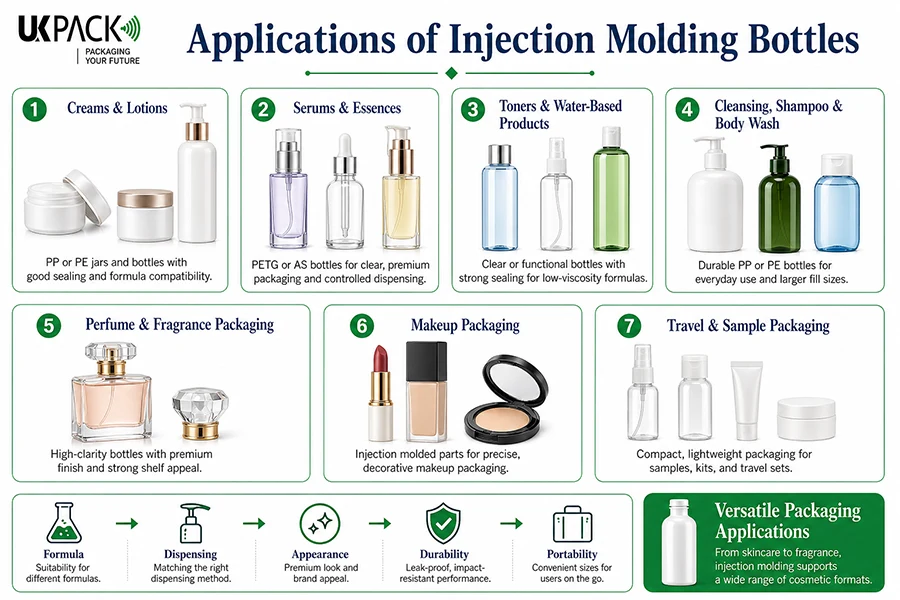
Creams and Lotions
Cream jars, lotion bottles, and wide-mouth containers often use PP or PE because these materials offer good chemical resistance and cost control.
For higher-end products, PETG, AS, or PMMA may be used when clarity, gloss, or a heavier visual impression is needed.
The main requirements are sealing, smooth opening and closing, and compatibility with thicker formulas.
Serums and Essences
Serums and essences often use PETG, AS, or other clear materials because brands want to show the formula and create a premium look.
These bottles are commonly matched with pumps, droppers, or small-output dispensing systems.
For this category, clarity, surface finish, pump output, and formula compatibility are key.
Toners and Water-Based Products
Toners and water-based products usually need good sealing and stable dispensing. PETG is common for clear packaging, while PP or PE may be used for cost-sensitive projects.
Depending on the product, the bottle may use a screw cap, flip cap, fine mist sprayer, or small-hole reducer.
Leakage testing is especially important because these formulas are often low-viscosity.
Cleansing, Shampoo, and Body Wash
Larger bottles for cleansing products, shampoos, conditioners, and body wash often use PP or PE. These materials are durable and cost-effective for mid-size and large-volume packaging.
The bottle needs to withstand handling, filling, transport, and repeated use in wet environments.
Pump quality is also important because haircare and bodycare formulas often need stable output and smooth actuation.
For two-formula haircare products, you can also explore our dual chamber shampoo bottles.
Perfume and Fragrance Packaging
Perfume packaging usually demands high clarity, good gloss, and premium surface decoration. AS and PETG are commonly used when brands want a glass-like appearance without using glass.
Caps and decorative parts may use ABS, PMMA, or electroplated components.
In this category, visual quality and spray performance are often the main priorities.
Makeup Packaging
Many makeup packaging components are injection molded, including lipstick tubes, foundation bottles, compact cases, powder cases, caps, inner trays, and applicator parts.
Materials vary depending on function. ABS is common for decorative or electroplated parts, while PP and AS are used for structural or transparent components.
Precision is important because makeup packaging often includes moving parts, snap-fit structures, and tight assembly tolerances.
Travel and Sample Packaging
Travel-size bottles and sample packaging often use PP or PE because they are lightweight, practical, and cost-effective.
These products need good sealing, easy dispensing, and compact dimensions.
For brands, travel packs are also useful for promotional sets, trial kits, and retail sample programs.
Why Work with UKPACK for Injection Molding Bottles?
UKPACK develops and manufactures cosmetic packaging for skincare, haircare, bodycare, fragrance, and personal care brands. For injection molding bottle projects, we support material selection, mold development, surface decoration, component matching, sample review, quality inspection, and export-ready packing.
Benefits of working with us include flexible custom packaging development, multiple plastic material options, surface finishing support, component matching for caps and pumps, and packaging solutions that can move from concept to production.
If you are developing custom injection molding bottles for a cosmetic packaging project, contact UKPACK to review your bottle structure, material choice, decoration method, and production requirements.
FAQ
1. Can bottles be made by injection molding?
Yes, but it depends on the bottle structure. Injection molding is commonly used for thick-wall cosmetic jars, caps, shoulders, pump parts, closures, and some rigid bottle components. For thin-wall hollow bottles, manufacturers may use injection blow molding, extrusion blow molding, or stretch blow molding instead.
2. What is the difference between injection molding and blow molding bottles?
Injection molding pushes molten plastic into a closed mold to form a solid or semi-solid part. Blow molding forms a hollow container by inflating heated plastic inside a mold. In simple terms, injection molding is better for precise components, while blow molding is better for lightweight hollow bottles.
3. Is injection molding suitable for thin-wall cosmetic bottles?
Not always. Thin-wall hollow bottles are usually better made by blow molding or injection blow molding. Injection molding is more suitable when the bottle needs a thicker wall, sharp details, precise threads, premium surface quality, or matching molded components.
4. What files are needed to make a custom injection molded bottle?
A supplier usually needs a 2D drawing, 3D file, capacity target, material requirement, neck finish, closure or pump specification, decoration method, and reference samples if available. If the design is still early, a concept image and target dimensions can be enough to start the first review.
5. Can an injection mold be changed after sampling?
Yes, but only within limits. Small adjustments such as texture, minor dimensions, gate marks, or fit corrections may be possible. Major changes to bottle shape, capacity, wall thickness, or neck structure may require mold rework or a new mold insert.