How to Choose Sustainable Cosmetic Packaging for Your Brand

Founder of UKPACK, chief packaging engineer and designer with 18 years of experience, and Red Dot Award winner. I work on cosmetic packaging structure, material selection, mold feasibility, decoration processes, and leak-risk control, helping brands turn packaging ideas into reliable production-ready solutions. See my senior packaging engineer qualification.
- Why Choosing the Right Sustainable Packaging Matters
- Define Your Brand’s Sustainability Goals
- Compare Common Sustainable Packaging Materials
- Match Packaging Format with Your Product Type
- Understand Compliance and Regional Regulations
- Test, Iterate, and Collect Feedback
- Final Checklist: What to Ask Before You Choose
- Ready to Launch Smarter, More Sustainable Cosmetic Packaging?
As a packaging engineer working closely with beauty brands, one question I hear all the time is: how to choose sustainable cosmetic packaging that’s both eco-friendly and commercially viable.
It’s never a simple answer.
What works for a refillable skincare jar may not suit a lip gloss tube. And just because a material is labelled “green” doesn’t mean it meets your formula’s needs, branding goals, or regional regulations.
In this guide, I’ll walk you through the real decision-making process — not the buzzwords — to help you choose packaging that aligns with your values and performs on the shelf.
Let’s break it down together.
Why Choosing the Right Sustainable Packaging Matters
1. It’s Not One-Size-Fits-All
In theory, sustainable packaging sounds simple — just pick something “eco” and move on.
But in reality? It’s a lot more nuanced.
I’ve worked with brands that sell essential oils, solid balms, high-viscosity serums, and even powder-based formulas.
Each of them needed a different packaging solution, even though all were committed to sustainability.
A paper tube might work beautifully for a lip balm, but be completely impractical for a water-based serum.
Glass might look premium and recyclable, but not every e-commerce brand wants to deal with breakage risks.
There is no universal eco-packaging answer — and that’s why making the right choice matters so much.
2. Balancing Brand Image, Sustainability, and Functionality

Let’s be honest: sustainable packaging isn’t just about the planet — it’s also about your product, your customer, and your brand.
As a packaging engineer, I always ask clients to weigh three things equally:
- Sustainability: Does the material reduce waste, carbon impact, or plastic use?
- Functionality: Will the structure protect your formula and perform well during shipping and use?
- Brand Image: Will the packaging design look and feel like your brand — luxurious, minimalist, clinical, fun?
I’ve seen clean beauty brands switch to glass jars only to find customers struggling with weight and fragility.
I’ve also helped heritage brands switch to PCR without compromising their premium look — just by adjusting wall thickness, colour tone, and finish.
The best sustainable packaging choice is one that ticks all three boxes — not just one.
Define Your Brand’s Sustainability Goals
When a brand comes to me asking for “eco-friendly” cosmetic packaging, the first thing I ask is:
“What does sustainability mean to you?”
Because not all brands define it the same way — and that’s perfectly fine. Some focus on reducing plastic, others want reusable packaging systems, while a growing number are aiming for certified materials or net-zero carbon strategies.
Before choosing any material or structure, get clear on what your sustainability priorities are.
1. Common Brand-Level Goals:
| Goal Type | What It Means in Packaging Terms | Examples |
|---|---|---|
| Recyclability | Uses mono-materials or widely accepted resins | PET, aluminium, PP jars |
| Refillability | Designed for reuse or refill inserts | Refillable compacts, drop-in pods |
| Plastic Reduction | Replaces virgin plastic with paper, glass, or aluminium | Paper tubes, glass droppers |
| Bio-Based Materials | Derived from renewable sources like sugarcane | Bio-PE bottles, PLA caps |
| PCR Content | Uses post-consumer recycled materials | 30–100% PCR PET / PP components |
| Compostable / Biodegradable | Breaks down naturally under certain conditions | PLA, bamboo paperboard |
| Carbon Footprint Reduction | Lightweight designs, local sourcing, LCA-optimised | Thin-wall bottles, local suppliers |
2. Packaging Tip from the Field
I’ve seen brands choose biodegradable materials thinking they’re universally “better” — only to find their products were blocked from EU export due to compostability claims not matching infrastructure.
That’s why we always start with clear, measurable sustainability goals before we touch any design file.
3. Ask Yourself (or Your Team)
- Do we want materials with certifications like FSC, USDA BioPreferred, or COSMOS?
- Are we open to refillable designs, or is single-use still our norm?
- Is brand storytelling a bigger driver than technical recyclability?
- What matters more to our customers: low waste or luxury look?
Once you define these goals, choosing the right materials — whether it’s PCR, bio-based, glass, or paper — becomes much easier and aligned with both mission and market.
Compare Common Sustainable Packaging Materials
Sustainable cosmetic packaging comes in many forms — and each material offers unique benefits and limitations. Whether your brand prioritises recyclability, carbon reduction, or a premium look, understanding these common materials helps you make informed choices.
1. PCR Plastic

PCR(Post-Consumer Recycled)plastic is made from recycled consumer waste, like used PET bottles. It supports a circular economy while reducing reliance on virgin plastic.
Advantages:
- Reduces landfill waste and carbon footprint
- Compatible with existing moulds and structures
- Accepted in many recycling systems
Considerations:
- Colour may vary between batches (especially for clear packaging)
- Surface finish may look slightly less “clean” than virgin plastic
- Requires clear PCR percentage declaration for compliance
Best for: Tubes, bottles, jars, caps — especially where mould compatibility matters
2. Bio-Based Plastic

Bio-based plastics are produced from renewable resources such as sugarcane or corn starch. They are visually similar to petroleum-based plastics but offer a lower carbon impact.
Advantages:
- Derived from renewable, plant-based sources
- Lightweight and mouldable into familiar shapes
- Good for storytelling and sustainability positioning
Considerations:
- Not always compostable or biodegradable
- Some materials (e.g., PLA) require industrial composting
- Higher MOQ and cost than traditional plastics
Best for: Tubes, airless pumps, flexible bottles — where renewable origin matters
3. Glass, Aluminium, and Paper
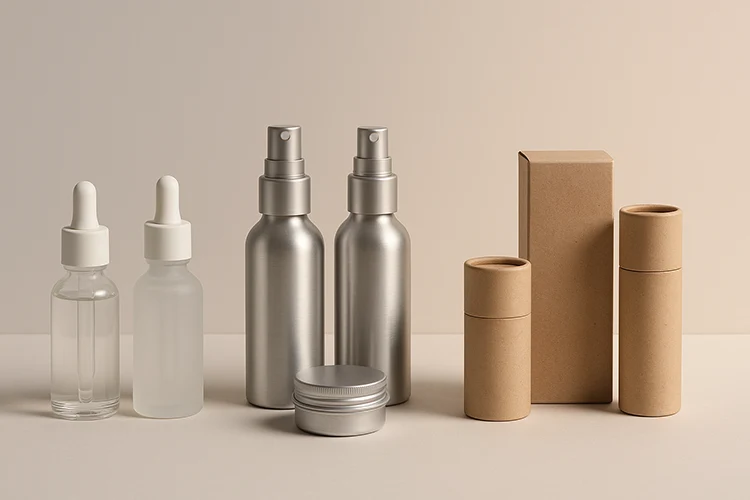
These traditional materials are making a strong comeback in sustainable packaging — each with its own role.
Glass
- Fully recyclable
- Visually premium
- Stable for reactive formulas
- ⚠ Fragile, heavy, higher shipping cost
Aluminium
- Infinitely recyclable without quality loss
- Lightweight and protective
- Sleek and metallic appearance
- ⚠ Can dent without proper wall thickness
Paper / Paperboard
- Biodegradable, renewable, easy to source
- Ideal for outer boxes or dry-product packaging
- Supports FSC or PEFC certifications
- ⚠ Needs lining or coating for liquid/oily formulas
Best for:
- Glass → Serums, essential oils
- Aluminium → Sprays, balms, deodorants
- Paper → Sticks, secondary packaging, masks
4. Pros and Cons Comparison Table
| Material | Pros | Cons | Common Uses |
|---|---|---|---|
| PCR Plastic | Reduces waste, mould-compatible, recyclable | Colour inconsistency, rougher finish | Bottles, tubes, caps |
| Bio-Based Plastic | Renewable source, low CO₂ footprint, familiar look | Costly, unclear end-of-life options | Tubes, flexible containers |
| Glass | Recyclable, high-end image, formula stability | Fragile, heavy, shipping cost | Creams, oils, serums |
| Aluminium | Infinite recyclability, light, premium | Dents easily, may need interior coating | Sprays, balms, jars |
| Paper | Biodegradable, tactile, low impact | Not moisture-proof, limited to dry use | Outer packaging, solid sticks |
Match Packaging Format with Your Product Type
Not every sustainable material works for every product. The texture, viscosity, application method, and shelf life of your formula all play a role in deciding which packaging format is suitable — and truly sustainable — for your product.
1. Skincare, Colour Cosmetics, Lip Care – One Size Doesn’t Fit All
Different product types require very different packaging formats, both structurally and functionally.
| Product Type | Ideal Sustainable Formats | Notes |
|---|---|---|
| Serums & Essences | Glass dropper bottles, PCR airless pumps | Sensitive to oxidation; needs barrier protection |
| Creams & Balms | Refillable jars, aluminium tins | Best suited for thicker, scoopable textures |
| Lip Gloss & Concealer | PCR tubes with doe foot applicator | Easy to apply, great for precision formats |
| Powder-Based Makeup | Paper-based compacts, aluminium tins | Good dry formula compatibility |
| Body Lotions & Washes | Bio-PE bottles, refill pouches | Large-volume use, good candidate for refills |
| Face Masks (dry) | FSC paper sachets or aluminium | Avoid moisture until use |
| Lip Balms & Sticks | Paper tubes, aluminium sticks | Simple twist-up mechanisms available in eco options |
Choosing the wrong format can result in leakage, oxidation, or wasted product — even if the material itself is eco-friendly.
2. How Application Methods Affect Packaging Design
The way your product is applied will heavily influence packaging structure, and ultimately which sustainable formats are viable.
Pump vs Squeeze:
- Pumps require tight component tolerances and air resistance — ideal for airless systems, but more complex to recycle.
- Squeeze tubes are simpler, and monomaterial PCR tubes are now widely available.
Dropper vs Spray:
- Glass droppers are ideal for precise dosing (e.g., serums).
- Sprayers work well with aluminium or glass bottles, but nozzle parts may need special sorting for recyclability.
Swivel / Twist-up / Applicator:
- Lip care or colour sticks work with paper-based barrels, but require clever friction-fit or compostable mechanisms.
Jar vs Pouch:
- Pouches are lighter and ideal for refills, while jars (especially refillable) create a luxury unboxing feel.
A truly sustainable pack isn’t just about what it’s made of — it’s also about how your customers use it.
3. Refillable vs Single-Use Systems
Refillable cosmetic packaging is gaining popularity, but it’s not always the right fit for every product or brand.
Refillable Packaging: Pros
- Reduces long-term material waste
- Encourages repeat purchase and customer retention
- Premium brands can offer branded refills or loyalty systems
Refillable Packaging: Challenges
- Higher initial production cost
- Requires durable outer shell and smart refill design
- May confuse customers if not properly labelled or explained
When Refillables Work Best:
- High-margin skincare (e.g., face creams, foundations)
- Solid products (e.g., balms, deodorants, sticks)
- Products used daily (justifying refill logic)
Packaging tip: Refill systems only make sense if the refill process is easy, clean, and clearly communicated. Otherwise, it becomes wasteful — or worse, unused.
Understand Compliance and Regional Regulations
Sustainable packaging doesn’t just need to look eco-friendly — it needs to meet the legal definitions of “recyclable”, “biodegradable”, or “compostable” in the markets where your products are sold.
Each region has its own rules, certifications, and recycling infrastructure. Ignoring them can lead to fines, product recalls, or greenwashing accusations.
Let’s break it down by region.
1. 🇪🇺 European Union
The EU leads the way in strict environmental packaging policies. If you’re exporting to Europe, your packaging must comply with:
- Packaging and Packaging Waste Directive (PPWD): Requires reduction of overall packaging waste and encourages design for recycling.
- Extended Producer Responsibility (EPR): Brands must register with local waste collection schemes (like CITEO in France or Der Grüne Punkt in Germany).
- Recyclability Standards: Packaging must be easy to sort and recycle. Multi-material packaging (e.g. plastic + foil) is often penalised.
- Labeling Requirements: Use of eco claims like “100% recyclable” must be verifiable and substantiated.
Tip: Stick with mono-material designs and clearly marked recycling symbols for EU compliance.
2. 🇺🇸 United States
The US has state-specific laws rather than one national policy. Key areas to watch:
- California’s SB 54 (Plastic Pollution Prevention and Packaging Producer Responsibility Act): Requires 30% recyclable or compostable content by 2028
- Green Guides (by the FTC): Regulates the use of terms like “biodegradable,” “compostable,” and “recyclable”
- Plastic Bag and Packaging Bans: Certain materials (like Styrofoam, black plastic) are banned in several states
Tip: Avoid misleading claims. Use certified labels (e.g. How2Recycle, BPI Compostable) when possible.
3. Asia (China, Japan, South Korea)
Asia is catching up fast with sustainability regulation — especially in cosmetics packaging.
🇨🇳 China
- Guidelines on Plastic Pollution Control mandate use of 30% PCR in certain categories
- Packaging should avoid “excessive” or decorative layers under GB23350 standards
- Cosmetic packaging also must align with CFDA labeling and ingredient rules
🇯🇵 Japan
- Focus on minimalism and recyclability
- Voluntary Eco Mark system for packaging
- Japan’s plastic recycling relies heavily on incineration, so compostables don’t always make sense
🇰🇷 South Korea
- Packaging must be rated under the “Packaging Material Grade Labeling System”
- Multi-layer, hard-to-recycle packaging receives low grade and may be restricted
Tip: In Asia, simple, clean packaging designs often outperform complex layered packs in both compliance and customer trust.
4. Global Compliance Checklist
| Region | Key Focus | What You Need |
|---|---|---|
| EU | Recyclability, EPR, clear labeling | Mono-material, EPR registration, no vague eco claims |
| US | State laws, FTC guides, % content targets | Certified claims, traceable PCR or compostable use |
| China | PCR mandates, anti-excess packaging | Lean design, PCR certificates, clear labeling |
| Japan | Minimalist, recyclability | Eco mark-friendly formats, no unnecessary complexity |
| South Korea | Material rating system | Simple, transparent packaging formats |
5. Final Thoughts
Regulatory compliance is part of sustainability — not a bonus.
When choosing packaging, always ask your supplier:
- Is this format legally recyclable in our target markets?
- Can you provide PCR content certificates or material declarations?
- Have similar formats passed compliance checks with major retailers?
Investing in compliant design from the start saves time, cost, and risk down the line.
Test, Iterate, and Collect Feedback
Even with the right material, format, and supplier — no sustainable packaging decision is complete without testing.
What looks great in a render might feel awkward in-hand. What aligns with your brand story might confuse your customers. That’s why prototyping and feedback loops are essential before committing to full production.
1. Start with Small-Batch Prototypes
Before scaling up, run a limited test using one or more of the following:
- 3D Printed Prototypes: Great for evaluating ergonomics, structure, and lid fit — especially for complex shapes.
- Mockups with Final Materials: Useful for photography, texture checks, and brand alignment reviews.
- Low MOQ Trial Runs: Some suppliers offer smaller trial quantities (1,000–3,000 pcs) to validate functional and aesthetic aspects before committing to 10K+ orders.
Tip: UKPACK’s 3F Services (Free Design, Free 3D Render, Free Mockup) are designed specifically for this stage — so you can move forward with confidence.
2. Iterate Based on Internal and External Feedback
Testing shouldn’t be limited to your internal team.
Involve actual users, retailers, and supply chain partners to catch blind spots.
- Ask your warehouse or fulfilment team: Is it easy to pack, stack, and ship?
- Ask your product team: Does it preserve the formula’s stability?
- Ask your customers: Is it intuitive to open, use, and recycle/refill?
You can run:
- In-house surveys with testers or employees
- Soft launches on select SKUs or platforms
- QR code feedback loops printed on the pack to collect live data
3. Avoid These Common Mistakes
- Skipping user feedback and launching based on internal opinions only
- Assuming eco claims are enough without proving usability
- Investing in a “perfect” refillable pack… that no one refills
- Choosing materials that customers can’t easily dispose of
Sustainable cosmetic packaging only works if it’s used as intended — and that comes down to human experience, not just environmental specs.
4. Final Reminder
Treat your first sustainable packaging release as a version 1.0 — not the final form.
The real wins come from observing, adjusting, and improving over time based on what people actually do with your packaging, not what they say they’ll do.
Final Checklist: What to Ask Before You Choose
Before you commit to any sustainable cosmetic packaging solution, here’s a practical checklist to help you stay on track.
Sustainability
- Is the material recyclable, reusable, or renewable — or just “green-looking”?
- Can the packaging be sorted by most municipal recycling systems?
- Do we have certificates or verified data (PCR %, compostable claim, etc.)?
Product Compatibility
- Will this material protect and preserve our formula properly?
- Is the structure suitable for viscosity, fill method, and shelf life?
Customer Experience
- Is the format intuitive, comfortable, and aligned with our branding?
- Will the consumer know how to use, refill, or recycle it?
Supply Chain & Cost
- What’s the MOQ and lead time?
- Can we handle the price difference vs traditional packaging?
- Are we ready for small-batch testing and feedback?
Compliance
- Is this pack compliant with EU, US, or Asia regulations?
- Are our claims (recyclable, compostable, refillable) legally safe and clearly labelled?
If you can confidently check most of these boxes, you’re ready to move forward.
Ready to Launch Smarter, More Sustainable Cosmetic Packaging?
Whether you’re switching to PCR, exploring refillable designs, or just starting your sustainability journey — you don’t have to figure it out alone.
UKPACK works with beauty brands worldwide to turn sustainable ideas into scalable, production-ready packaging.
From free concept designs to real-world mockups and full-scale manufacturing, we support you every step of the way.
Contact us for a free consultation.